CONCEPT
For my visual research object, I selected the Pepsi advertising campaign featuring Madonna, launched in 1989 around the song «Like a Prayer.» This is a case where a commercial advertisement intersected with a music video, a public scandal, and religious controversy, even though the advertisement itself was structured as fairly safe, mass-market promotion.
At first glance, this is a typical example of a major musical collaboration: an international brand leverages an artist’s popularity to communicate with a younger audience on its own terms. However, this case proved much more complex than standard soft drink advertising. The campaign quickly moved beyond commercial communication to become part of a cultural conflict where a mass brand, pop music, religious symbolism, and public reaction collided.
Therefore, the Pepsi $\times$ Madonna campaign is interesting as an example of the disconnect between the advertised image and the context of its reception. Pepsi controlled the footage, the editing, the product placement, and the script of the commercial, but it could not control all the meanings that the viewer assigned to the song «Like a Prayer» or to the image of Madonna.
SUBJECT OF STUDY
The subject of this study is the 1989 Pepsi advertising campaign featuring Madonna, specifically the television commercial «Make a Wish,» which utilized the song «Like a Prayer.» The official «Like a Prayer» music video is also included in the analysis because it fundamentally altered the perception of the advertising campaign and spurred public reaction. It is crucial not to conflate these two materials. The Pepsi advertisement and the Madonna music video are distinct visual texts. They possess different objectives, different tonalities, and different contexts.
RESEARCH HYPOTHESIS
The Pepsi × Madonna campaign was visually effective as image advertising, but strategically vulnerable because the brand tied itself to an artist and song whose meaning it could not control.
In other words, the campaign illustrated the limitations of celebrity endorsement: if a celebrity has an overly strong personal visual and cultural image, the brand inherits not only their popularity but also all the risks associated with their public reputation.
PEPSI CONTEXT AND MARKETING OBJECTIVE
In the 1980s, Pepsi actively associated itself with popular music, attempting to solidify its image as the drink of the younger generation. The brand was already collaborating with major artists; Michael Jackson, Tina Turner, David Bowie, Lionel Richie, and other performers appeared in Pepsi advertisements. Against this backdrop, a collaboration with Madonna seemed like a logical progression of this trend. The beverage needed to be linked to what was happening now: music, television, music videos, the youth audience, and mass pop events.
In 1989, Pepsi signed a contract with Madonna worth approximately $5 million. As part of the campaign, the song «Like a Prayer» was required to be featured in a commercial, and Pepsi became the sponsor of her next tour.
Pepsi advertising/promotional poster with the inscription «Pepsi presents Madonna — Like a Prayer World Tour, ” Pepsi — Madonna „Make a Wish“ (1989)
For Pepsi, this was a logical extension of a strategy that linked the brand to mainstream music and youth culture. Pepsi does not explain the product’s rational advantage to the viewer. Instead, Pepsi constructs a brand image through association with an event: a new song, a new Madonna, television, a mass audience—a feeling of synchronicity with pop culture. According to Vanity Fair, Pepsi was planning a global launch of the commercial in 40 countries, targeting an audience of around 250 million people. This meant the campaign was conceived as an international media event. The wider the audience, the higher the standard for message safety. Yet, Pepsi chose an artist whose public strategy was already built on pushing boundaries.
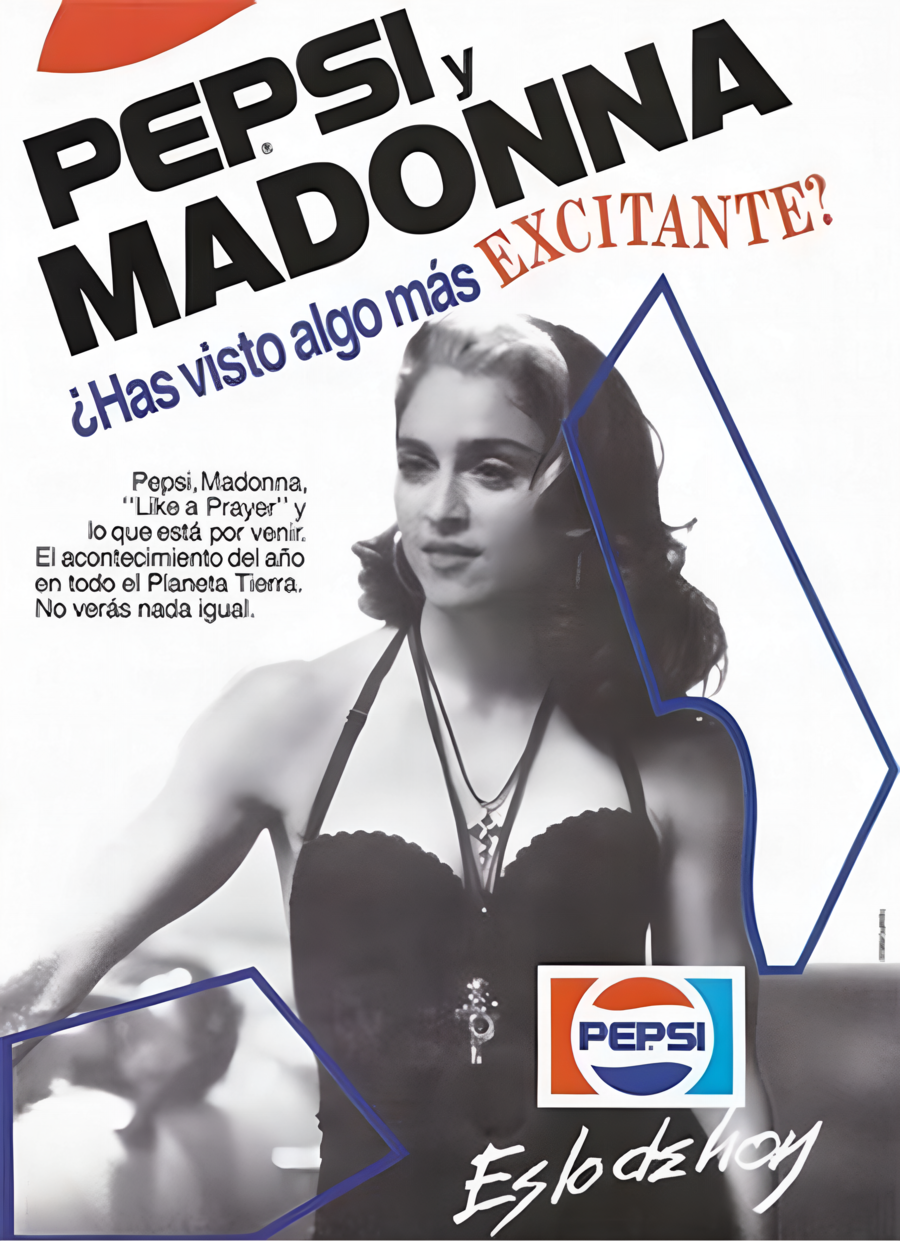
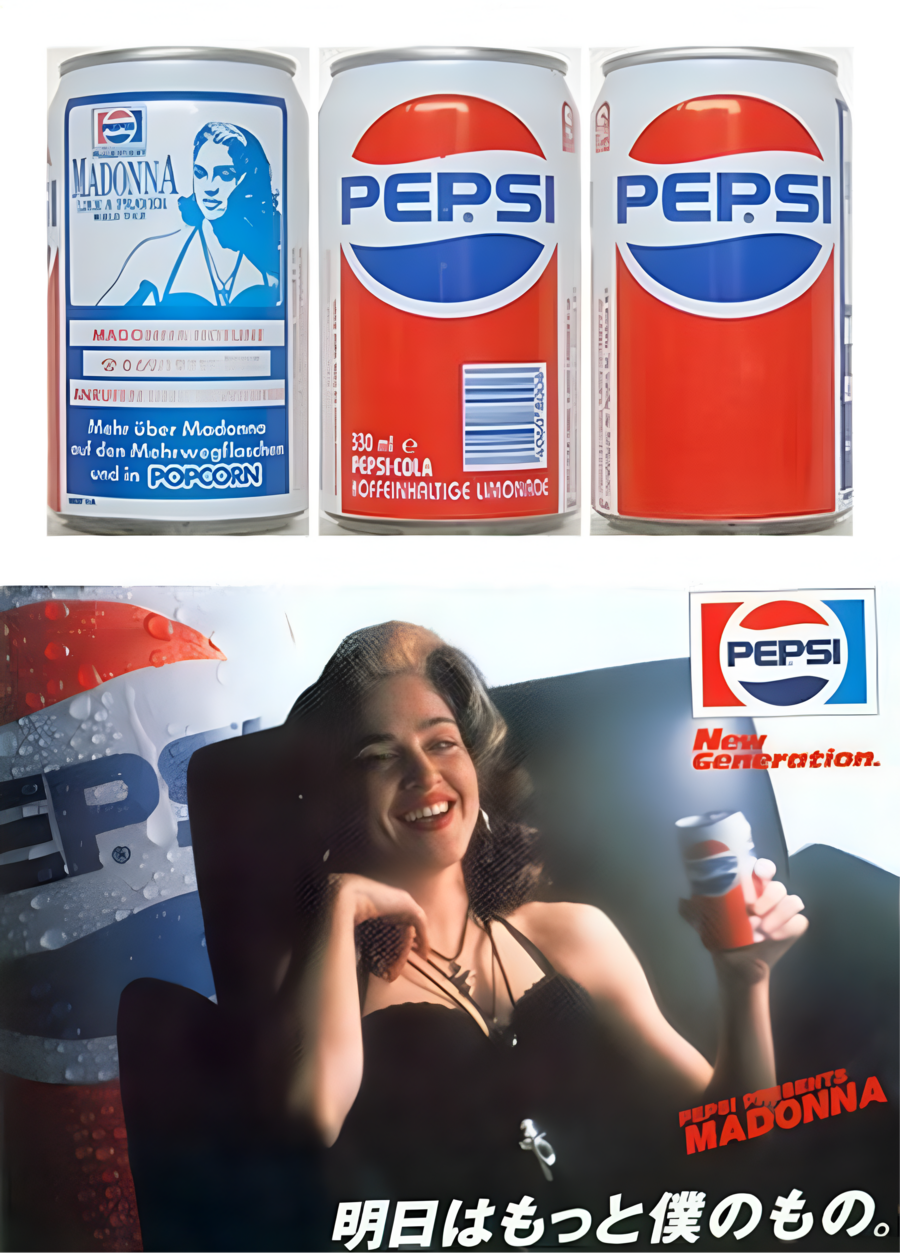
Pepsi advertisement/promo poster with the inscription «Pepsi presents Madonna — Like a Prayer World Tour, ” Pepsi cans featuring Madonna’s „Like a Prayer“ design, Pepsi advertisement/promo poster—Madonna „Make a wish“ (1989)
VISUAL ANALYSIS OF THE PEPSI MAKE A WISH VIDEO
The promotional video is titled «Make a Wish.»
Stills from the Pepsi — Madonna «Make a Wish» commercial (1989)
The Pepsi Make a Wish commercial revolves around a simple yet highly effective mass-market advertising narrative: a child’s wish meets adult success. A little girl watches Madonna on television, and the final line, «Go ahead, make a wish,» transforms the entire spot into a story of fulfillment.
This framing is crucial because it mitigates some of the risk associated with Madonna’s public persona. By 1989, she was far more than just a popular singer. Her reputation was built on a consistent engagement with provocation, sexuality, religious allusions, and the disruption of conventional notions of female behavior in mass culture. For Pepsi, this image was both valuable and perilous. It was valuable because it lent the brand relevance and attention. It was dangerous because mass advertising cannot exist entirely within a state of conflict.
Stills from the Pepsi — Madonna «Make a Wish» commercial (1989)
Little Madonna translates adult Madonna from the realm of scandalous celebrity into the realm of recognizable human experience. Almost any viewer can grasp the narrative of desire: a child watches the screen, sees a vivid image of adult success, and imagines themselves in that place. Pepsi leverages this universality. The brand doesn’t need to explain the complexity of the artist’s image; instead, it selects the safest narrative line—the dream, the journey, growing up, the realization.
The television within the commercial amplifies this effect. The young protagonist looks at adult Madonna through the screen, and the actual viewer does the same. Within the advertisement, a model of her own influence appears—the screen connects an ordinary person with a pop icon. This was especially relevant in the late 1980s, when music videos, commercials, and television premieres already coexisted in a shared media landscape.
Stills from the Pepsi — Madonna «Make a Wish» commercial (1989)
Stills from the Pepsi — Madonna «Make a Wish» commercial (1989)
Within the Madonna advertisement, she is specifically presented as a figure of collective joy. The dance and mass movement do not position her as an isolated provocateur. This is a standard, yet effective, tactic in music advertising: when people in the frame move together, the viewer perceives social consensus. Pepsi depicts a world where Madonna’s music unites, and the product is positioned alongside that unity. Visually, this creates the illusion of already achieved acceptance—everyone is sharing one rhythm, everyone is part of the celebration, and there is no conflict.
The spaces within the video also serve this objective. UPI described the advertisement as featuring Madonna dancing on the street, in a school hallway, and in a church to the soundtrack of «Like a Prayer.» These locations are not arbitrary; they assemble several layers of widespread recognition around the artist. The street gives the advertisement the feeling of an open urban celebration, the school hallway connects her to childhood and memory, and the church adds solemnity and a direct association with the song’s title. However, in the advertisement, these spaces have been purged of any real conflict.
Stills from the Pepsi — Madonna «Make a Wish» commercial (1989)
The church is particularly significant. In the Pepsi video, the religious setting does not yet read as a dangerous image. It is integrated into the musical and almost celebratory tone. The church here rather denotes sublimity—a strong, «prayerful» scale to desire. But after the release of the «Like a Prayer» music video, this same code came to be read differently.
Stills from the Pepsi — Madonna commercial, «Make a Wish» (1989)
This is why the real reaction to the campaign sharply contrasted with its internal logic. The video depicts agreement, but protests erupted outside the video.
VISUAL CONFLICT IN THE LIKE A PRAYER CLIP
The «Make a Wish» video was crafted as a safe narrative about a child’s dream, a musical premiere, and the fulfillment of a wish. However, Madonna’s official music video for the same song employed a completely different set of imagery: a church, a Black saint, stigmata, a gospel choir, burning crosses, and a storyline involving the wrongful accusation of a Black man. Madonna’s official website describes the video as a work by Mary Lambert, where religious iconography merges with the narrative of false accusation. The brand tied itself to the release, which had its own distinct visual program.