Concept
Navigator:1. Concept2. Music as Object. Selection via Physical Medium.3. Music as File. Selection via Digital Library.4. Music as Stream. Selection via Algorithm.5. Conclusion
In a record store, an unfamiliar album might be noticed by chance—by looking at the cover or by its placement on a display. Today, similar discoveries happen more often within an application. The homepage already features several curated selections, assembled without the listener making a direct request. This raises the question: how has this journey to new music evolved, and how much of the discovery process is now being delegated to the service?
The vinyl record sleeve served a quite practical purpose. In a music store, it helped a customer locate a familiar album among others and could entice someone toward an unknown recording. Buyers were not always able to listen to the music beforehand. In such situations, the image and packaging became a crucial part of the purchase decision.
The physical collection had clear constraints: money, shelf space, and the assortment available at the nearest store. Purchasing an album required a separate decision. Even a failed recording still ended up at home. Every experiment with unfamiliar music cost money, and finding a rare edition was sometimes a project in itself.
The Walkman allowed users to listen to personal tapes while traveling [1]. The amount of available music depended on how many recordings a person brought with them—a choice that had to be made at home, before leaving for a walk or a trip. Within the player itself, the selection was limited to the cassette inside and the fast-forward/rewind buttons.
The MP3 format changed the entire nature of the music collection. In the player, songs are presented in lines showing the title, artist, and album. The list can be sorted, and a desired track can be found using search. The home media library began to take up disk space on the computer, although the owner still had to curate its content.
The streaming service offers music even to those who haven’t built a personal library yet. You can open a playlist for work or travel and start listening immediately. The recommendations feature tracks based on the user’s previous activity [2]. These are compositions they might never have sought out by name. Now, introducing themselves to such music only requires starting a curated collection.
Music recommendations existed long before streaming. They were given by salespeople, radio DJs, and magazine writers. Modern services can factor in a specific listener’s history—including what songs they listened to previously [2]. Personalized curation has a distinct advantage: it helps users navigate an enormous catalog. However, the reasons behind a specific track appearing in recommendations often remain unknown.
Research Question: How has listener participation in music selection changed when transitioning from physical media to digital libraries and streaming services? For comparison, we will examine a music store, portable players, iTunes, and several modern services. In each example, two scenarios are crucial: searching for a known track and discovering music the person had not previously chosen.
Hypothesis: The fewer actions required to continue playback, the easier it is to convey music selection to the interface. This convenience helps users discover unfamiliar tracks but may weaken the habit of seeking them out independently. The return of some listeners to physical media—CDs, vinyl, and local files—allows us to gauge how important control over one’s own collection is to them.
Music as an object. Selection through a physical medium.
HMV Music Store, Great Britain, 1980s. Shelves stocked with vinyl records and cassettes, with a dedicated «Top Albums» section. Photograph from the archive collection.
A photograph of HMV shows that the search for music was tied to a specific physical space. To discover an unfamiliar album, a shopper walked along the shelves, examined the covers, and moved from one section to another. However, the assortment was not placed randomly. A «Top Albums» sign highlighted certain records among others, and items placed prominently had a greater chance of engaging a visitor. This meant the store functioned as more than just a record warehouse; it already served as a musical curator—assisting in the discovery of new music while simultaneously guiding the customer’s initial focus.
Ian McMillan — Photography; John Cash — Design. The Beatles, Abbey Road, 1969.
At Abbey Road, there isn’t even a band name—just the four members of The Beatles walking across the pedestrian crossing [3]. This is a particularly interesting example for the late 1960s. The album needed to stand out among the many other covers, but instead of using large typography, it employed a single, easily memorable photograph. Customers recognized the recording from the image before even pulling the record out of the stack. Thus, the cover had a fairly practical function: it helped people locate and distinguish the music. In digital media libraries, this role is partially taken over by text search, file names, and the catalog interface.
The self-composed list of compositions on the cassette inlay card. The photograph was published in a feature about the documentary film Analog Love, 2021.
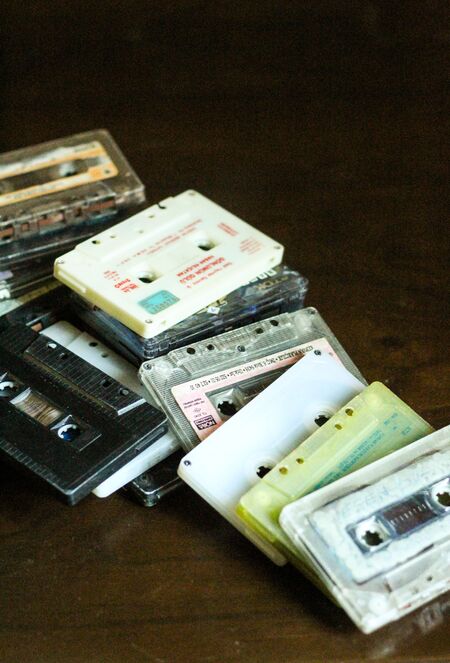
A handwritten list on the insert is a trace of another person’s work in curating music. Unlike a ready-made album, the mixtape was assembled independently: one had to hunt for the desired tracks, transfer them onto cassette tape, and decide the sequence in which each song would play. Recording onto magnetic tape was time-consuming, and the track order could not be changed as easily as arranging lines in a digital playlist. Therefore, the selection became a complete undertaking, often intended for a specific person. Essentially, it is a precursor to the modern playlist, but in it, the process of selection, recording, and presentation was far more apparent.
Sony Walkman TPS-L2, 1979 model. Playback and fast-forward buttons, along with volume switches and controls, are located on the device’s body.
The Walkman made the home collection mobile: the cassette could be taken with you and listened to in headphones outside the house [1]. But if you look at the TPS-L2 buttons, you can see how differently people controlled music. They could play, stop, and fast-forward the tape, but they could not open a song list and click on a specific title. More often, they had to listen to the recorded sequence or manually search for the beginning of the track. It is useful here to separate two things: the device expanded the freedom of listening location, but it barely changed the navigation within the cassette itself. That was still determined by the physical tape.
Sony. D-50 Portable CD Player, 1984. Photograph by Binarysequence, 2016.
The Sony D-50 was released in 1984, a time when the compact disc was still considered a relatively new music format [4]. The photograph shows the disc compartment open—the recording still exists as an object that must be brought and inserted into the player. However, the means of control had already changed. The CD allowed users to skip to the next track without long rewinding, meaning listeners could more easily skip a song or return to a favorite. In the history of music selection, this was an intermediate phase: transitions between compositions became faster, but changing albums still required physically changing the media.
In the era of physical media, music discovery was tied to the physical space of the store, the packaging of albums, and personal collections. The buyer wasn’t just choosing a piece of music; they were adopting an object. Even then, their attention was being guided by window displays, ratings, and advertising. The key difference in this model wasn’t the complete lack of recommendations, but that the process of discovery, storage, and playback remained tethered to tangible objects.
Music as a file. Selection through the digital library.
Diamond Multimedia. Rio PMP300 MP3 Player, 1998.
The Rio PMP300 still looks like a familiar pocket player, but you no longer need to insert a cassette or disc. The model, released in 1998, played MP3 files that had been pre-loaded from a computer [5]. This was an important shift in the listening preparation process itself. Previously, a person would choose which cassette to take on a trip; now, they decided which recordings to load onto the device’s memory. Early MP3 players couldn’t hold massive collections, so song selection still had to happen beforehand. The only difference was that the location of this selection moved from a shelf of media to the computer screen.
Apple. iTunes 1, Music Library window, 2001.
In the first version of iTunes, music transforms into a table on the screenshot. Unlike a physical record store shelf, where records are arranged in a specific physical order, a computer library can be reorganized in seconds: you can find an artist, sort by title, or build a playlist. iTunes, which debuted in 2001, also allowed users to transfer recordings from CDs to the computer [6]. The album cover did not disappear from music culture, but it ceased to be the primary navigational tool. Listeners now interacted primarily with titles and lists, and the same song could be included in different collections without creating new copies of the media.
Apple. First-generation iPod with a mechanical scroll wheel, 2001 model.
Apple introduced the first iPod (2001) as a device capable of holding up to a thousand songs [7]. When compared to the Walkman, the main difference is apparent even without powering it on: where rewind buttons once were, there is now a screen with a menu and a scroll wheel. Users navigate not along a magnetic tape, but through a list of artists, albums, and tracks. But this wasn’t streaming. For a thousand songs to fit in a pocket, they first had to be collected in a personal library. The iPod simplified access to a private collection, keeping the decision of what belonged in it with the owner.