
Categories
- Concept
- The Error That Started It All
- The Error That Demonstrated Speed
- Error as Proof
- Error as Language and Method
- Digital Error: Real vs. Fake
- Conclusion
- Bibliography
- Image Sources
1. Concept
In 1912, eighteen-year-old Jacques-Henri Lartigue photographed a racing car and was dissatisfied. The wheel was stretched into an oval, spectators on the roadside were tipped over, and the car itself did not fit in the frame. Today, this «unsuccessful» photo is one of the most recognizable photographs of the 20th century. How did this happen?
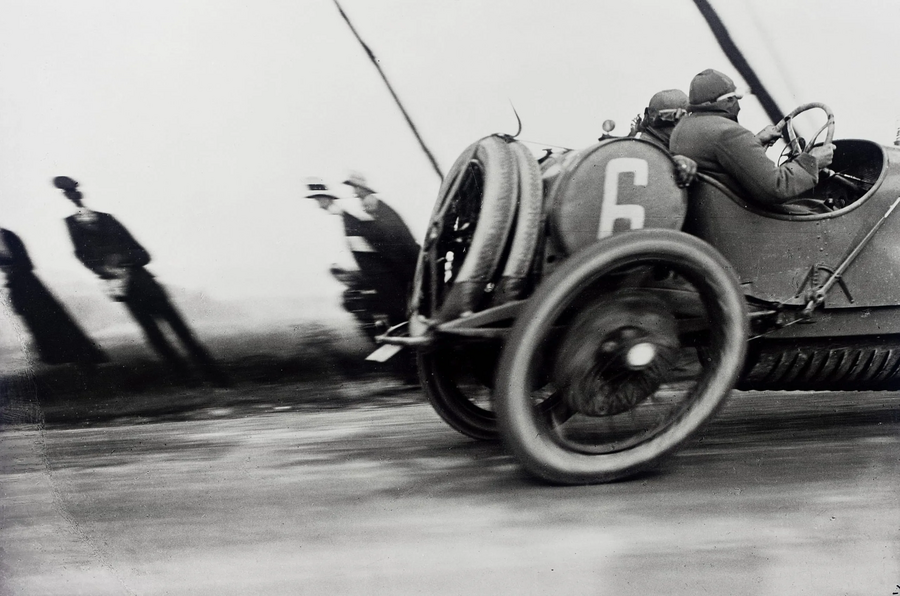
Jacques-Henri Lartigue. Grand Prix of the French Automobile Club, 1912. Gelatin silver print.
From the photograph, precision was expected from the very beginning. It was valued for conveying the world with greater detail and honesty than the artist’s hand, so anything that hindered this precision—blur, lack of sharpness, distorted proportions, coarse grain—was considered a flaw.However, if one traces the history of the medium, an interesting detail emerges. Many shots that failed by the standards of their time are now held in museums alongside flawless images, and some have become emblems of the era.This contradiction became the starting point for the research.
When discussing a photographic error, people usually approach it either as a technical flaw that needs fixing or as a stylistic effect. I am interested in viewing it as a continuous thread in the history of photography—to understand what a mistake reveals about the medium itself. After all, the way different eras treated flawed images tells us what they expected from a photograph and what they believed in it. Furthermore, an error always contains an element of chance, and chance, according to Roland Barthes, is what brings the image to life. Barthes calls the «punctum» the detail that «pricks» the viewer beyond the photographer’s intention. Often, this detail turns out to be precisely a defect: the oval wheel in Laritage’s photograph or the single passerby on an empty street in Daguerre’s.
The topic is particularly relevant now, when smartphones automatically remove noise and blur, yet apps and filters often add artificial grain, flares, and scratches to images.
The error—or the aesthetic imperfection—is a universal optic: it works equally well for a Daguerreotype from 1838 and for a file from a smartphone, allowing us to trace the entire history of the medium along a single path. There is a flip side, though: a photograph devoid of any flaws is increasingly met with suspicion, often presumed to have been digitally processed or AI-generated. Ultimately, the question of the error becomes a question of how we distinguish a genuine photograph from an artificial one.
Key Question: How did the inclusion of flaws become an artistic device and a sign of authenticity in photography?
Error—the only place in a photograph where time, movement, and the apparatus itself are visible. The more perfect the technique became, the more valuable this trace grew.A perfectly sharp frame looks as if no one took it: there is no visible photographer, camera, or the seconds it took to capture the moment. A flaw reveals all of that at once. Blur indicates that the subject was moving; a tilted horizon suggests the photographer was moving; and grain indicates a lack of light. Error transforms the image into a testament to a specific moment.The attitude toward imperfection changed in stages. During the era of long exposures, it was tolerated as an inevitability. Futurists discovered that distortion conveyed speed. Robert Capa’s photos from the Normandy landings demonstrated that people believed more in a blurry frame. Japanese photographers from Provoke made «grain, blur, and defocus» their manifesto. And when the technology learned not to err, the error began to be faked.
The study includes images where the defect is immediately apparent and originates during the capture process—due to shutter speed, aperture, focus, grain, or file compression. The chronological scope spans from the 1820s to the 2010s.The sections follow a chronological progression, and in each, the error plays a new role—ranging from inevitability to fabrication.
2. The Mistake That Started It All
Early photographers couldn’t avoid making mistakes. Exposures lasted for minutes, or even hours, and anything living either disappeared from the shot or became blurred. The defect here isn’t an error, but a prerequisite without which the image wouldn’t exist at all. They simply tolerated it, waiting for the technology to improve.
Joseph Nicéphore Niépce. View from the window in Le Gras, 1826–1827. Heliography on a pewter plate. Harry Ransom Center, Austin.
The oldest surviving photograph, taken with Joseph Nicéphore Niépce’s camera—"View from the Window at Le Gras"—resembles a stain more than a landscape. The exposure, according to traditional estimates, lasted eight hours, or perhaps several days. The sun managed to circle the courtyard, and the walls are illuminated from both sides simultaneously, though we would never witness such a moment in real life. Clément Sherer calls this plate the first «flickering» image in the medium’s history. It turns out that photography began with a «failed shot.»
Louis Daguerre. Boulevard du Temple, 1838. Daguerreotype.
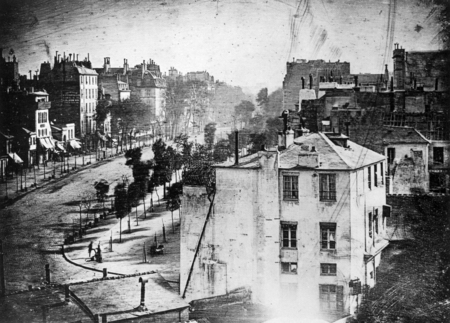
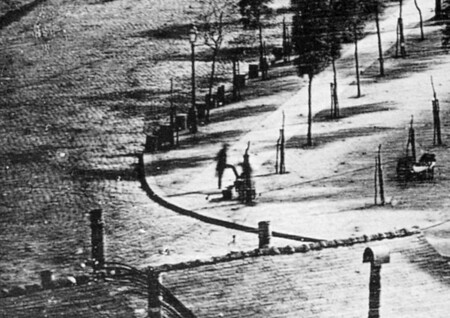
Louis Daguerre. Boulevard du Temple, 1838. Daguerreotype.
Nearly ten years later, Louis Daguerre captured a clearer image. The shooting took place in the morning, capturing a bustling Parisian boulevard filled with carriages and passersby. However, the plate ended up showing an empty street.
In approximately ten minutes of exposure, everything in motion simply didn’t have time to leave a trace. The only person who remained captured was the man having his boots shined—he was standing still.
For Daguerre, this was just one of the trial plates of the day. For us, it became the first photograph that successfully captured a person, and he appeared on it only thanks to experiments with imperfect technology.
David Octavius Hill, Robert Adamson. Mrs. Elizabeth (Johnston) Hall, a fisherman from Newhaven, 1843–1846. Salt print. National Galleries of Scotland, Edinburgh.
David Hill and Robert Adamson made around 120 calotypes in the fishing village of Newhaven, near Edinburgh.To achieve a portrait, the subject had to remain still for a long time. This resulted in focused expressions and soft, almost melting contours—the photograph captured not a single moment, but an entire wait.
David Octavius Hill, Robert Adamson. Marion Finlay, Mrs. Margaret Laill and Mrs. Grace Ramsay («Letter»), c. 1843–1847. National Galleries of Scotland, Edinburgh.
Walter Benjamin recalls the New Haven fisherman in «The Flâneur and the Photograph» (1931). He observed that during a long exposure, the person seemed to «grow into» the image—something that doesn’t happen with an instantaneous snapshot. Benjamin was among the first to see value in a technical limitation, and the series of photographs of New Haven residents became one of the earliest examples of social documentary photography.
Yes, the first photographs are imperfect by definition. But it is precisely in this imperfection that the mark of time is best visible: the sun from both sides in Niepce’s work, the empty street in Daguerre’s, the frozen faces in Hill’s. For now, this is just a side effect, but soon photographers will discover that error can reveal what a sharp frame cannot see.
3. The Mistake That Showed Speed
By 1910, cameras learned to «freeze» motion, and blurring became an obvious flaw. But it was then that it became clear that a distorted frame conveyed speed better than a sharp one.
Jacques-Henri Lartigue. Grand Prix Automobile Club de France, 1912. Gelatin silver print.
In the photographs, Jack-Henri Lartigue, while winning the Grand Prix of the Automobile Club de France, has a stretched oval wheel. The spectators on the roadside are leaning to one side, and the car is leaning to the other.This is all due to two factors: the shutter, which exposed the plate through a narrow, moving slit, and Lartigue himself, who drove the camera following the car. As a result, each stripe of the frame was recorded at a different moment in time.
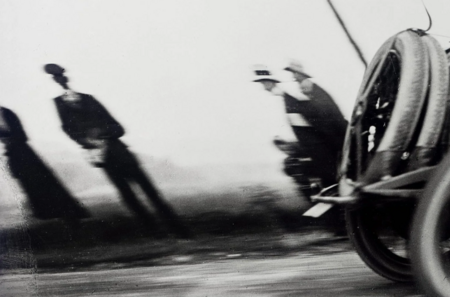
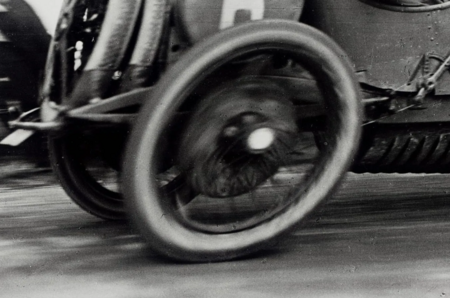
Jacques-Henri Lartigue. Grand Prix Automobile Club de France, 1912. Gelatin silver print.
Let’s zoom in on the wheel and the tilted figures. It is this deformation that the viewer remembers. Bart would have called it a «punctum"—a random detail that «pricks» the beholder.In the world of photography at that time, where «freezing» motion and sharp framing were valued, the eighteen-year-old author considered the shot weak, almost a failure.However, in the history of photography, this is now one of the first images of speed and an icon of 20th-century photography—a milestone in the history of the entire genre.