Table of Contents
1. Concept 2. Research Hypothesis 3. Azilian Ornaments a) Main motifs and composition b) Technical features / materials 4. Berber Tribal Tattoos a) Typology: main types of tattoos b) Semantics, symbols, social role 5. Interpretation. Conclusions
Concept
This study is based on the assumption of the existence of intercultural connections between painted pebbles and Berber tribal tattoos. The central idea is that the graphic motifs used in the ornaments on Azilian pebbles may contain the same elements as those found in African tattoos and reflect shared visual symbols (an analogous visual system), encompassing, for example, concepts such as identity, status, and others.
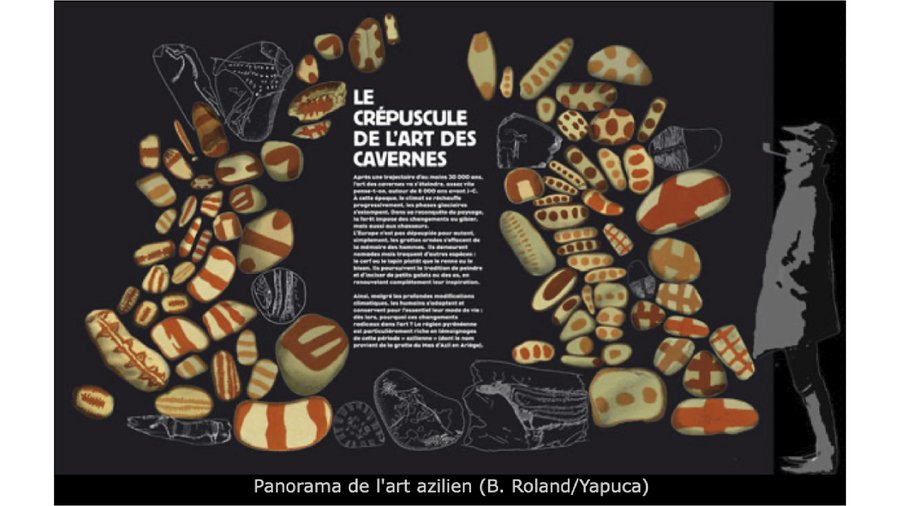
Azilian painted pebbles («galets coloriés, ” „galets peints“) were discovered at the Mas d’Azil site in southwestern France by the archaeologist Édouard Piette. Later, Piette returned to the study of these pebbles and attempted to interpret them as an alphabetic system. In a report presented to members of ISIS, Johannes Deichmüller noted that „Piette saw in the ornaments representations of the sun, trees, and ancient numerical and writing systems“. The diversity of ornamentation on the pebbles gave rise to numerous interpretations, including hypotheses about proto-writing, cult objects, „art for art’s sake, ” gaming pieces, and even sacred anthelmintics.
Tattooing in Ancient Africa developed alongside social life and functioned as a means of communication. Different ornaments were used to convey affiliation and social status, as well as for religious and spiritual rituals. Ancient African tribes created ornaments imbued with deep symbolic meaning. In her work Indelible Signs: Tattooing as a Historical Source, M. B. Mednikova notes that among Congolese peoples (Upper Congo, Northern Congo), scarification was widespread. For example, facial scars among the Bopoto tribe functioned as an ethnic marker, and their application could extend over a period of up to 30 years. Alongside tribal identification, Berbers used tattooing as a divine symbol, a sign of fertility, and more. In Berber culture, applying ornaments to the skin is considered an ancient ritual tradition.
Hypothesis
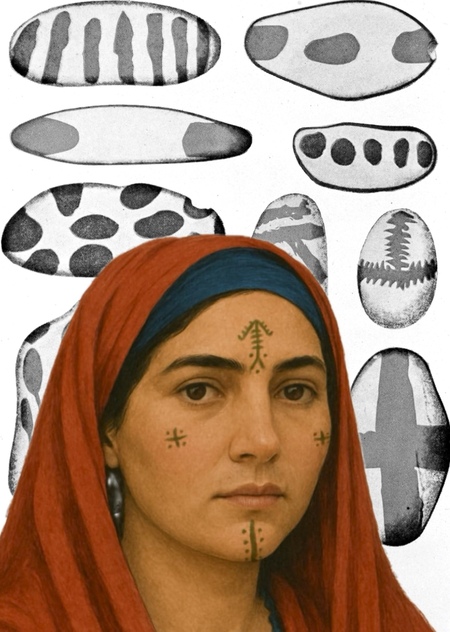
The motifs of Berber tribal tattoos display ornaments similar to the painting and engraving found on pebbles (stones, cobbles) discovered at Azilian sites. These ornaments are not directly connected but correspond as manifestations of human interpretation of patterns across millennia and may contain a similar traditional visual system and shared symbolic signs.
The aim of this study is to conduct comparative, contextual, and visual analyses of combinations of ornaments in both cultures. For this purpose, it is important to determine what the iconography on the pebbles might signify from the perspective of symbolic signs and a traditional visual system.
Azilian Ornaments: Main Motifs and Composition
a) simple composition
— dots
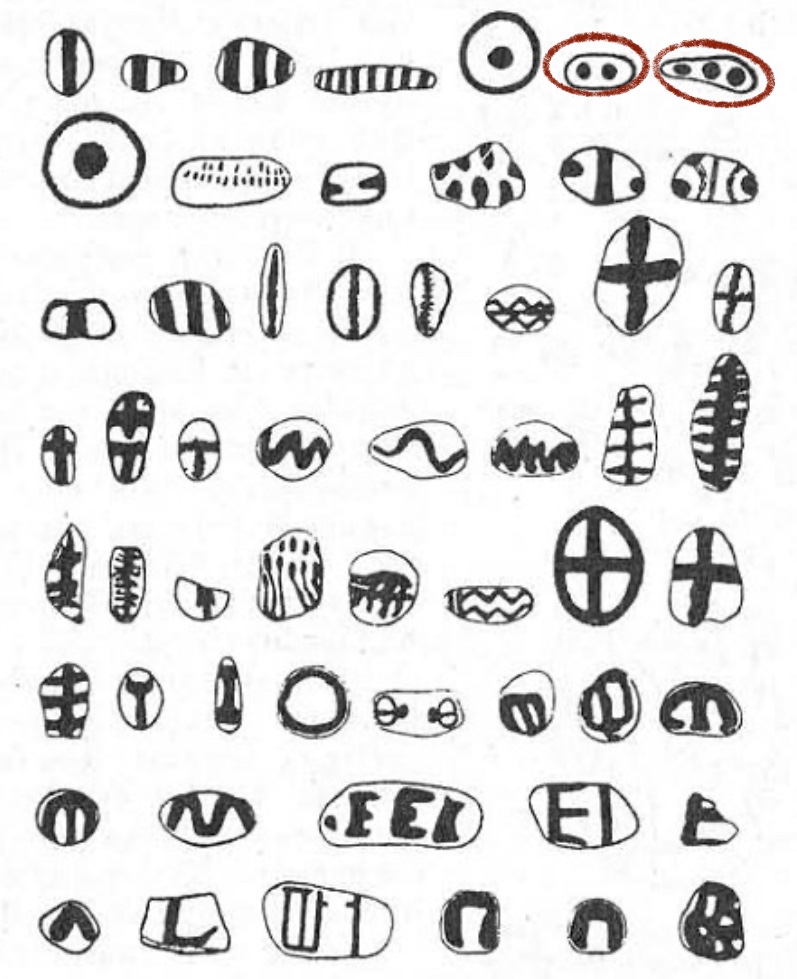
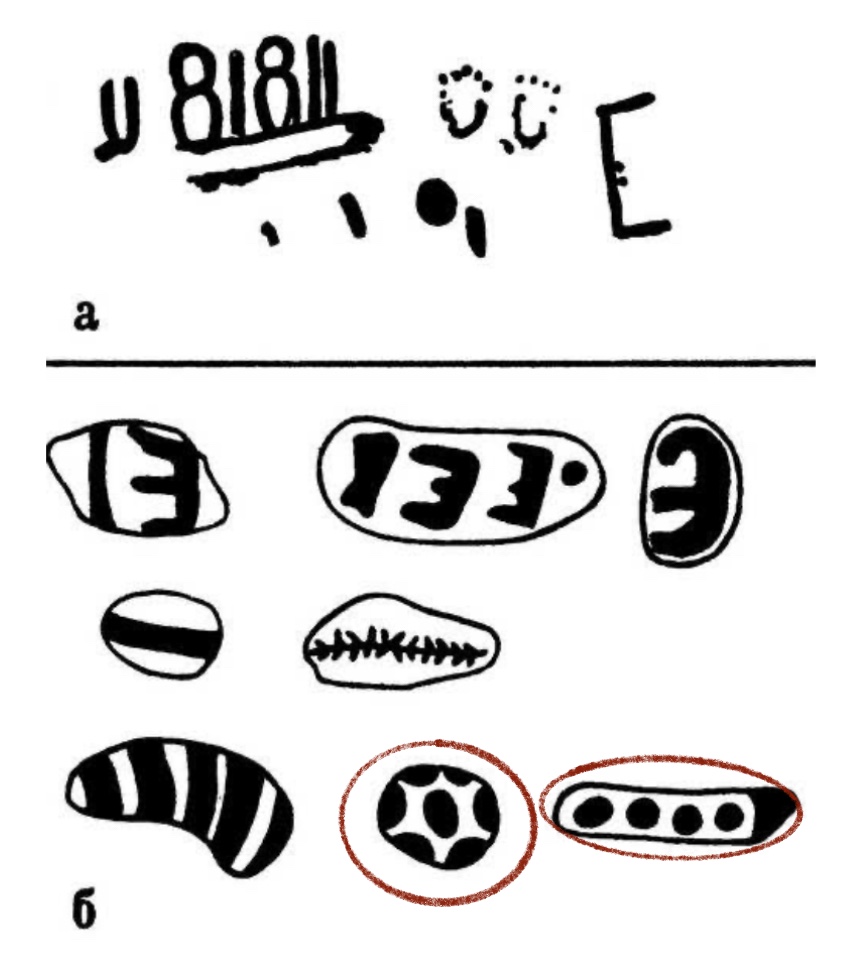
Source: Soviet Historical Encyclopedia, Mikhail Zilberman, Archaic Writing Systems
— straight lines
— zigzag lines
— curved lines
— perpendicular lines (crosses)
b) composite composition
We identified several elements belonging to composite compositions: — dots within a contour (round or oval pebbles) — perpendicular lines (crosses) within a contour — a straight line and multiple parallel lines — a straight line and zigzag lines — a straight line and dots — compositions using three or more simple elements
— compositions using three or more simple elements