Navigation Menu
Introduction Historical Context of Persian Rugs The Significance of Persian Rugs During the Safavid Era Creation Technology: Materials and Weaving Techniques Symbols, Ornaments, Motifs, and Color Palettes Persian Rugs in the Modern World Conclusion Bibliography
Introduction
Persian rugs are more than mere household items meant to provide warmth and comfort; they are an entire chronicle of eras. Since antiquity, they have been regarded as precious tapestries embroidered by master artisans. Each such rug, adorned with various symbols, holds within its patterns a thousand-year history, philosophy, and the culture of its peoples. Every rug is an encrypted chronicle, woven from wool, silk, and symbolism. Throughout the centuries, artisans elevated this craft to high art, though the zenith of carpet weaving occurred during the Safavid era (16th–18th centuries). It was during this period that the rug transitioned from a mere craft item into a work of art comparable in significance to miniature painting and architecture.
Today, Persian rugs are valued worldwide. Surviving historical pieces—whether museum relics or specimens in private collections—are perceived not merely as works of art; they have become the thread that connects us to bygone eras, allowing us to touch the art of the past.
I decided to select this topic for my visual research because I am interested in understanding the ornaments of rugs and their meanings. Persian rugs remain an unsurpassed standard of beauty and harmony, and I also want to trace how their ornaments have been preserved and transformed in contemporary art and design. I chose the Safavid era as my time period because it is considered the «golden age» of rug weaving. During this era, the techniques were perfected and the characteristic principles of ornamentation were established—principles by which one can identify the city or workshop that created a particular rug.
In my search for visual material, I consulted the digital archives of museums housing authentic Persian carpets. When selecting literature, I focused not only on general information regarding the history of carpet weaving but also aimed to find a more detailed analysis of the ornamental motifs for each carpet individually.
In my paper, I will first present a broader overview of all motifs characteristic of Safavid-era carpets, and then I will analyze the specific motifs and ornamentation of each carpet separately. However, before moving on to specific artifacts, it is necessary to establish the historical context: why the Safavids became the «golden age» of Persian carpet weaving, what significance was attributed to these pieces, and what the creation technology was—because without understanding the material and technique, it is impossible to appreciate the full complexity of the designs. In the conclusion, I will draw parallels to contemporary art to understand how classic motifs are transforming, being reinterpreted, and acquiring new resonance within the context of today’s visual culture.
Historical Context of Persian Rugs
The Persian rug is a variety of hand-woven carpets, among the most renowned globally. It is one of the symbols of Persian culture. The oldest surviving carpet is the Pazirik Carpet (5th century BCE). It was discovered in 1949 in a burial mound in Altai (present-day Russia). Its pattern features a mature composition: a central field with a square border, and figures of deer and riders on horseback.
However, knowledge of carpet weaving was interrupted following the Arab conquest (7th century). A new wave of flourishing occurred during the Seljuk era (11th–12th centuries). During this time, the symmetrical knot and high-pile technique emerged, although the rug ornamentation remained geometric, lacking floral scrolls.
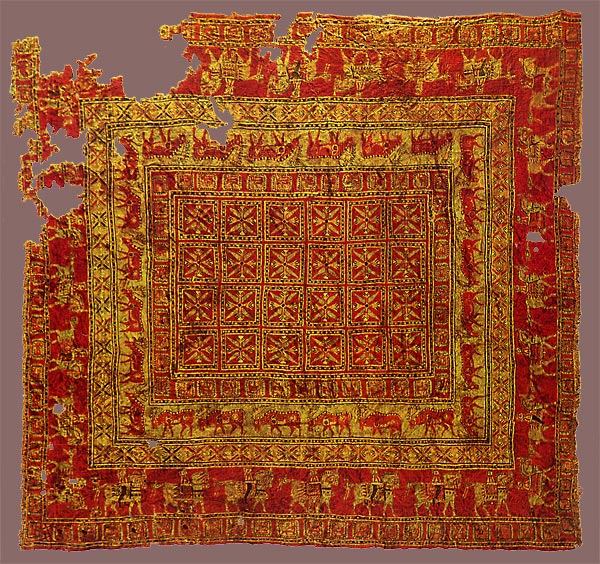
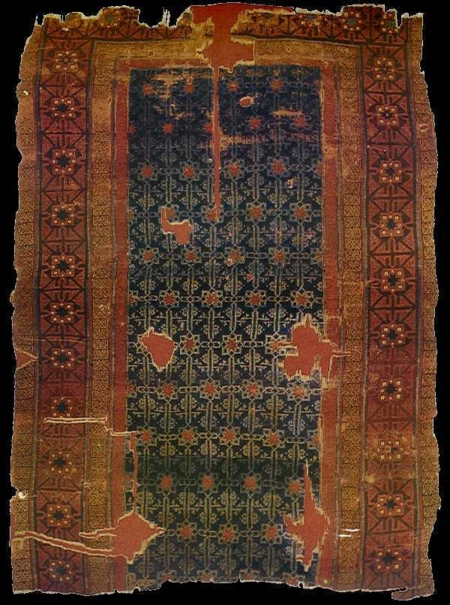
Pazyryk Carpet, Hermitage Museum, circa 400 BCE / Seljuk Carpet from Alaaeddin Mosque, Konya, 13th Century
This major turning point arrives in the 16th century with the rise of the Safavid dynasty (1501–1722). By this time, three necessary conditions were established in Persia:
- Economic — carpets became a strategic export commodity (to the Ottoman Empire, India, and Europe).
- Artistic — court workshops were headed by former manuscript illustrators (the Tabriz School). They transferred curved arabesques, palmettes, and hunting scenes from book miniatures onto weaving.
- Technological — the asymmetrical Farsi knot (Persian knot) allowed for the creation of flowing lines and fine details that were unattainable with the rigid Turkish (symmetric) knot.
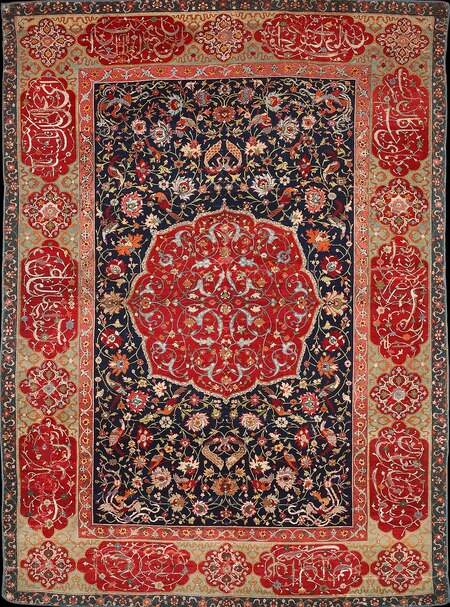
Schwarzenberg Carpet, Museum of Islamic Art, Doha, 16th century
It was during the Safavids that the rug ceased to be merely a household item—it became the state’s calling card, an element of diplomatic gifts, and a luxurious adornment for palaces. Shah Abbas I founded manufactories in Isfahan, Kashan, and Kermanshah, where silk and gold rugs were woven that were comparable in value to jewels.
Thus, all prior developments in carpet weaving (from the Pazyrık rug to Seljuk examples) prepared the way for the Safavid Golden Age—a period when the classical Persian ornament was established and is still considered the standard.
The Significance of Persian Carpets During the Safavid Era
The era of the Safavid dynasty, spanning the sixteenth and seventeenth centuries, is called the «Golden Age» of Persian carpet weaving. During this time, the craft reached its true zenith: imperial manufactories produced floor coverings of colossal size—up to 60 square meters. Remarkably, even at these scales, the quality of execution did not suffer, remaining at the highest level. It was then that recognizable ornamental systems were established, and weaving techniques were continuously refined. Thanks to these advancements, contemporary specialists can determine with great precision which city or even which workshop a particular piece was woven in.
Depending on their intended use, Safavid carpets are traditionally divided into several types: • Palace Carpets—These were works made using silk, and gold and silver threads. The patterns on these carpets were characterized by exceptional complexity, and they served as a vivid representation of the wealth and power of the Shah’s court. • Mosque Carpets—These were rendered in a restrained, tranquil color palette and incorporated prayer niches. These carpets created a unique, reverent atmosphere necessary for prayer. • Nomad Carpets—These were entirely different in spirit: made of coarse wool, featuring simple geometric ornaments, and strictly forbidding depictions of living beings or hunting scenes, a constraint dictated by local traditions.
Regional schools played a monumental role in the development of carpet weaving, with each one cultivating a distinctive style. In Gilan, they produced the famous silk carpets, prized for the nobility of their material. Herati carpets, woven from dense wool, were equally renowned. Furthermore, carpets from Nain, Kermanshah, and Tabriz gained widespread recognition—each of these centers contributed uniquely to the broader tapestry of Safavid carpet weaving.
In creating their works, Safavid masters often drew upon architectural motifs and reproduced the layout of paradisiacal gardens described in religious texts upon the carpet fields. The carpet ceased to be merely an interior decoration—it transformed into a sacred image of paradise, laid out beneath the feet of the faithful or the noble elite.
In conclusion, it can be said that it was during the Safavid period that the Persian carpet definitively established itself as a high art form. It seamlessly integrated impeccable technical mastery, the richness of regional traditions, architectural thoughtfulness in its compositions, and profound symbolic depth—all of which allow this era to be considered the pinnacle of ancient craftsmanship.
Creation Technique: Weaving Materials and Methods
The following materials were used to create Persian rugs and their foundations: • Sheep’s wool—the most common and accessible material. The quality of the finished wool varied significantly depending on the grazing region, the animal’s breed, climatic conditions, and local raw material processing traditions. In some regions, the resulting wool was coarse and stiff, suitable for nomadic rugs, while in others it was incredibly fine and silky, used for the most luxurious palace furnishings. • Silk—occupied a special, privileged place in the hierarchy of rug materials. It was used not only for the pile but also frequently for the warp threads. Silk rugs were immensely expensive and were intended exclusively for royal palaces, diplomatic gifts, or the wealthiest mosques. Their surface shimmered and refracted light, creating the effect of a living, breathing textile. • Cotton—found wide application in rug weaving. It was most often used for the foundation—especially in regions where cotton was grown in abundance. Cotton threads lent the rug additional resilience and resistance to deformation, which was particularly important for large-format floor coverings designed for foot traffic.
The process of rug creation was a painstaking ritual that demanded immense patience and meticulous precision from the artisan. A foundation of cotton or wool was stretched onto a vertical loom, and then each knot was tied by hand. It was the knot that formed the pile and determined the pattern. Two main types of knots developed in Persian carpet weaving: • The Turkish knot—symmetrical, used less often, and primarily in carpets with geometric designs where sharp, linear forms were required. • The Persian (Senneh) knot—asymmetrical; masters favored this type of knot during the Safavid era because it allowed for the creation of more complex, curved, and fluid ornaments, which became the hallmark of the Safavid style. Thanks to the asymmetrical knot, the elegant arabesques, floral garlands, and calligraphic inscriptions for which this art form is renowned became possible.
Symbols, ornaments, motifs, and color palette
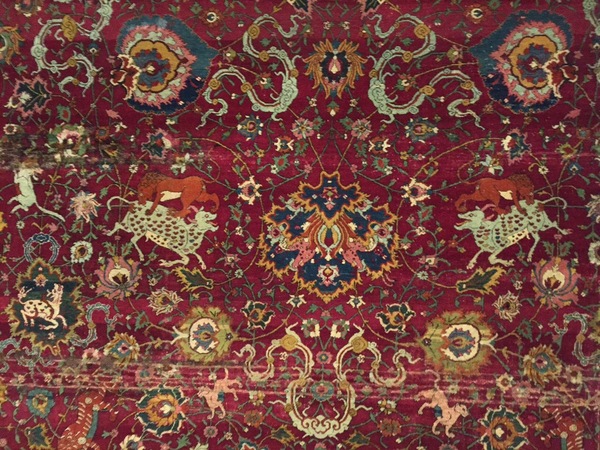
The visual language of Safavid-era Persian carpets represents a complex and multi-layered system, intertwining religious concepts, poetic imagery, architectural principles, and centuries-old artisanal traditions. Based on their compositional structure, Safavid carpets can be divided into several types: hunting carpets depicting scenes of animal pursuit, vase carpets (characteristic of the Kermanshah school), medallion carpets featuring a central focal point, and garden carpets reproducing the structure of a paradise garden.
By the end of the 15th century, radical changes occurred in carpet design. The previous ornamentation, characterized by strict geometric forms, gave way to intricate curvilinear compositions. Large-scale medallions emerged, and the ornamentation enriched itself with large spirals, scrolls, and arabesques. Depictions of flowers, animals, and mythical creatures began to be placed symmetrically along the long or short axis of the carpet—a technique that achieved remarkable harmony and rhythmic balance.
Each element of a Persian rug represents a kind of letter in a visual alphabet, carrying a specific semantic meaning: • Medallion—this is a key compositional element. During the Safavid era, a classical medallion scheme developed, where the central medallion was often surrounded by smaller medallions and corner elements. This composition created a sense of endlessness in the pattern, reminiscent of the structure of a dome. For nomadic tribes, the octagonal medallion could signify tribal affiliation and serve as a lineage marker. • Endless border—this encircles the rug in several rows. It is not merely a decorative edge but a philosophical reminder of the cyclical nature of time and the infinity of the universe. The pattern has neither a beginning nor an end, drawing the gaze into continuous motion. • Hunting scenes—this is one of the most popular motifs in Safavid rugs. They depict riders pursuing lions, gazelles, and wild beasts, as well as dragons and fantastical birds. Hunting was not just a favorite pastime of the nobility; it was also a form of military preparation and a metaphor for humanity’s internal struggle against its passions. • Calligraphy—this is a sacred art through which the beauty and grandeur of language can be expressed. Elegant inscriptions often contained poems by Persian poets, the names of master artisans, or religious formulas, transforming the rug into a kind of manuscript woven in textile.
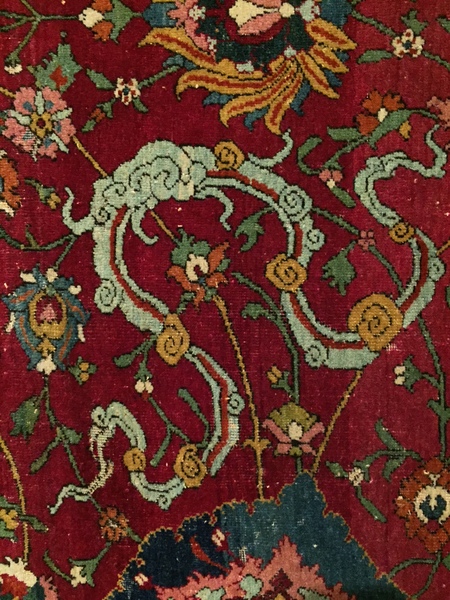
Friezes of Carpets from the Safavid Era
• Vegetal ornamentation is the true soul of the Safavid carpet. It was during this era that carpets acquired the name «floral,» as plants played such an important role in their decoration. Every flower in this ornamental system held specific meaning: • The lotus symbolizes purity, spiritual rebirth, and enlightenment. • The rose embodies love, beauty, and divine grace.
Among the most recognizable motifs in Persian carpet weaving, the following can be highlighted: • The Herati motif—this is a rhomboid medallion (or rosette) surrounded by curved, feather-like leaves, which are typically arranged parallel to each other on both sides. This motif is also known as «fish"—there is a poetic legend suggesting that the rosettes symbolize small fish splashing in the moonlight on the water’s surface. • The Buta motif—an almond-shaped element resembling a curved cypress leaf or a drop of water. It symbolizes fertility, immortality, and acts as a talisman against evil. • Arabesques—elegant, continuously intertwining lines that form complex vegetal compositions. They symbolize the continuity of life and divine grace.
The animals and birds depicted on the carpets also carry deep symbolic meaning: • The peacock is a symbol of immortality and paradise and was often associated with royalty. • The nightingale is a traditional image of a beloved and poetic inspiration. • The phoenix and the dragon—fighting a battle between good and evil—were introduced to Persian art from Chinese mythology and were fully integrated into the local artistic tradition during the Safavid period.
In Persian carpets, the color palette played a role as significant as the patterns themselves. Each color held its own interpretation and was carefully selected by the artisans: • Red — a symbol of happiness, joy, good fortune, wealth, and vitality. • Blue — the color of the sky, mystery, honesty, and power. In a religious context, blue could also symbolize the afterlife or divine infinity. A deep blue background was often used for the central field of the carpet. • Brown — the color of the earth and fertility, a reminder of the soil that gives life. This color lent the carpet stability and a connection to the natural world. • Yellow and gold — colors of the Sun, divine light, and royal authority. They were associated with rulers and were used in the most precious court carpets, often combined with gold and silver threads. • White — a dual symbol. On one hand, it signified purity, holiness, and tranquility; on the other, in certain contexts, it could symbolize mourning and sorrow. • Green — the color of paradise, gardens, and the Prophet. It was used in mosque carpets and other items connected to the sacred sphere. • Black — used with caution, primarily for outlines, borders, and creating contrast. It brought clarity and depth to the design.
Small silk medallion carpet of the Rothschilds, Museum of Islamic Art, Doha, mid-16th century
All these rich hues were obtained exclusively from natural materials: • Madder (plant roots) — provided deep reds. • Indigo (plant leaves) — yielded intense blues. • Saffron, pomegranate peel, or chamomile — produced yellow and golden tones. • Walnut shell — offered browns and blacks. The quality and permanence of the dyes were a source of great pride for the artisans. Natural dyes did not fade over time; rather, they acquired a noble depth, which is why antique carpets only become richer with age.
During the Safavid era, several major carpet weaving centers developed, each possessing a distinct visual signature: • Tabriz — one of the oldest centers, renowned for its intricate medallion compositions, exquisite arabesques, and hunting scenes. • Isfahan — the capital’s school, whose carpets often incorporated gold and silver threads and were intended for the Shah’s court and as diplomatic gifts; these carpets were also characterized by opulent ornamentation and a diverse color palette. • Kermanshah — carpets featuring the «vase» ornament were created here. • Kashan — a center for producing luxurious silk carpets, typically featuring depictions of birds, animals, and complex medallions.
Below, we will examine famous Safavid-era carpets that have survived to this day—many of them are striking representatives of one of the regional schools described above.
Ardabil Rug or Sheikh Safi Rug