Project Concept
«One Thing» is a media series on costume history, where each episode is dedicated to a single item from the museum collection: a bustle, a mourning brooch, an embroidered waistcoat. Through the object, one can see the person who wore it and the era in which they lived.It is a resource for designers, illustrators, cosplayers, and historical game developers who require authentic references. Since every publication links to an exhibit on the museum’s website, any item can be verified.The artifacts are selected via a script in n8n using open museum APIs, the draft is assembled by a language model, and the editor fact-checks it. Platforms: Telegram, Zen, VKontakte, Pinterest.
1. Media Fundamentals
Theme and Niche
«One Thing» tells a story of fashion through individual pieces from museum collections. Each issue is dedicated to a single item—a bustle, a mourning hair brooch, an embroidered vest. Through it, we see the person who wore it and the era in which they lived.Subject Matter
Broad Segment: Fashion and costume history. Specific Focus: One museum object per issue—its history and owner. Format: Item cards with photos on Telegram, long-form articles on Dzen, carousels and clips on VKontakte, and images on Pinterest.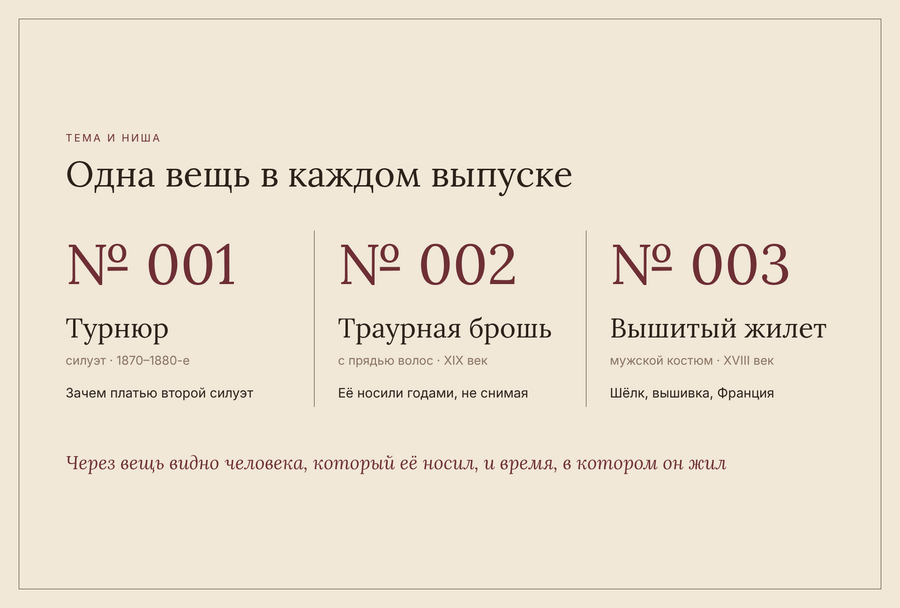
Goal
To make the history of costume relatable and accessible without a lecture-like tone. The media is intended for those who value authentic visual references and the short stories behind them: designers, illustrators, cosplayers, authors of historical games, and simply curious readers. Everything published is tied to a real museum exhibit with a corresponding link.Project Objectives:
1. Regularly release item cards linked to the exhibit: 4–5 posts per week on Telegram. 2. Bring in new readers from Yandex search through long-form articles on Dzen and from Pinterest via pins. 3. Build a community on Telegram and VKontakte that returns for new content. 4. Automate the search for exhibits and drafts so the editor can focus on fact-checking and historical narrative.Platforms
Telegram is the main platform: this is where item cards, collections, and announcements are posted. Dzen is responsible for long-form articles discoverable through Yandex search. VKontakte is the most accessible platform with the broadest audience: this is where carousels, clips, and articles are shared. Pinterest functions as a visual showcase, and every Pin links directly to Telegram.AI and Automation
Automation handles the searching and drafting; humans are responsible for accuracy and voice. The workflow in n8n pulls exhibits from museums' open APIs, a language model compiles the draft card, and an editor verifies the facts and elaborates the narrative. A detailed diagram is provided in item 8.2. Information Architecture
Topics
There are five topics in the media. Main content lives on Telegram, VKontakte hosts visual versions of the same topics, and Pinterest brings in a new audience.Platform Connections
At the end of every article on Dzen and every post on VKontakte, there is a link to Telegram. In Telegram, there is a pinned message with navigation by topic and hashtag.The reader’s journey: search article, pin, or clip → Telegram → saved collection → subscription.3. User Scenarios
Three typical paths in media: through Pinterest, through search, and through VK recommendations. In all three, the reader returns for something they cannot find elsewhere: a vetted item and its accompanying story.
4. Competitor Analysis
Niche
The «single item» format already exists in museums: the «Image of the Era» section at the Hermitage and «What We Wear» at the Ethnographic Museum. But there, it is just one more feature among the news, and each museum only showcases its own collection. There is no independent media that gathers items from different museums around the world and tells the story with an authorial voice—not in Russian.Key Search Terms
Yandex Wordstat data for September 2026. General phrases like «19th-century fashion history» are barely searched; instead, people search for specific items: bustle, corset, dress. This confirms the «one item, one post» format. Queries like «what is this in simple terms» show demand for explanations without jargon.The word «corset, ” without qualification, is reserved for medicine, so we use „historical corset“ in the titles. „Bustle pattern“ refers to reenactors and Sims 4 fashion for players—both groups are covered in the studio.