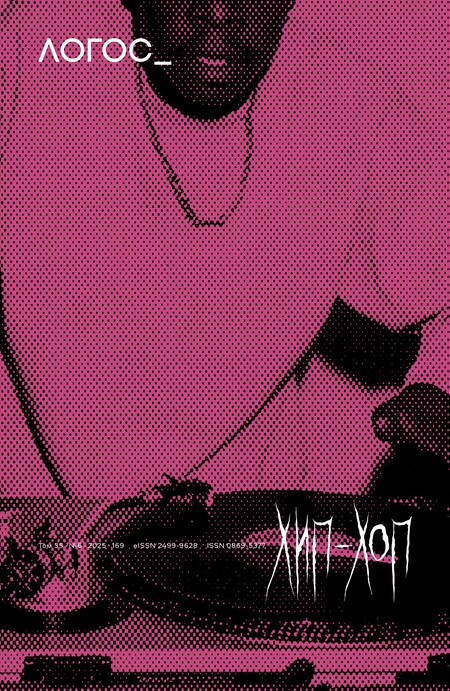
«Logos» (2025. Issue 6) addresses hip-hop research. While this might seem like an unexpected turn, a deeper dive into the journal’s archives reveals issues dedicated to the blues and Obereites—after all, the journal is fundamentally philosophical and literary. This particular issue focuses on the history of hip-hop’s socio-political dimensions in the United States and its reception in the USSR and the post-Soviet space. The editor and compiler of this issue is Tatyana Pyrova.
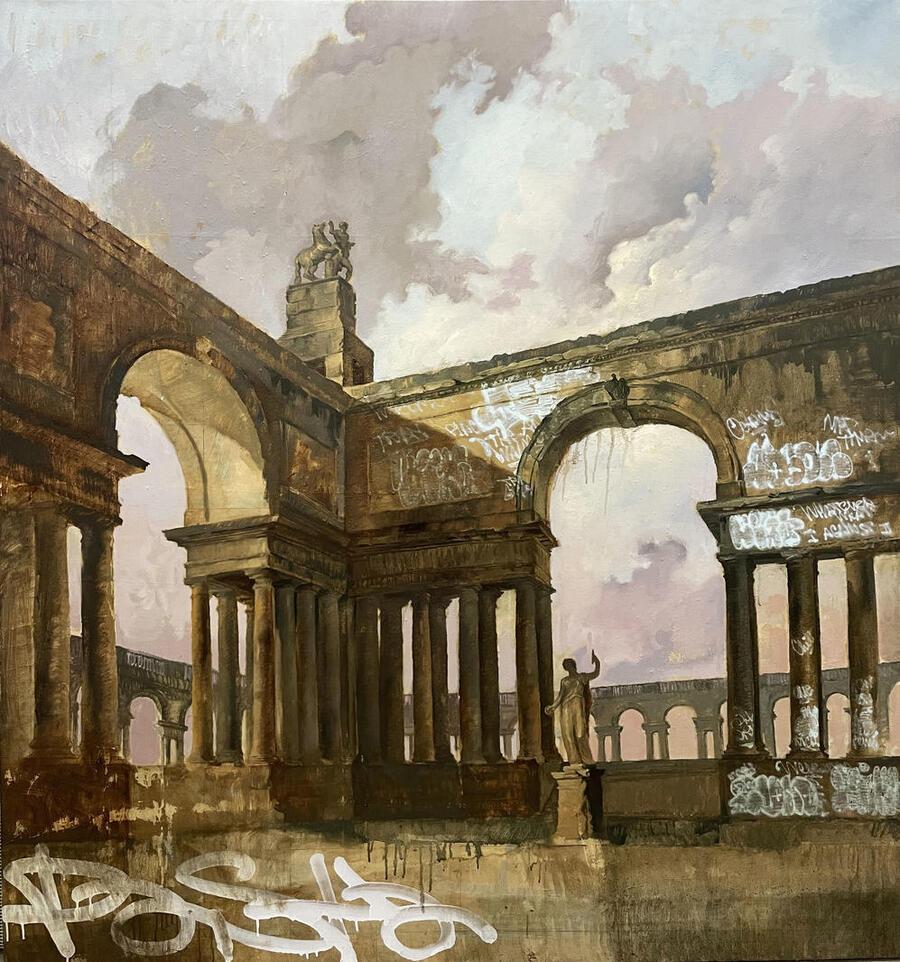
LARKANDRE. Untitled, 2024
Diving into the quirky world of hip-hop, the reader begins with Artem Rondarev. He provides an extensive interdisciplinary overview of hip-hop’s early history as a multilayered cultural phenomenon that cannot be grasped by the concept of a subculture. It all started in the South Bronx, New York. Locality and situativity played a leading role in this development: the origin of the artists and their connection to their specific neighborhoods were crucial (23–24). This was fully evident in the initial stages of hip-hop’s formation: tags (proto-graffiti) drawn on walls and subway cars represented the residents of particular streets. These tags provoked fierce opposition from the authorities and were consequently reinterpreted as a form of resistance. Later, other elements were added to graffiti: MCing (rap), breaking, DJing, and knowledge (research), which also possessed an oppositional character.
«Both the participants of the subcultures and those who opposed them were well aware of the transgressive potential and the political undercurrents of what was happening» (28).
It is the combination of political meaning and artistic gestures, alongside the accessibility of the latter, that has fueled the longevity and popularity of hip-hop, notes Rondarev. Moreover, it is significant that hip-hop successfully resisted appropriation by mainstream pop culture; instead, it creatively assimilated and reworked its elements while maintaining a distance from Western musical traditions (62). Rondarev emphasizes hip-hop’s role as a form of cultural resistance against capitalism and globalization, noting that it is simply «fun, loud, and unusual» (62).
LARKANDRE. Psyche Awakened, 2024
A concentrated expression of the will toward social protest becomes the focal point of artistic action, structurally indistinguishable from the act of political struggle. The artist is not a solitary creator, but a seeker of collective truth—an activist who constructs the public sphere. Thus, the principles inherently embedded in non-African aesthetics are amplified: functionality, cooperativeness, depersonalization, and contextualization (84).
LARKANDRE. Untitled, 2024
An intrinsic element of hip-hop, tied to its confrontational nature, was a specific ideal of authenticity and masculine identity, which the genre codified as «gangsta.» Murray Forman traces its formation in his article and its gradual replacement by the «post-gangsta» concept in the 2000s. In post-gangsta, the unwavering masculinity of the gangsta is softened by discussions of the mental health of Black individuals and the diversity of their experiences and identities. Discourses on internal experience, vulnerability, and weakness become possible.
«The ways authenticity is expressed in hip-hop and rap music have increasingly internalized, shifting into the realm of intimate thoughts and feelings with a new focus on affective expression. It is particularly significant that this articulation takes the form of a confessional monologue, which helps to explore issues of mental health and other forms of emotional or mental distress […] hip-hop sensibility, which developed in the late 1980s and was formulated by the principle of 'Keep it real! ', cannot exist without considering all aspects of emotional and psychological states. The public disclosure of one’s internal processes, thoughts, and emotions is profoundly important and can only be examined within the broader contexts of racial injustice, social struggle, political awareness, and action» (118–119).
LARKANDRE. 5 o’clock, 2024
What was the state of domestic reception of hip-hop culture, given that there was no context in which hip-hop formed and developed? Fedor Kyrlezhev offers a rich article on this topic, focusing his attention on the period from the late USSR through the late 1990s. He notes that hip-hop entered the country as «a specific complex of urban psychosomatic practices based on rhythm» (137), entirely devoid of ideology.
There were two phases of this culture’s reception within the process of Westernization. During the first, Soviet, phase, hip-hop possessed distinct characteristics shaped by informational isolation and state control. However, once secondary Westernization occurred following the dismantling of the Iron Curtain, Russian hip-hop no longer retained its uniqueness, having lost its distinct character due to global cultural homogenization.
Anna Sinelnikova continues the discussion of Russian hip-hop. Drawing from an analysis of interviews, she presents three perspectives on Russian rap—that of performers, listeners, and researchers.
LARKANDRE. Snow, 2025
What was happening in the post-Soviet border regions where the heterogeneity of the environment could not fail to leave its mark on the reception of hip-hop? In his article, Florian Koppenrat studies the features of Russian-language rap in Central Asia. Here, his chords were concerned with finding a specific Asian identity while simultaneously striving to stand out from the rest of the Russian-language rap scene and promoting linguistic diversity. Koppenrat traces the different forms and functions of the concept of «Asianness» and shows that the hip-hop culture’s inherent attention to locality and the demand to derive from it contributed to Russian-language rap in this region acquiring a decolonial character in several cases (166).
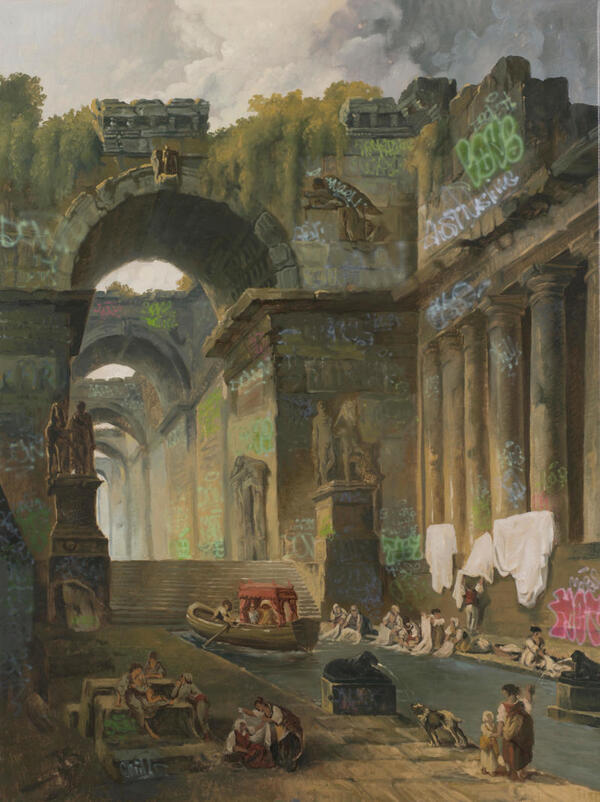
The cover design features the artworkLARKANDRE. Ghost wash, 2024
Illustration Source:https://vladey.net/ru/artist/ladkarne