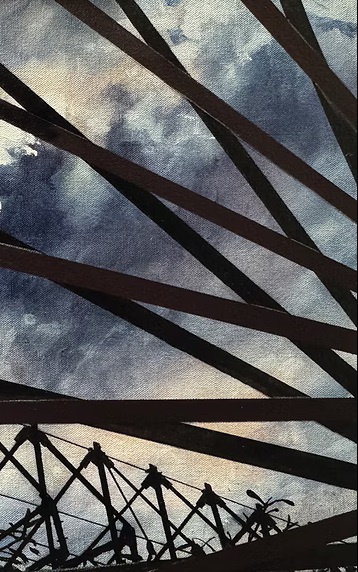
«Art Magazine» (2024, No. 124) addresses the current state of art in the country, dedicating the issue to «The Production of Space.» Given the cessation of the «transnationalization» (92) of contemporary art and the closing of many opportunities and themes in Russia, the question of restructuring artistic spaces has arisen. This primarily concerns designated social and anthropological spaces where the production of art—and life in general—is possible. Therefore, themes of escape and departure, as well as the creation of new identities and communities, have frequently appeared among the authors.
Often, the search for new spaces is conducted through immersion in history and the revival of previously discarded forms. For instance, Yulia Tikhomirova and Arseniy Zhilyaev theme the domestic salon as a medium, drawing upon the rich history of artistic precedents. Such a salon is closer to a show—a situation where the subject is present and displays intermedial objects but does not claim curatorial authority (for more on the thematization of presentation as an anthropological act, see Tristan Garcia’s article in the same issue). Simultaneously, these salons are open only to a specific circle of visitors; entry requires «an introduction, ” which serves as their protective function. „The salon in a time of change becomes a defense, a comfortable space that allows one to develop dangerous themes, argue, and debate… it is a bell where one can breathe deeply“ (30). This is „resistance to mental anabiosis, stupor, and catatonia“ (31).
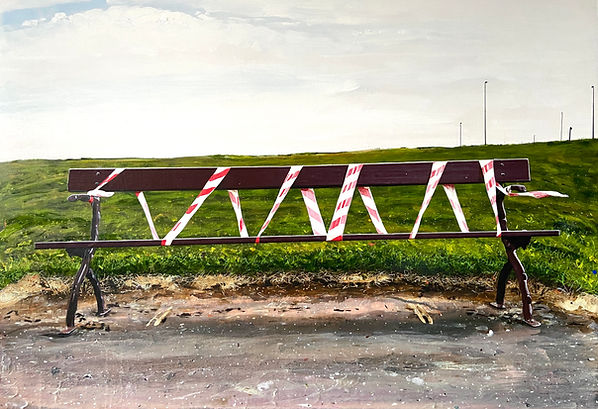
Narbi Price. Untitled Bench Painting (Lockdown), 2021
Essentially, this model represents an internal migration—an escape from public reality. However, this escape is ambivalent: it is a liberation that threatens to devolve into escapism, whose core is unfreedom. Vlad Kapustin’s text explores the ontology of escape, developing an eschepology that specifically addresses the distinction between escape as liberation and escape as unfreedom. Escape can be viewed as a manifestation of imagination, and because of that, it is linked to the search for and invention of new, free spaces. In fact, the art of eschepology consists precisely in the search for such spaces. «To achieve this, an analysis of the existing world and contemporary humanity is necessary. This will give us the ability to see what forms of escape we still possess» (61).
An interesting resonance builds between Kapustin’s reflections and the essay by philosopher Tristan Garcia on exposition. According to the latter, an exhibition is a «directed relationship between the subject, prepared for its own absence (the one arranging things), and the present object (the arranged things) […] As soon as a living being begins to exhibit something, regardless of what that is, it is preparing its own disappearance in the eyes of others» (76–77). Minimal ontological escape, in short, is embedded in the exhibition as a partial transference between subjectivity and objectivity.
Narbi Price. Untitled Bench Painting (Lockdown) 3, 2021
In Garcia’s interpretation, this circumstance explains the failure of participatory art: «Either the exhibition suffers defeat, generating a gesture that negates it—a gesture held until the subject who enacts it in this moment is gone; or the exhibition persists, and then it cannot claim spontaneity in the gesture—it suffers defeat because it still depends on the mechanisms of mediation and ritualization that sustain it in space and time beyond the gesture» (82). There is no room for spontaneity or immediacy here, and ultimately, «a good exhibition is a carefully considered and constructed revelation» (84).
A specific theme of the issue is self-organized and «grassroots» non-commercial spaces. Sergey Guskov views such spaces skeptically and calls for honesty: independent art spaces do not exist (35). In his opinion, such forms are inherent to neoliberalism and only reinforce the logic of precarity, offering no real alternatives. They function as a career springboard for beginners, a space for experimentation, and part of the art world’s ecology. However, Dima Filippov disagrees with him. In his autobiographical essay on the situationality and contingency of collective artistic work with space, he writes that «in today’s reality, the ability to exist autonomously appears as an important value, toward which alternative art spaces and the artists who organize them have moved» (136). Agreeing with him, Yulia Tikhomirova notes the growing number of non-commercial spaces in the Moscow art scene (29). In these spaces, artwork is not considered in isolation from the physical space itself, which thus becomes a medium.
Narbi Price. Untitled Barrier Painting (Westerplatte), 2019
This reflection resonates with Tatyana Mironova’s ideas regarding space or situation as a product of contemporary art (144). The project «Be Careful! Your Carelessness Could Have Consequences» in the «Quiet» gallery, analyzed in an essay by Evgeny Kuzmichev and Artyom Filatov, can serve as an example. Another example is the projects of the Institute of Coincidentology, discussed by Alek Petuk.
Continuing the theme of grassroots environments, Maria Kalinina describes the context and objectives of the Swedish rural community «Cultivator» on Eland Island—a «weaving of art, farming, forestry, and numerous other parallel phenomena into a unique artistic biome» (40). This extends beyond established art systems while simultaneously rethinking the experience of being on the periphery.
But what unites the participants in any community?
Narbi Price. Untitled Promenade Painting (Bombardment for Theo Jones), 2020
As Boris Groys notes, «today, identity is paradoxically understood not as that which identifies an individual, but rather as that which the individual shares with the members of the community to which they belong» (19).
Shifting to this understanding—moving away from individualism—he connects it with naturalization (different people possess different «natures,» leading to principles of diversity and tolerance) and the animalization of humanity. The cultured body is much more inert than the soul, and therefore, according to Groys, current communities based on race and gender are more rigid. He believes it is necessary to politicize «natural» identities: «identity becomes a matter of technological invention and political choice» (23). Thus, he does not advocate for the individualization of identities, but rather for a commonality at the level of regimes that produce new, artificial identities. In such a case, the ultimate solidarity is the solidarity of rupturing with «the same"—that is, with the old identity.
Narbi Price. Untitled Bench Painting (Lockdown) 2, 2020
Continuing the theme of production, Nikolai Ukhrinsky shifts focus to the production of space within Henri Lefebvre’s Marxist concept. He demonstrates that the potential for art is implicitly contained within space. Among the three forces of production—spatial practices, the representation of space, and the space of representations—the latter possesses liberating potential. This is the «space of leisure, pleasure, corporeality, and play… in the body resides a remainder that cannot be reduced to rational discourse; therefore, liberating art can emerge from this point, grounded in play» (48–49).
The idea of salvation or escape is inseparable from the question of whether this is done individually or collectively. It is a widespread notion that the contemporary Russian subject inherited cynicism from the late Soviet era. Alexei Yurchak reiterates his critique of the concept of late Soviet cynicism, pointing out that «purely formal participation in Soviet rituals allowed for the preservation of the importance of many socialist values and a continued, fundamental commitment to them. Therefore, Soviet people could simultaneously critique the state bureaucracy while still treating many ethical norms of socialist society seriously and acting accordingly» (107). The idea that life’s meaning is tied to some common good—a better future—retained its power as the foundation of the society’s moral fabric.
Untitled Windows Painting (Maxs Kansas City), 2022
Subsequently, the idea of «freedom from responsibility for others» began to dominate. According to Ilya Budraitsky*, this only partially echoed Western neoliberalism, as the latter emphasizes not merely being personally free, but also «reproducing conditions of freedom, nonviolence, and non-interference» (109). In contrast, Budraitsky* argues that in the post-Soviet space, if an idea is motivated by a specific and private interest, this lends it authenticity because it corresponds to something that genuinely exists. This justifies any means and applies at both the individual and group level, as well as at the level of states and ideologies, which explains the characteristics of recent politics.
According to Anatoly Osmolovsky*, «the forgetting of materiality, the failure to understand one’s own potential—is fatal and can lead to collapse and death quite rapidly… Where there is a limitation, there is always a deficiency, and where there is a deficiency—that is where politics, sociality, and culture arise» (7). Osmolovsky* suggests recalling the lessons of Modernism, which was essentially a reflection on materiality (in contrast to Postmodernism and Metamodernism).
Narbi Price. Nowt to Cling Into, 2025
However, the material quality is distinct. Materialist critique is often identified as a call to confront reality’s painful realities. It is crucial not to confuse this with the ideological imposition of a materialist consciousness, such as neoliberalism. According to Alexey Yurchak, «under current circumstances, the main thing an artist can do is support spaces and forms of publicness [that are not reducible to a neoliberal narrative]. In one way or another, these social spaces are preserved in museums, exhibition halls, and through public events and discussions. It is necessary not to let go the spaces for joint critical deliberation (for instance, simply discussing artistic projects or texts) where shared ethical values can be formed—values that do not align with the dominant viewpoint, according to which each person is solely responsible for themselves and is a carrier of a predetermined essence» (114).
Source:Pisarev A. From Mathematics and Cinema to Agamben: A Review of Russian Intellectual Journals // Neprikosnovenny Zapas. 2024. No. 2 (154). pp. 190-204.Cover:* — included in the list of foreign agents.