How does a raven become a symbol of horror, and why can this same image belong to a defender, messenger, or hero?
A black raven next to a dead body has long become an established symbol of death, although the origin of this association cannot be definitively traced today. Meanwhile, in painting, film, manga, fashion, and games, the same bird brings food to the hungry, offers protection, restores the deceased to life, or becomes the hero itself.
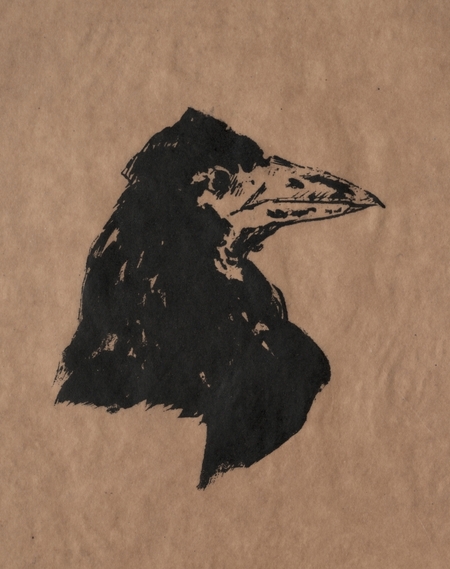
Manet depicts the raven separately—without a room or a person—and from such an image, it is impossible to tell what role the bird will play in the narrative.
[Édouard Manet. Raven’s Head in Profile, 1875. Cleveland Museum of Art]
I am interested in what visual elements make the raven appear threatening, and which allow it to be perceived as a defender.
I suspect the raven becomes sinister when the human is helpless, but the bird can still see, wait, or act.
To test the hypothesis, I examine what the bird does, how the character perceives it, and what the viewer sees. It is crucial to distinguish these perspectives because the feeling that a raven knows more than a human is often created by the person themselves. For example, in Poe, the raven’s prophetic answers are attributed to the narrator, whereas in Hitchcock, the viewer notices the flock before the heroine, though the birds' intentions remain unknown to him.
The selection spans painting, book graphics, sculpture, photography, film, manga, fashion, and games. Each medium imposes its own constraints, allowing the image of the raven to be explored from different angles: in a painting, it remains static; in a film, the director chooses the moment of its appearance; in fashion, the costume translates the bird’s features onto a human figure; and in a game, the player can control the bird themselves.
The works have been curated so they can be compared based on a single criterion. From the fashion collection, only those garments are selected whose connection to the raven is substantiated by the collection’s title or the curator’s commentary. This allows us to separate coincidental visual resemblance from confirmed influence.
In Roland Barthes’s «Mythologies, ” he shows how text refines the meaning of an image and participates in the narrative [1, pp. 38–41]. Thus, the raven on the bust of Pallas becomes a conversational partner for someone who knows the narrator’s questions. Consequently, the plot is retold only where the image would be incomprehensible to the reader without it. The analysis relies on the bird’s position, its size relative to the human, and its direction of movement.
Attributions, dates, and plot details were gathered from museum, authorial, and publishing sources.
The sections are organized according to how the relationship between the bird and the human changes—from proximity to a dead body and the attempt to elicit an answer, to the exchange of glances, penetration into the body, and the transference of avian traits onto a costume. In the final section, the raven initially aids the human before becoming the protagonist itself.
The names raven, crow, and „ворона“ have been preserved according to the sources. The biological species of the stylized birds is not determined in this study.
[1]
the bird remains
In the first section, the funnel is next to the body. Subsequent works show this proximity at different moments: when death has already occurred, when it is imminent, and when it needs to be announced.
Vasily Vereshchagin. «The Apotheosis of War, ” 1871. Canvas, oil. State Tretyakov Gallery
In Vereshchagin’s work, the consequences of war are reduced to a pyramid of skulls among dry trees and ruined walls [3]. The clear daylight reveals every detail. The skulls merge into a mass where individual people cannot be distinguished.
The crows here pose no threat to anyone and behave normally: the site of the catastrophe has become a place of rest and feeding for them. Yet, the viewer strives to comprehend what happened and to preserve the memory of the deceased. What is unsettling is the discrepancy between the birds' routine behavior and the scale of the tragedy.
August Friedrich Albrecht Schenk. Anguish, 1878. Canvas, oil. National Gallery of Victoria
Shenk’s sheep stands over the dead lamb and screams, while black birds sit motionless in the snow around it. The museum description also notes that the flock awaits a moment of weakness [4]. The mother shields the opening between the crows and the body.
Her defense cannot last forever—the moment she steps away, the birds will approach. Therefore, the flock’s stillness is perceived as waiting, and the viewer shares the mother’s helplessness in the face of loss. In Vereshchagin’s work, the crows have already claimed the place of death; Shenk stops the scene just before they approach the body.
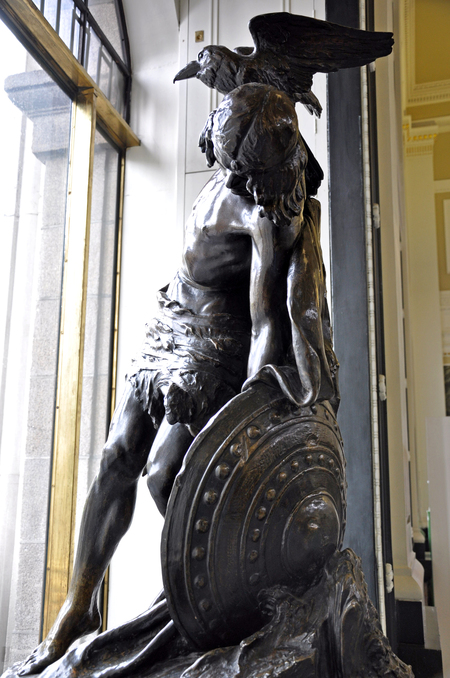
According to legend, the enemies believed Kuhulin was dead when a bird landed on him [5]. In Sheppard’s work, the hero remains standing: his head is bowed, his arm is weak, and a raven with a raised wing confirms his demise. In 1935, the sculpture was unveiled in Dublin’s General Post Office as a memorial to the 1916 uprising [6]. The bird helps honor the fallen: it makes the hero’s death visible, even though he never actually fell.
[Oliver Sheppard. «The Death of Kuhulin, ” 1911–1912; the memorial was installed in Dublin’s General Post Office in 1935]
In all three pieces, the bird maintains the ability to move, wait, and stay near the deceased. Against the backdrop of loss, this freedom creates the impression that the raven understands what is happening better than those grieving.
A person seeks an answer
The narrator in the poem «The Raven» takes this feeling seriously and begins to question the raven. He longs for the deceased Lenore, and the night visitor responds with the single word, «Nevermore.» The hope of overcoming grief and seeing his beloved after death makes every answer heavier [2]. By illustrating the same episodes, Maine and Doré depict in different ways how a chance visitor assumes power over a person.
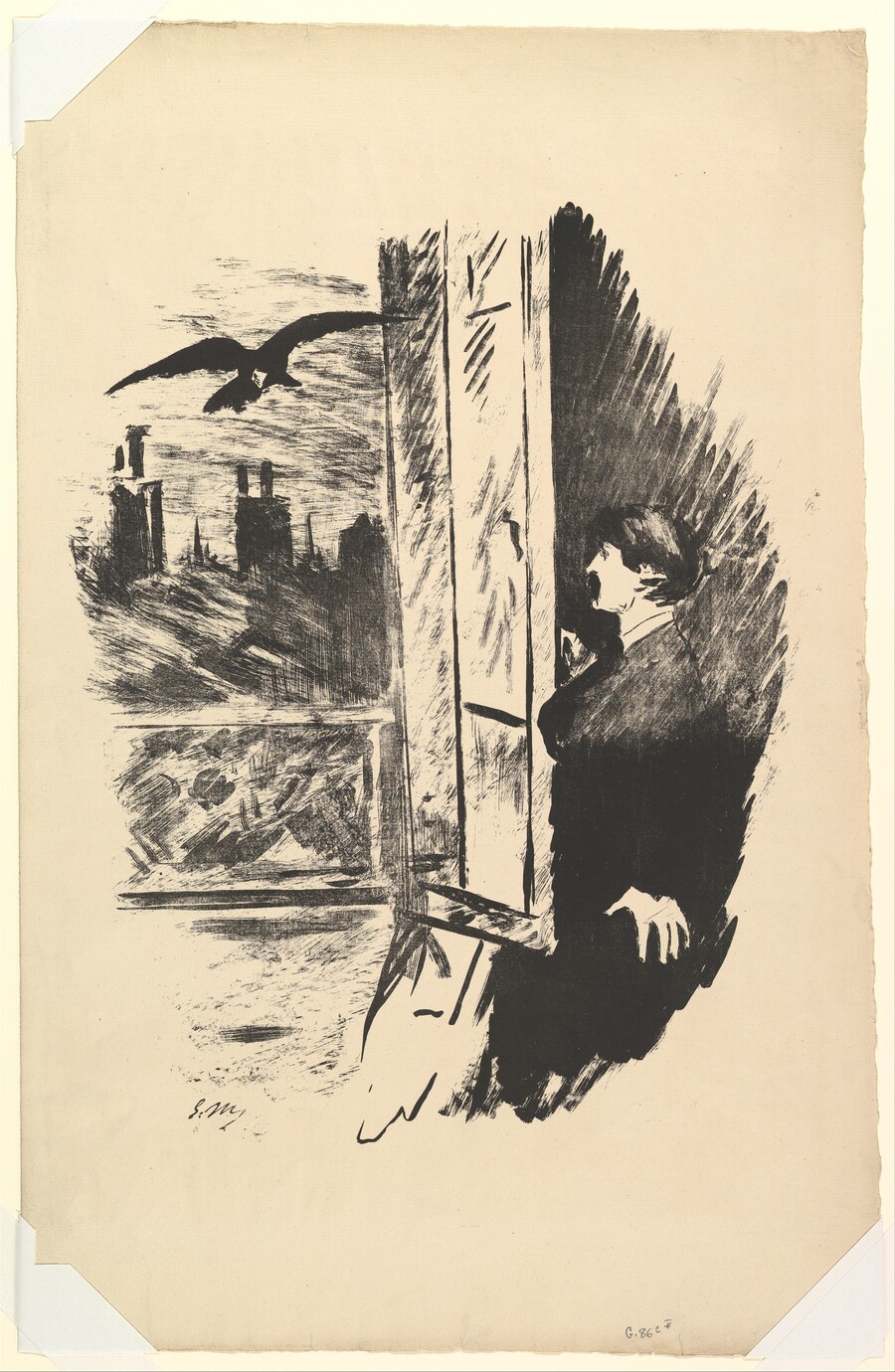
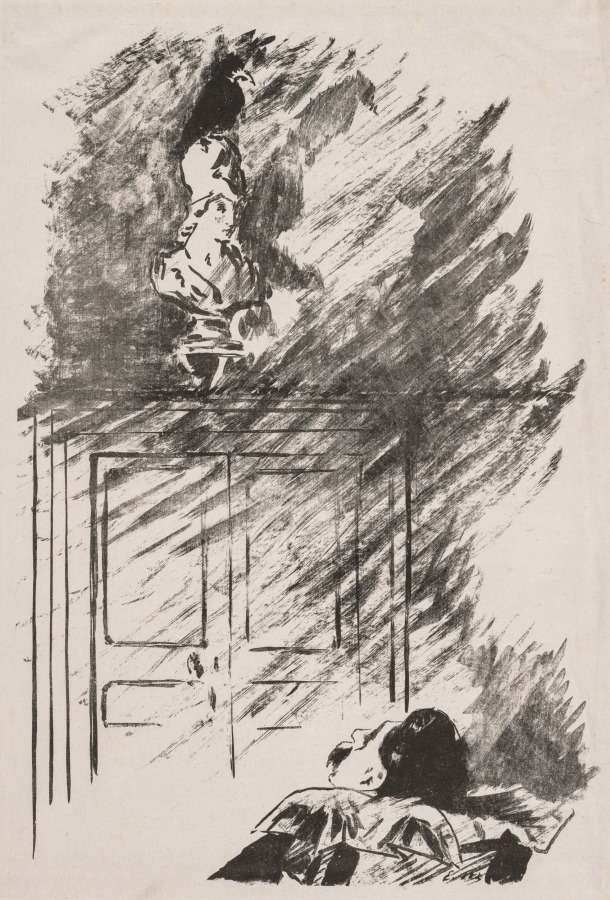
Édouard Manet. Illustrations for Edgar Allan Poe’s «The Raven,» translated by Stéphane Mallarmé, 1875. Lithographs. Metropolitan Museum of Art, Cleveland Museum of Art
In the Mane, the meeting is drawn with light lines, featuring large areas of white paper. A raven flies in diagonally through an open window, behind which rooftops are visible. The light lines of the shutters and curtains barely separate the room from the city. The person turns toward the bird, and the space remains open for now. Then, as in the poem [2], the raven lands above the door on the bust of Pallas, the goddess of wisdom.
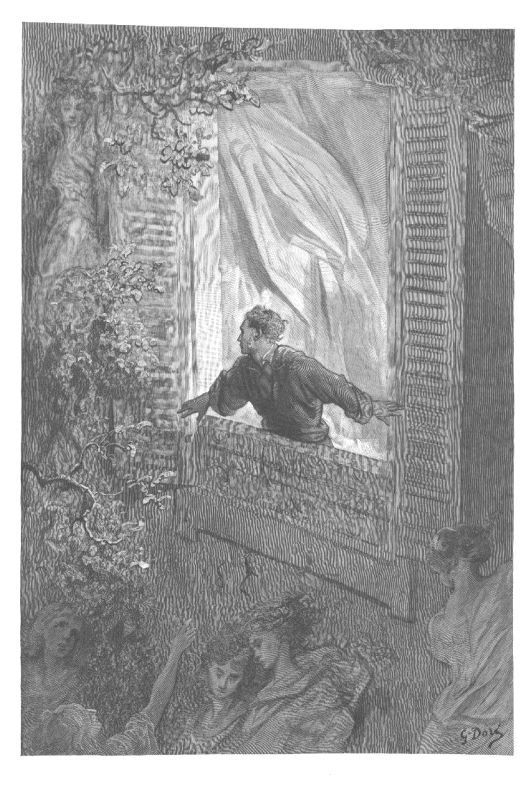
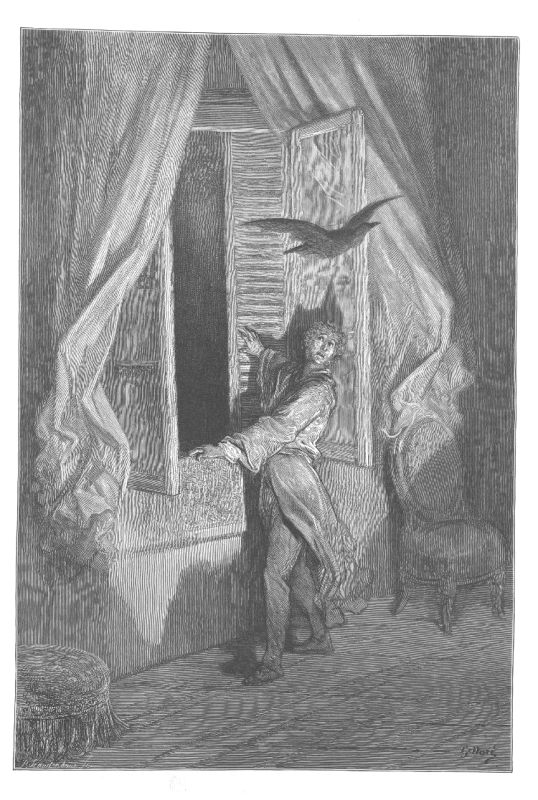
Based on Gustave Doré's drawings. Illustrations for Edgar Allan Poe’s «The Raven,» Harper & Brothers edition, 1884. Engravings: the raven’s arrival
In Dore, the same meeting takes place in a cramped room with dense cross-hatching, heavy drapes, and many objects. A bird bursts into the enclosed space, and the turn of the person toward it appears sharper. If Manet’s focus is concentrated on specific objects and gestures, in Dore, the cluttered room itself heightens the sense of anxiety.
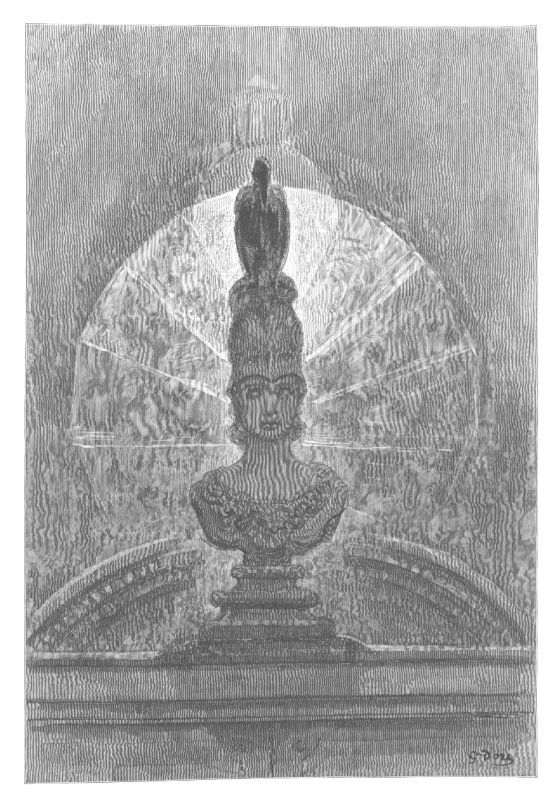
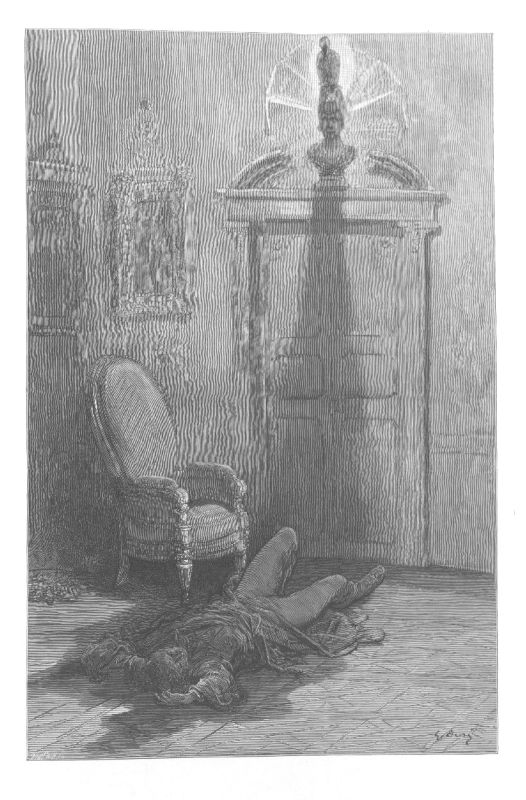
Based on Gustave Doré’s drawings. Illustrations for Edgar Allan Poe’s «The Raven, ” published by Harper & Brothers, 1884. Engravings: the raven on the bust of Pallas and the finale.
The raven statue above the doorway is also present in the prelude, and in the finale, the person lies on the floor. A small, still bird remains above. This draws a line through the outcome of the conversation, where the person lies broken, and the raven figure reflects unwavering composure.
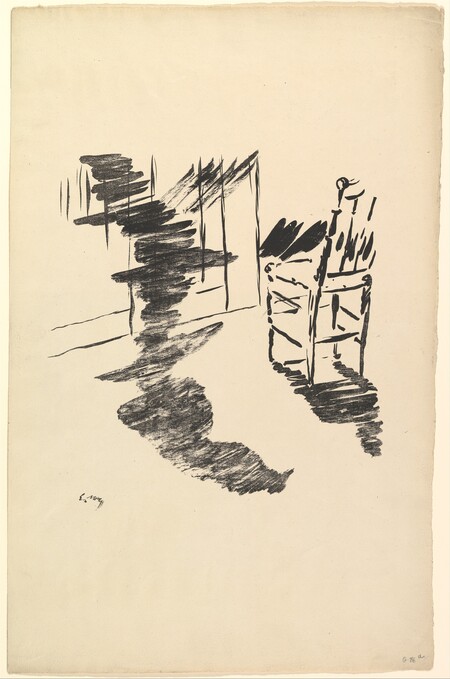
Mane concludes differently. The final sheet contains neither narrator nor bird. Despite this, the presence of the raven—an outside observer—can still be felt, like a drawn shadow.[Édouard Manet. «Shadow on the Floor.» Le Corbeau, 1875. Lithograph. Metropolitan Museum of Art]
The power to the raven is given a high place in the room, along with the narrator’s questions and the finale chosen by the artist. Dore concludes the story with the bird defeating the human, while Manet ends it with a room that the bird’s presence never leaves.
In Masahisa Fukase’s photographs, his interlocutor is gone, yet the birds’ connection to loss persists. After his marriage dissolved in 1976, he worked on a series that was published as the book Karasu in 1986 [7].
Masahisa Fukase. Kanazawa, 1977, from the Karasu / Ravens series. Masahisa Fukase Archives
In the image from Kanazawa, the black bodies of birds merge with the network of branches. A single bird is distinguished by a bright dot in its eye, but its gaze immediately finds the next and cannot stop. The crows appear simultaneously to be part of the canopy and a multitude of observers.
Masahisa Fukase. Kanazawa, 1978, from the Karasu / Ravens series. Masahisa Fukase Archives
Masahisa Fukase. Nayoro, 1977, from the Karasu / Ravens series. Masahisa Fukase Archives
In the next shot, a flock sits in a tree under a vast, empty night sky, and the frame is noticeably tilted. In another shot, birds circle a wooden structure. The shift from stillness to motion makes it difficult to discern individual birds.
Masahisa Fukase. Erimo Cape, 1976, from the Karasu / Ravens series. Masahisa Fukase Archives