Representing the Phenomenon of «Pleasure Houses» in Parisian Exhibition Culture of the Late 19th Century: From the Scandal Surrounding Édouard Manet’s «Olympia» to the Works of Henri de Toulouse-Lautrec and the Art Nouveau Movement of the First Third of the 20th Century
Navigator
- Concept
- Introduction
- From Myth to the Modern Woman
- Cafés and Urban Pause
- The Night Scene and Cabaret Culture
- The Brothel Without Myth
- The City After the Salon
- Allegory, Morality, and Social Judgment
- The Room, Exhaustion, and the Closed Gaze
- The Street and the Ambiguity of the Female Image
- Silhouette, Mask, Modernism
- Conclusion
Concept
The project examines the image of the public woman in European visual culture from the second half of the 19th century through the Art Nouveau movement of the early 20th century. The focus is not on the history of prostitution as a direct social documentary, but on the artistic language through which the female figure becomes connected to the city, spectacle, desire, money, public life, and control. Therefore, the theme is considered more broadly than just the depiction of brothels; the Salon, cafes, theaters, cabarets, posters, the street, interior spaces, windows, mirrors, the bed, clothing, and the very situation of the gaze become significant.
The starting point is Édouard Manet’s Olympia. This work is important not only as an image of a nude woman but as a moment of disruption in established artistic distance. Nudity ceases to be a safe form of myth, classical allegory, or academic ideal. Before the viewer emerges a modern woman whose body belongs not to the eternal realm of beauty, but to a specific urban reality. Her gaze does not dissolve into the role of a passive object; rather, it returns the viewer’s own presence and makes visible the tension between desire, consumption, social status, and exhibition scandal.
The project’s further trajectory is linked to the urban culture of late 19th-century Paris. The female image moves beyond the academic painting and exists in the space of the music hall, the masquerade, the theater, the street, and advertising graphics. A dancer, singer, courtesan, actress, fashionable passerby, or cabaret patron may share external similarities because urban visual culture is built on shades of gray, suggestion, and recognizable silhouette. Important is not just the woman’s social role, but also the manner of her appearance: a gesture, a pose, a costume, light, line, the name on a poster, the presence of a crowd, and the gaze directed toward it.
Henri de Toulouse-Lautrec occupies a special place. In his works, the previous solemnity of the image disappears. The brothel and nighttime Paris do not transform into an exotic scene of pleasure; on the contrary, they unfold as an environment of fatigue, anticipation, habit, and inner confinement. The women in Lautrec’s work often do not play the role of seductresses: they sit, converse, wash their faces, adjust their clothing, wait, lie in bed, or exist in the pause between events. Thus, the body ceases to be solely an object of desire and becomes part of the daily rhythm of a profession, domestic life, and social structure.
The central thread of this project is space. The female figure here is inseparable from the environment in which she appears. For Manet, this environment is the exhibition hall and a scandalous encounter with the viewer; for Degas, it is the café, the terrace, the interior where visibility merges with isolation; for Lautrec, it is the cabaret, the poster, and the enclosed room; and for the Modernists, it is the street, the shop window, the nocturnal city, the window, and the fragmented body. Space does not function as a neutral backdrop—it shapes the image, sets the distance, makes the woman visible, or conversely, transforms her into a silhouette, a sign, a shadow, a component of the urban surface.
Therefore, the project does not reduce all the female representations presented to a single social archetype. Rather, it examines the precarious boundary between actual prostitution, theatrical roles, urban fashion, the eroticized image, and male fantasy. Visual culture of the late nineteenth to early twentieth century often does not name this boundary directly, yet it constantly engages with its ambiguity. It is in this zone that the new image of the public woman emerges: not an ancient Venus, not a moral allegory, and not merely a character from a brothel, but a figure of modernity where desire, anxiety, commodification, loneliness, and the power of the gaze converge.
The project’s structure is organized as a trajectory—from the exhibition scandal to the urban nightlife culture, then to the closed interior, and finally to the modernist deformation of the image. Initially, the rupture between academic nudity and the modern female form in Manet is examined. Attention then shifts to the entertainment landscape of Paris—cafés, cabarets, masquerades, and posters. Following this, the mundane and almost silent aspects of the theme in Toulouse-Lautrec are unveiled. In the final section, the image of the public woman enters the art of the twentieth century, where it becomes not just a social figure but a signifier of the metropolis, alienation, fear, desire, and a new visual velocity.
Thus, the research addresses how the artistic perception of the female body changes in the age of Modernity. Prostitution, public visibility, and nightlife culture are important here not as a closed topic for moral judgment, but as ways to speak about the city, the viewer, and the power of representation. The woman is made visible through multiple mediums: the museum, the street, the stage, the poster, the room, the mirror, the window, and the bed. This connection among body, gaze, and space becomes the central concept of the project.
Introduction
The project begins with the question of how the image of the woman, connected to the city, public life, and the culture of the gaze, changes in French art of the latter half of the 19th century. Nudity, costume, pose, and interior design cease to be neutral details; through them, the pleasure market, social tension, the theatricality of nightlife, and the enclosed existence of the public house become apparent.
«In the Salon on Rue Moulin.» Henri de Toulouse-Lautrec, 1894. Oil on canvas. Musée Toulouse-Lautrec, Albi. (https://clck.ru/3TrdfY)
Therefore, the focus is not solely on prostitution as a social theme, but on a visual system where the body is intertwined with space, money, performance, and observation.
From Myth to Modern Woman
«Olympia.» Édouard Manet, 1863. Oil on canvas. Musée d’Orsay, Paris. (https://clck.ru/3Trdxx)
In Manet’s «Olympia,» the nude figure ceases to be a safe mythological trope. Before the viewer is not Venus nor an allegory, but a modern woman intertwined with consumption, gaze, and social tension. This is precisely what connects the painting to the urban reality of the 19th century.
«The Birth of Venus.» Alexander Cabanel, 1863. Oil on canvas. Musée d’Orsay, Paris. (https://clck.ru/3TreQu)
Academic nude from the mid-19th century maintains a distance between the viewer and the depicted body. Nudity is transposed into the realm of myth, ideal, and smooth pictorial surface. The woman exists not as a contemporary urban figure, but as a conventional ideal of beauty, devoid of social conflict.
«Breakfast on the Grass.» Édouard Manet, 1863. Oil on canvas. Musée d’Orsay, Paris. (https://clck.ru/3TrefW)
In Mane, nudity moves out of safe, mythological space. The female figure is positioned alongside modern, clothed men, devoid of allegorical justification or academic idealization. It is this aspect that brings the painting closer to urban reality, where the body becomes part of the social scene and the viewer’s tension.
«Nana.» Édouard Manet, 1877. Oil on canvas. Hamburger Kunsthalle, Hamburg. (https://clck.ru/3Trf4Y)
In «Nana,» the theme of contemporary sexuality is translated into interior space. The corset, mirror, vanity table, and a male figure in the background create a space of anticipation and observation. The woman here is not transformed into an ancient ideal—her image is linked to fashion, the economy of the gaze, and urban culture of pleasure.
«Masquerade Ball at the Opera.» Édouard Manet, 1873. Oil on canvas. National Gallery of Art, Washington. (https://clck.ru/3TrfFV)
Opera and masquerade belong to spaces where public life and private interest exist side by side. Crowds, fragmented figures, black costumes, and female silhouettes create the atmosphere of urban entertainment. The feminine image is woven into the culture of the gaze, chance encounter, and social spectacle.
Cafes and urban pauses
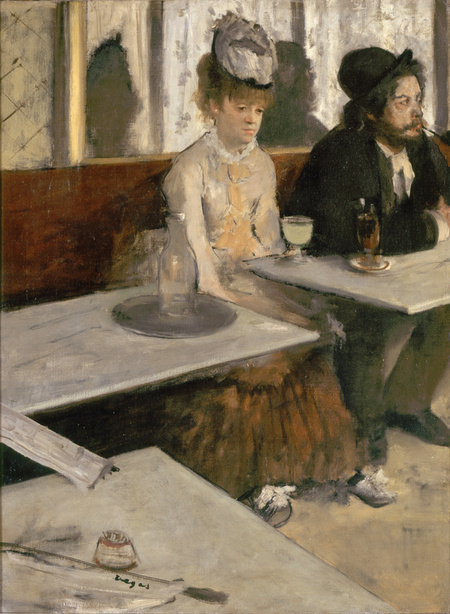
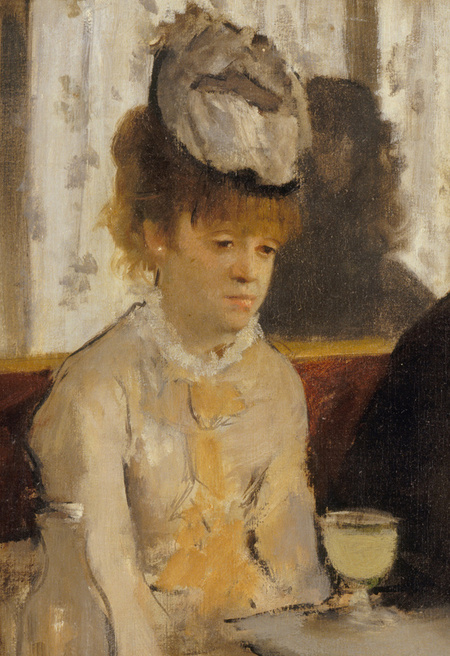
«In the Café, ” or „Absinthe.“ Edgar Degas, 1875–1876. Oil on canvas. Musée d’Orsay, Paris. (https://clck.ru/3TrgBA)
The cafe scene by Degas is no longer about overt allure, but about the alienation of city life. The female figure is immersed in stillness and internal weariness. The empty surface of the table, the skewed composition, and the absence of contact amplify the sense of loneliness within a public space.
«Women on a Terrace at Evening in a Café.» Edgar Degas, 1877. Pastel over Monotype. Musée d’Orsay, Paris. (https://clck.ru/3Trke8)
The evening city creates a distinct kind of female presence. The figure is no longer separated from the street, light, and motion. She becomes part of the urban surface—almost a silhouette, almost a sign, almost a shadow. In such scenes, biography is less important than the feeling of time, when a personal fate dissolves into the rhythm of boulevards, cafes, and chance encounters.
The Night Scene and Cabaret Culture
«Moulin Rouge.» Henri de Toulouse-Lautrec, 1892–1895. Oil on canvas. Art Institute of Chicago. (https://clck.ru/3Trkig)
The cabaret forms the night theater of the modern city. Light, mirrors, noise, audience, and stage create an environment where pleasure becomes an organized spectacle. The female figure is included in this mechanism not only as a performer or patron but as a symbol of desired, temporary freedom. Nightlife promises liberation, yet its space is constructed upon the ritual of repetitive consumption.
«Moulin Rouge: La Goulue.» Henri de Toulouse-Lautrec, 1891. Color lithograph. Museum of Modern Art, New York. (https://clck.ru/3TrkqE)