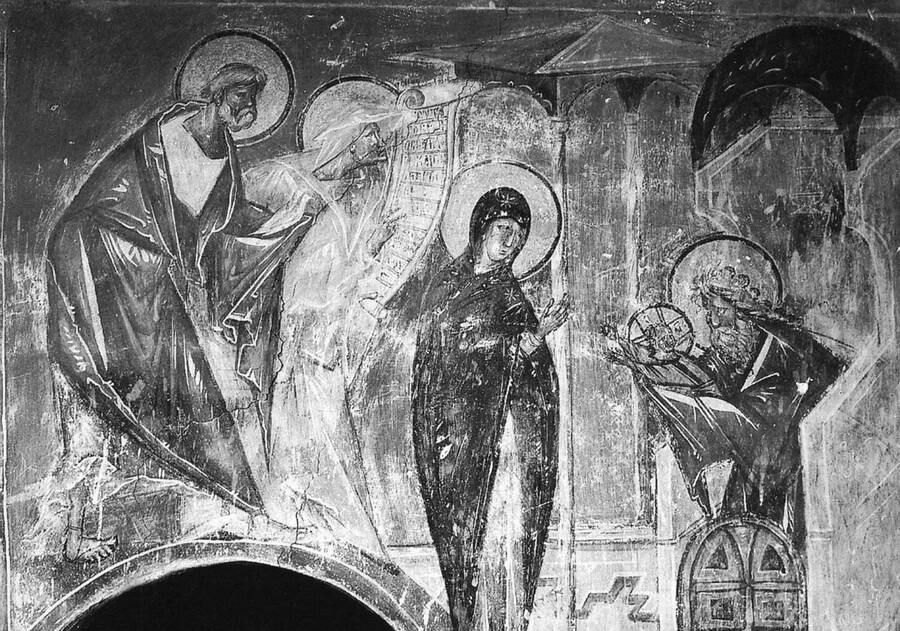
Образ порога в иконографии Сретения Господня: от поздеантичной церемонии к литургическому пространству
Contents
1. Concept 2. Initial Images of the Threshold. Late Antique Ceremony. 3. Formation of the Threshold Image. Liturgical Space. 4. Conclusion
1. Concept
Joseph and Mary watched what was said about him. Simeon blessed them and said to Mary, his mother, «Behold, this Child is destined to cause the falling and rising of many in Israel and to be a sign of controversy—and a sword will pierce your own soul too”—so that the thoughts of many hearts may be revealed.
The Meeting is a liminal event. It represents a transition from the Old to the New Testament, from Christ’s birth to his future sacrifice, from expectation to the fulfillment of prophecy.
The history of iconographic depictions of the Meeting reveals how, as the experience of the feast evolved and as the liturgical space transformed, a new artistic language developed to convey the complex theological ideas of the Gospel event.
Across the centuries, changing in correspondence with theological and architectural thought, the same Gospel episode acquires increasingly complex spatial and theological life. This study examines the formation of the threshold image in the tradition of the Meeting. From the earliest preserved monuments to the establishment of the canon.
The central research question is how the tradition of depicting a threshold changed and evolved in the iconography of the Meeting. How did the architectural alterations to the interior decoration of the church influence the imagery of the threshold?
The threshold in this study is the space between Mary and Simeon—the space through which the infant Christ is passed from one set of hands to another. It is a space of transition from life to death, from earthly to heavenly, from past to future. In established tradition, the altar occupies this space. It is not merely an architectural detail signifying the Jerusalem Temple and the place of sacrifice; rather, it represents a symbol of Christ’s future suffering. It is the compositional and thematic center of this transition—the throne of God, who revealed Himself to Simeon through Christ.
The study is interested in tracing how the symbols of the Presentation changed alongside the altar space. How the architecture of the temple evolved and how it revealed the theological idea of transition.
The study traces a trajectory from the early centuries of Christianity—from the basilica-type temple, where the altar is open, corresponding to the open space between Simeon and Mary, to Old Russian architecture with its darkened temple space and closed altar. It illustrates how a zone of dual nature emerged within the church: the altar was a visible, physically existing space while simultaneously designating a sacred, inaccessible area, which corresponded to the nature of the Visitation—an event on the boundary between Heaven and Earth.
In this context, the traditional depiction of Simeon before the altar is particularly compelling—within the structure of the church, this spot is located by the Royal Gates, at the entrance to the Kingdom of Heaven.
2. First Images of the Threshold. Late Antique Ceremony.
On the triumphal arch of the Basilica of Santa Maria Maggiore is the earliest surviving depiction of the Meeting of the Magi.
Santuario di Gesù, Santa Maria Maggiore, 432–440 AD
Compositionally, the mosaic evokes the solemn frescoes and bas-reliefs of the Roman Empire, depicting the offering of gifts to emperors. Simeon’s slightly tilted posture, the positioning of Mary and the Christ Child above Simeon, and the drapery of the hands as if presenting gifts to a ruler—all these techniques draw upon an established tradition of depicting a grand ceremony.
Fragment of black triclinium, Villa Farnesina, 20 BCE
Simeon’s receiving hands symbolize reverence for Christ, for the Jewish King. This same technique is used in other scenes—in the episode of the feeding of the five loaves, and in the Baptism. Later, it appears in the Deposition from the Cross, the Entombment, and the Dormition.
Here, the passing of Christ to Simeon acquires a public solemnity—there are many witnesses to this act of transfer.
Holy Trinity, Santa Maria Maggiore, 432–440 CE
Miraculous feeding with five loaves and two fish, mosaic of the Basilica of Sant’Apollinare Nuovo in Ravenna, circa 520 CE.
The most compelling figures are the angels, unnoticed by any of the protagonists. The angels stand between Joseph and Anne, situated at the point of the infant’s transfer. They witness the triumph—a threshold between the earthly and the heavenly—with halos reserved only for Christ and the angels.
Here, we observe artists selecting imagery to convey the idea of transition and to fill the space. There is a palpable desire to find an expression for this passage. In the iconography of the Visitation, the angels disappear.
Holy Trinity, Santa Maria Maggiore, 432–440 CE
The sacred space resembles the Second Temple and the interior of the basilica itself.
Michael Avy-Yon, Second Temple model, 1966
The viewer observes a solemn gathering outside the church while situated within the church itself. The narrative takes on a new resonance, echoing in the sacred space as if unfolding in the present moment. Furthermore, the placement of the narrative onto the triumphal arch is highly significant.
The interior of the Basilica di Santa Maria Maggiore, built in 352 AD.
Later iconography of the Meeting became more concise and refined. The mosaic in the Church of the Theotokos Kyriotissa features only three figures, a gold background, and empty space between them. The narrative becomes more focused—the gesture assumes narrative weight, outlining a threshold.
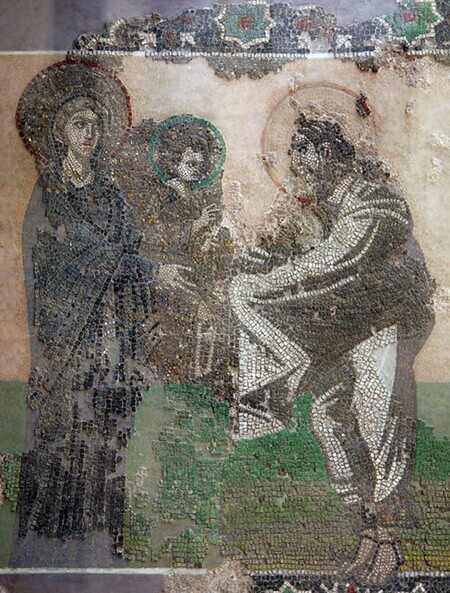
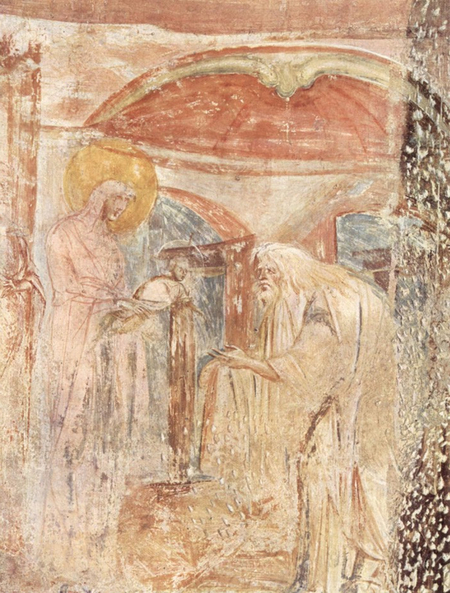
Sretenie, Church of the Theotokos Kyriotissa, 6th–7th century Sretenie, Church of St. Mary in Castelseprio, 10th century
If at the Church of the Theotokos Kyriotissa, the threshold was established through gesture and distance, then in Castelseprio, it first receives an architectural expression. The artist strives to delineate this enigmatic «in-between» space. Such changes can be correlated with the development of architecture. Churches gradually transformed into complexly organized spaces, and the understanding of the altar evolved. It is within this architectural framing that subsequent artists sought ways to express the space of transition.
3. Shaping the Threshold Image. Liturgical Space.
Miniature «The Incarnation of the Lord, ” Vasilios’ Menologies 2, circa 10th century
In this miniature, the central focus is the space that is already beginning to take shape as an altar for transmission. The structure against Simeon might evoke the interior of the Holy Sepulcher, specifically the aedicule. This decision reinforces the motif of Christ’s impending suffering.
Church of the Holy Sepulchre, Jerusalem, built in the 4th century
Here, we can also see the retention of previous motifs—the veiled hands, the tension in the posture, and the development of a tradition of depicting the altar as a space of transition.
But why did the artists find the altar to be the vehicle for expressing the idea of transition?