TABLE OF CONTENTS:
3–8 Concept
9–21 I. The Emergence of Myth and Medusa in Art
22–35 II. The Gorgoneion as a Symbol of Protection Against Evil
36–45 III. Humanizing the Gorgon Image
46–50 Conclusions
51 Bibliography
52 Image Sources
CONCEPT
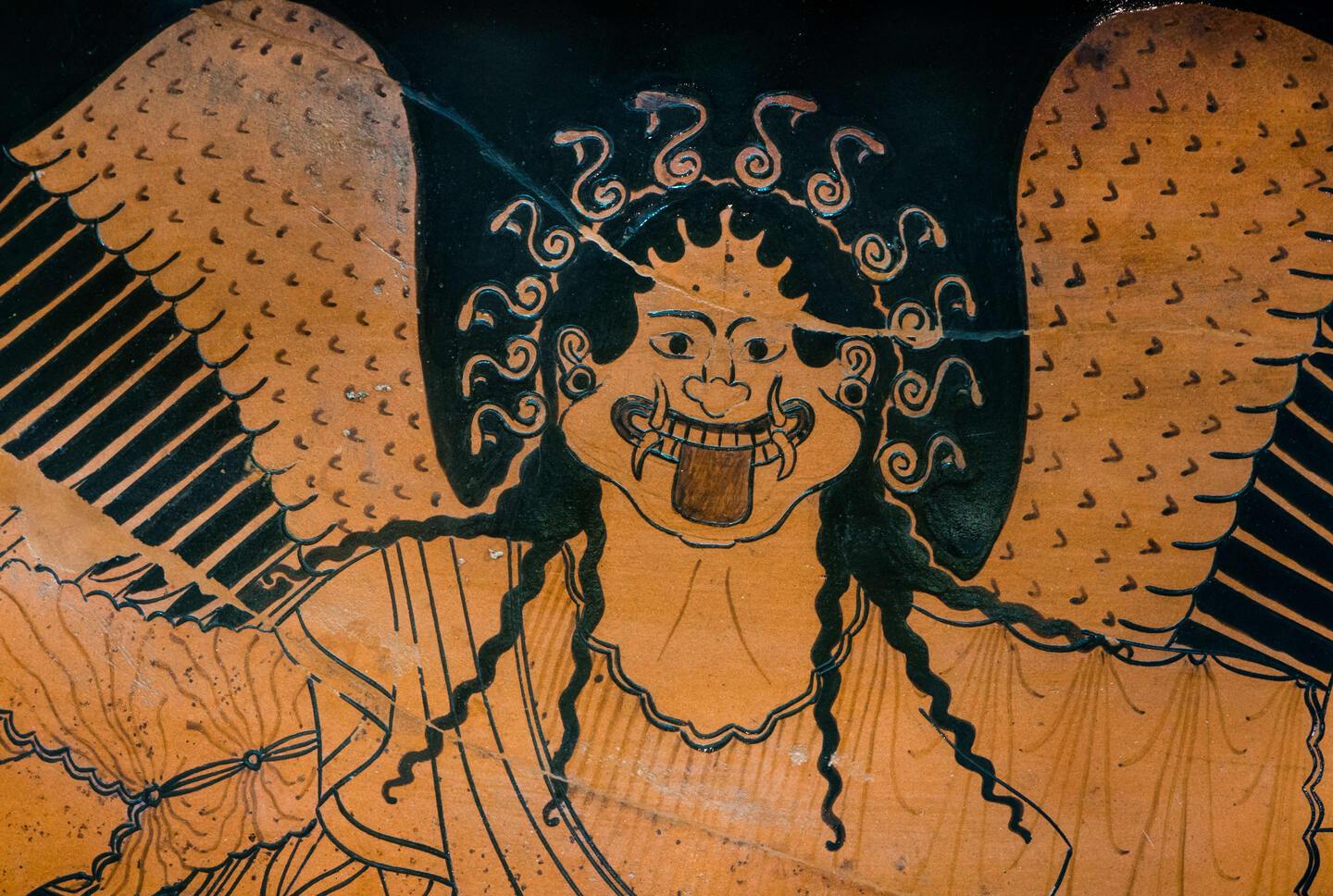
The image of Medusa the Gorgon is one of the most recognizable figures in ancient Greek mythology, and it simultaneously holds a special interest for me from a visual perspective. Unlike many mythological characters, Medusa in ancient Greek art existed not only as a participant in specific mythological narratives but also as an independent visual symbol. However, it is important to note that the figure itself, as depicted in ancient Greek works, is quite distant from our modern associations. We are accustomed to the image of an attractive, albeit dangerous woman with serpentine hair and a petrifying gaze. The ancient Greek Medusa, however, appears different; in her depiction, one doesn’t immediately perceive a woman. The emphasis is placed on her monstrosity: a snarling mouth, a protruding tongue, enlarged eyes, and a wrinkled nose. Her facial features might even evoke not human, but rather leonine characteristics. Despite this, even with her overtly monstrous features, the image of Medusa the Gorgon—specifically, her terrifying face, the gorgoneion—was placed on architectural elements, weapons, household items, and other objects, serving as a talisman against evil, the evil eye, and enemies.
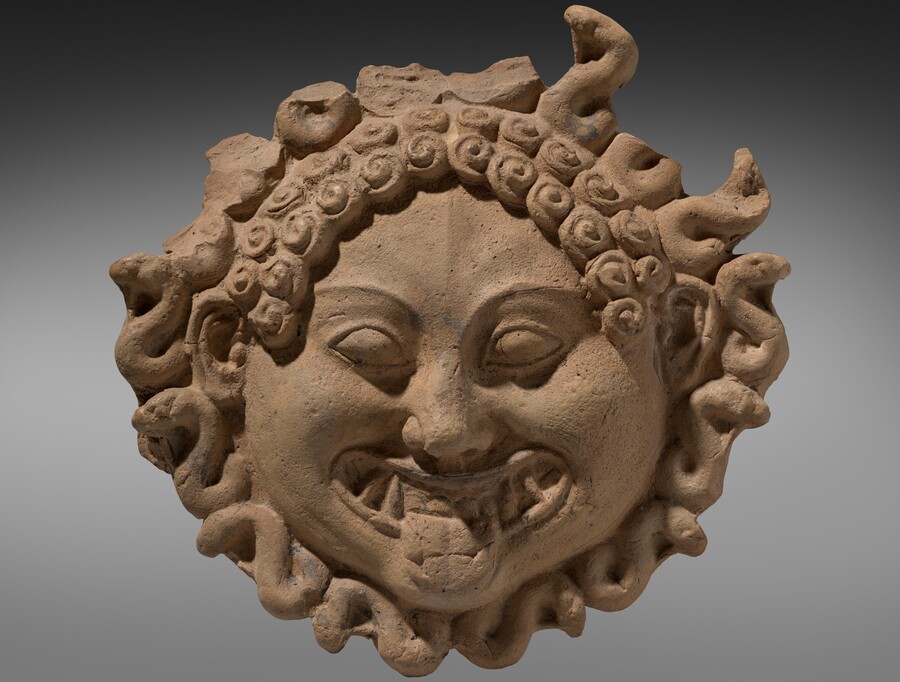
Terracotta round gorgoneion-antefix, 5th century BCE
Isn’t this evidence that the image of Medusa Gorgon was complex—combining both danger and protection?
The choice of topic stems from my interest in tracing how the visual representation of a single mythological character evolved within ancient Greek artistic culture. I am particularly interested in the transition from the early, grotesque, and terrifying depiction of the Gorgon to a more anthropomorphic and aesthetically organized female figure. This study does not aim to treat Medusa as solely a literary character or to analyze her subsequent interpretations. The primary focus is on the artistic image itself—its formal characteristics, functions, and modes of interaction with the viewer. The structure of the visual research will be built simultaneously on chronological and thematic principles. The chronological principle will demonstrate the transformation of Medusa’s image within ancient Greek art, while the thematic principle will examine the various functions and visual characteristics of this image. Visual materials will be selected based on the diversity of the image carriers. I will include architectural plastic arts, vase painting, sculpture, and depictions on shields and ancient Greek weaponry. This will allow an examination of how the function of an image depends on the object and environment in which it exists. For example, Medusa depicted on temple architecture, on a vessel surface, or on protective weaponry is perceived differently, yet in all instances, it can retain a connection to the function of terror and defense. My goal has been to investigate the complexity of creature imagery and to study the reasons why the Gorgon Medusa could function as both a threat and a defense. Furthermore, it is necessary to determine how the creature’s image visually changed in ancient Greek art.
My hypothesis regarding the visual transformation of the Gorgon image posits that, over time, the image of Medusa in ancient Greek art became more humanized, driven by artists' shifting priorities toward depicting human anatomy.
I. THE ORIGIN OF THE MYTH AND THE APPEARANCE OF THE MEDUSA IN ART
To begin, it is worth recalling the origins. One of the early written sources where the Gorgons appear is Homer’s epics. Already in the poet’s epic world, the image of Medusa exists as something terrifying. However, at this stage, there is no detailed history of a specific Medusa. The Gorgon is perceived primarily as a monstrous creature whose image is linked to fear and threat.
In the thoughts of what the monster desires, the head of the terrifying Gorgon,
To send from the darkness Aidoneus against me Persephone.
A more elaborate description of the origins of the Gorgons appears in Hesiod. In his Theogony, the Gorgons are presented as three sisters—Stheno, Euryale, and Medusa—daughters of the sea gods Phorcys and Ceto. They dwell on the far western edge of the world, beyond the space familiar to humans. Among the three sisters, Medusa holds a special position: unlike the others, she is mortal.It is Medusa’s mortality that becomes the most crucial element of this mythological narrative. The hero Perseus is able to defeat the monster by beheading it. After Medusa’s death, Chrysaor and the winged horse Pegasus emerge from her body. Thus, in early Greek mythological tradition, Medusa is connected simultaneously with several significant themes: monstrousness, danger, and death.
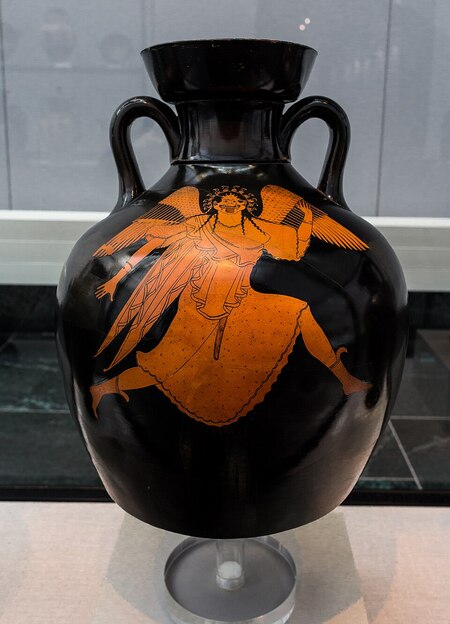
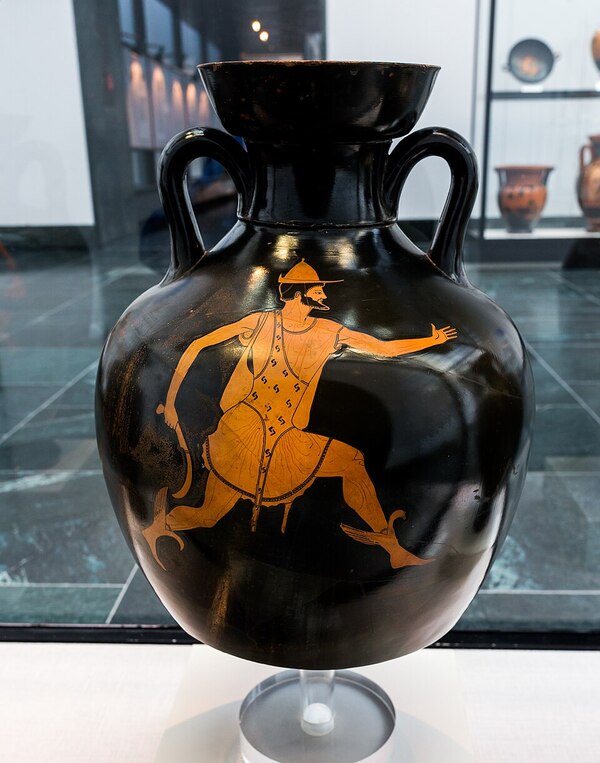
Amphora depicting Medusa pursuing Perseus, 500–490 BCE.
Hydria depicting Perseus after decapitating Medusa, circa 460 BCE.
Given Medusa’s role in mythology, ancient Greek artists deliberately created a face for her that starkly deviated from typical human appearance. The focus was on the creature’s monstrous nature: wide-open eyes, an agape mouth, prominent fangs, and distorted, lion-like facial features. The frontal depiction of the Gorgon’s head is especially significant in her portrayal. Most figures in ancient Greek art, particularly during the Archaic period, were usually rendered in profile or in a three-quarter view. The Gorgon’s face, turned directly toward the viewer, was intended to create the impression that she was making direct eye contact with the observer.
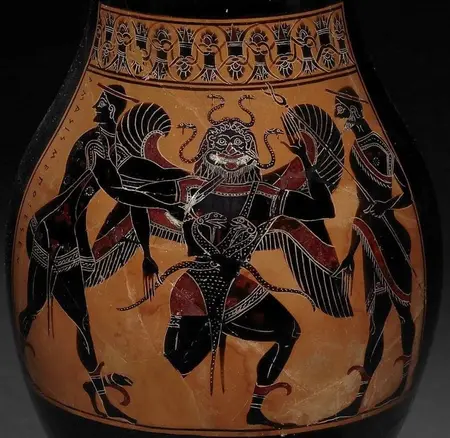
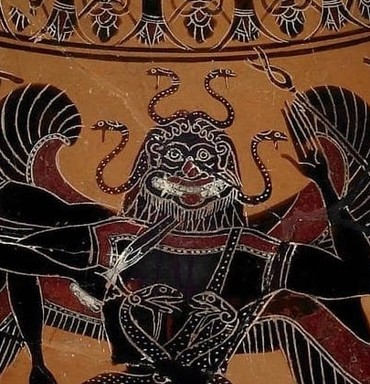
Olpa depicting Perseus slaying Medusa, 550–530 BCE.
Another distinguishing feature of the early Medusa imagery in art is her posture. In narrative scenes, the Gorgon is often depicted running. Archaic art is characterized by a specific stance, where the legs are shown bent and widely spaced. This schema creates a sense of swift motion and emphasizes the creature’s active, dangerous nature.
Initially, artists emphasized the danger and grotesque nature of the image, both in appearance and in posture.
Medusa Gorgon in the Temple of Artemis on Corfu Island, 6th century BCE.
In some early depictions, Medusa Gorgon might also have sported a beard, further distancing her image from the conventional portrayal of a female character.
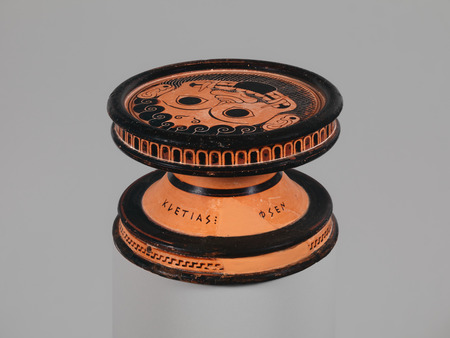
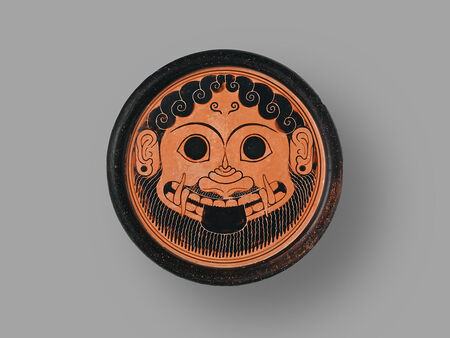
Terracotta base with Gorgonion, approximately 570 BCE.
II. THE GORGONION AS A SYMBOL OF PROTECTION AGAINST EVIL
Terracotta painted gorgoneion-antefix, dating to approximately 540 BCE.
It is worth recalling that one of the most significant forms of the Gorgon Medusa’s representation in ancient Greek art was the gorgoneion—an image of her face directed toward the observer. Unlike narrative scenes that depict Perseus’s feat and the slaying of Medusa, the gorgoneion exists independently, outside of any specific narrative. It was in this form that the image of the Gorgon achieved widespread popularity.
Typically, Gorgoneion representations featured a symmetrical image with large, fierce eyes, a broad, flattened nose with flared nostrils. The Gorgon’s mouth was usually fixed in a horrifying snarl, revealing fangs. Instead of hair, the face was framed by writhing snakes. The «magical» tracking effect was achieved because the Gorgon’s pupils were positioned exactly in the center of the eyeballs, creating the impression of a «watching gaze.»
Kylix with a gorgoneion on the base, dating to approximately 530 BCE.
Regarding the history of the symbol, the exact origin of the gorgoneion iconography remains unclear. There are theories that the original type—a face distorted in a grimace with a protruding tongue and boar tusks—appeared in Phoenician art even before the Greeks, who later creatively reinterpreted it. Researchers are also investigating roots in Ancient Egypt or Minoan culture. The oldest gorgoneia in ancient Greek art date back to approximately 700 BCE and were discovered during excavations in Tyrinth.
In Ancient Greece, the Gorgoneion became extremely popular, as evidenced by the large number of surviving archaeological artifacts.
What is the connection between the fame of the Gorgoneion symbol and Medusa? The most apparent interpretation of the Gorgoneion links it precisely to this protective function, as it was considered one of the most famous forms of apotropaic imagery (from Ancient Greek ἀποτρόπαιον—"an image warding off evil»). As ironic as it may sound, the monstrous image was used to counter another danger. Therefore, the Gorgoneion can be viewed as a peculiar visual paradox of ancient Greek culture—the image of evil becoming a means of defense against evil.
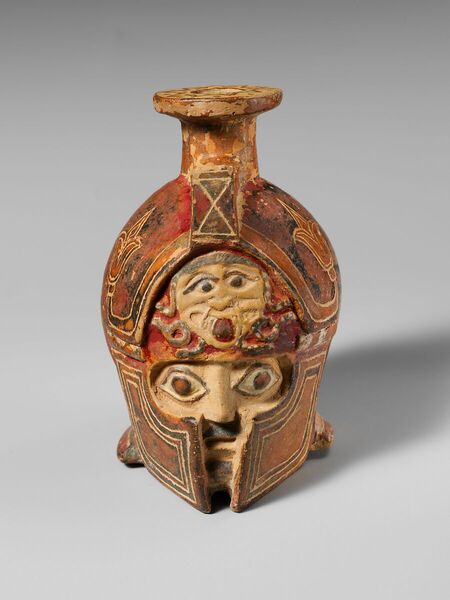
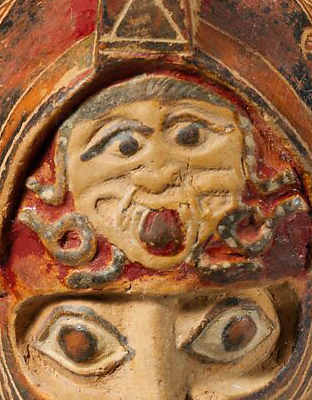
Gorgoneion on a terracotta aryballos in the shape of a helmeted head, circa 600–575 BCE.