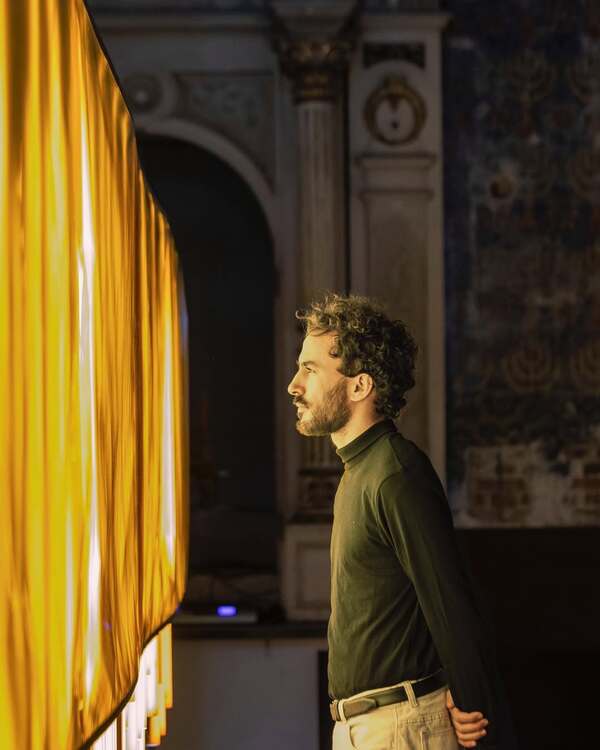
Concept
Contemporary art increasingly turns to the exploration of processes that cannot be perceived directly by human senses. Technological advancements have led to a state where humans exist within a space filled with invisible signals, electromagnetic fields, vibrations, and data streams. These processes remain hidden from everyday perception, yet they are precisely what shape the modern environment and influence human interaction with space. Consequently, artistic practices capable of making the invisible tangible become especially significant.
One artist working in this field is Marc Villanova— a Spanish media artist and sound artist who explores the hidden acoustic and technological processes of the environment.

Marc Vilanova
His artistic practice sits at the intersection of art, science, and technology; however, the core focus of his work is not technical experimentation but the exploration of human perception. Villanova views sound not merely as a musical form, but as a physical environment that impacts the body and space.
The artist himself notes that his interest in sound originated during his time learning to play the saxophone. However, his attention gradually shifted away from the musical performance itself toward how the audience perceives the sound and how it can be made visually and physically tangible. In one interview, Villanova says:
«I wasn’t just interested in the sound of the instrument; I was interested in how to make that sound more perceptible, more tangible, and more accessible through visual means.»
This idea subsequently becomes the foundation of his artistic method.
Vilanova works with infrasound, ultrasonic vibrations, radio frequencies, and electromagnetic fields, translating them into acoustically and physically perceptible forms. The artist emphasizes that technology allows humans to interact with processes that cannot be sensed directly: «Technology allows us to access realities that we are incapable of perceiving firsthand. This implies a more humble stance and an acknowledgement that humanity is not the measure of everything.»
The hypothesis of the visual study is that Mark Vilanov’s sound installations make audible and tangible the hidden processes of the environment—electromagnetic fields, infrasound, ultrasonic vibrations, and technological signals—transforming invisible physical phenomena into an acoustic and bodily experience. The artist investigates the boundaries of human perception, demonstrating that sound exists not only as an audible musical form but also as a material medium that affects space, technology, and the viewer’s body.
The goal of the visual research is to analyze how Marc Villanova uses sound, vibration, and technological systems to reveal invisible environmental processes and expand conventional spatial perception. The study aims to identify the ways in which the artist translates signals inaccessible to human hearing into physically and acoustically perceptible experiences.
«Improvisation allowed me to explore the instrument beyond fixed structures and continue investigating how sonic and visual languages can evolve together.» — Mark Vilanova
1. Autonomous Sound and the Vanishing Performer
Aresta Installation (2018) is a system of autonomous saxophones governed by an AI system. In this work, Mark Vilanova explores one of the key questions of contemporary sound art—can sound exist independently of human presence? Traditionally, musical performance is tied to the musician’s body, their breath, gesture, and physical interaction with the instrument. However, in Aresta, the artist removes the performer as the central figure in the sonic process.
The instruments continue to produce sound, but the source of human control has been replaced by an algorithm. Because of this, the installation creates a sense of an autonomous acoustic environment in which sound exists as an independent system. The work is particularly important for exploring the relationship between humans and technology, as Villanova demonstrates that modern algorithmic systems are capable not only of reproducing sound but also of forming their own acoustic logic.
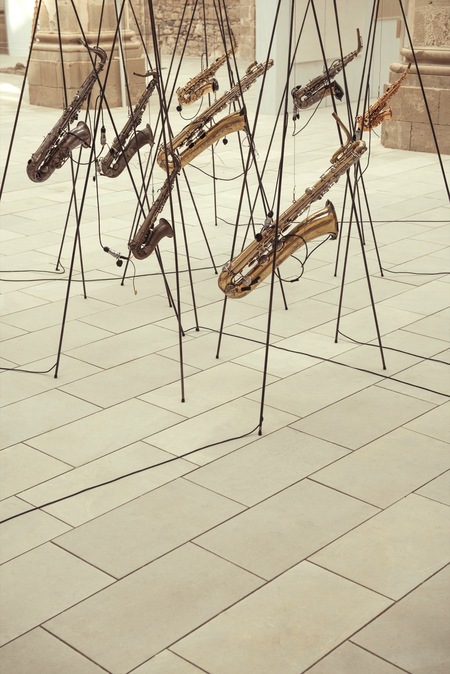
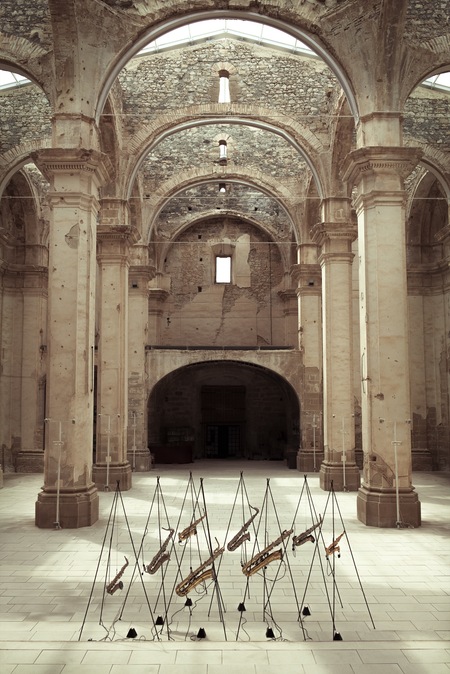
Mark Vilanov — Aresta, 2018, photo credit: author’s social media
Mark Vilanova — Aresta, 2018, photo by Anna Bennett
2. Sound of Invisible Frequencies
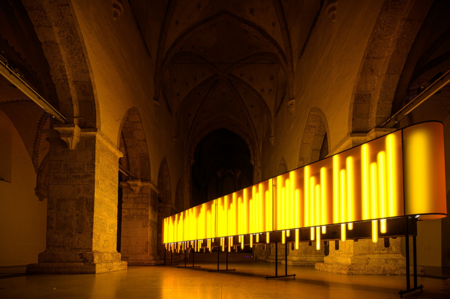
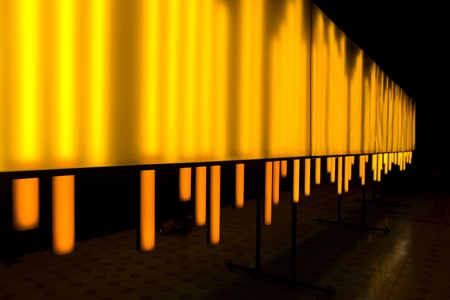
Mark Vilanova — Limen, 2019, photo by Tatyana Takacheva
Limen Installation (2019) is a key work by Mark Vilanov, most accurately reflecting his interest in the hidden processes of the environment. In this piece, the artist translates the ultrasonic vibrations of fluorescent lamps into an audible range. The space, which is usually perceived as visually neutral, unexpectedly reveals itself as a rich acoustic environment.
Mark Villanova — Limen, 2019, photo taken from the author’s social media
The piece is based solely on inaudible vibrations emanating from the lighting fixtures. These acoustic signals serve as the starting point for a light symphony composed of 128 fluorescent lamps. Their flickering is projected as an ultrasonic wave. The work is enveloped in a yellow filter—a color known to enhance concentration and perception by stimulating the other senses in addition to hearing.
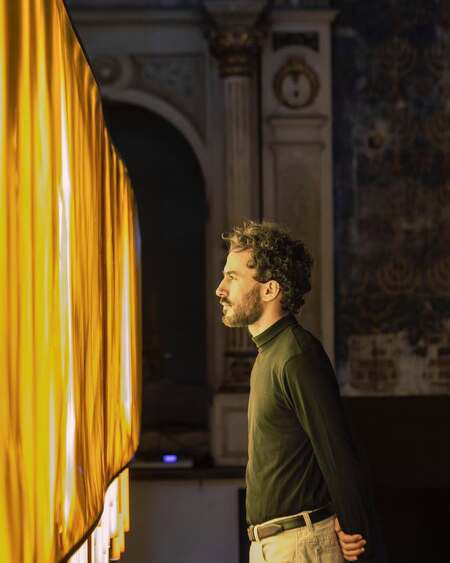
Installations are especially important for exploring the boundaries of human perception. The artist demonstrates that the surrounding environment is filled with processes that exist independently of humanity’s ability to hear them. In Limen, space becomes a system of hidden frequencies and vibrations that typically go unnoticed.
3. Electromagnetic Noise of the Modern Environment
Installation Spike (2019) by Mark Vilanov explores the electromagnetic fields constantly generated by technological devices in contemporary everyday life. In this work, the artist makes audible processes that usually remain outside human perception: the signals from household appliances, electrical systems, and digital infrastructure. Consequently, the space is perceived not as a neutral environment, but as a system saturated with invisible flows of information and energy.
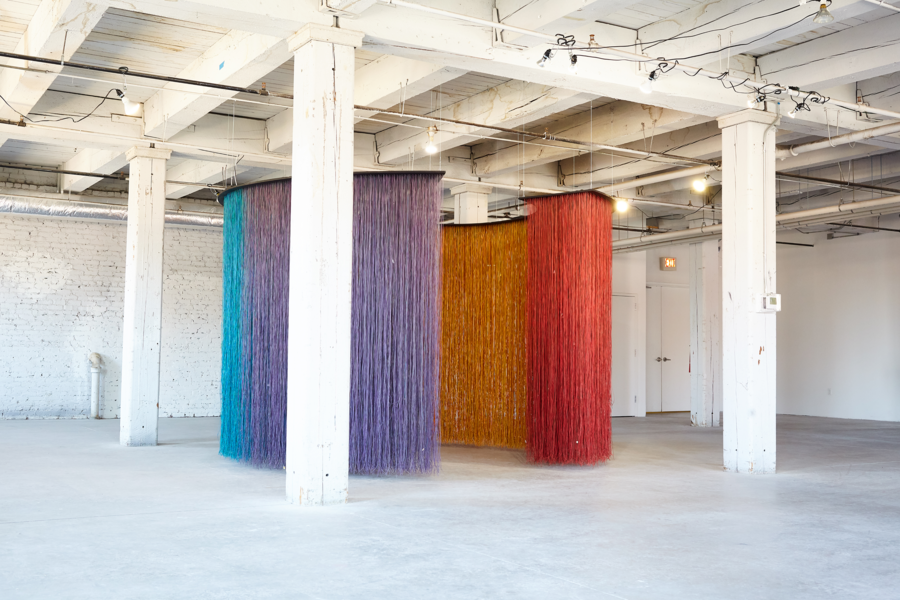
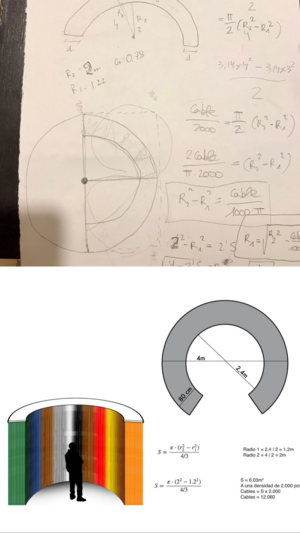
Mark Vila Nova — Spike, 2019, photos taken from the author’s social media
Suspended from a wooden structure are 14,200 ribbon cables previously used in vintage computers. Over 300 of these cables feature a small LED at the end that synchronizes with the accompanying sound. The sculpture visualizes the invisible electromagnetic fields that surround us, creating a kind of protective effect when you are inside.