Navigator
- Navigation
- Concept
- The Interior as a Bourgeois Stage
- The House as a Trap (Doors, Windows, Staircases)
- Water Inside the House: The Interior as a Flooded Space
- The Dragon and «Bourgeois Hell»: The Monster Within the Room
- The Bedroom as a Site of Wounding: Oedipus and the Bird-Headed Figure
- Gaze, Testimony, a Picture Within a Picture
- Conclusion
- References
- Bibliography
- Image Sources
Concept
This visual study examines how, in Ernst’s collage novel, the domestic space loses its familiar function of protection and instead becomes a space of anxiety, invasion, oppression, and catastrophe.
The focus of the research is not the entire «Weeks of Kindness» collection, but specifically the works set in rooms, bedrooms, living rooms, offices, stairwells, by doorways, windows, and beds.
How does Max Ernst transform interior space—a realm of private life, order, and bourgeois comfort—into a site of fear and violence?
«The Week of Kindness» was published in 1934 as a five-volume collage novel, featuring 182 printed collage images. The Musée d’Orsay clarifies that Ernst created 184 original collages in the summer of 1933, but the published version contained 182 images. The source material consisted of engravings from popular illustrated novels, natural science journals, and nineteenth-century trade catalogs. This initial duality is fundamental: Ernst takes the visual language of old bourgeois culture—meticulous engravings, interior scenes, historical costumes, «decent» rooms—and dismantles it from within.
During the «Week of Kindness,» the interior ceases to be mere backdrop and becomes the primary mechanism of anxiety. Violence does not occur in spite of the domestic space, but because of it: the walls, furniture, drapes, windows, doors, and beds organize the scene so that the home transforms into a trap, a theater of power, and a venue for the intrusion of the unconscious.
Therefore, it is important to consider not only the characters and monsters but also the structure of the rooms: where the door is, where the gaze is directed, what obstructs the exit, how furniture fixes the body, and how a curtain or painting on the wall intensifies the sense of a performance.
Musée d’Orsay indicates that each section is associated with a day of the week, an «element, ” and a recurring symbolic motif: mud, water, fire, blood, darkness, sight, and the unknown. These elements can be read as different forms of domestic disruption: power enters the interior through the figure of the lion, water floods the rooms, fire and dragons transform the bourgeois environment into hell, the bird-headed Oedipus makes the room a site of wounding, and the final bedrooms become a space of trance and escape.
Interior Design as Bourgeois Decoration of Violence
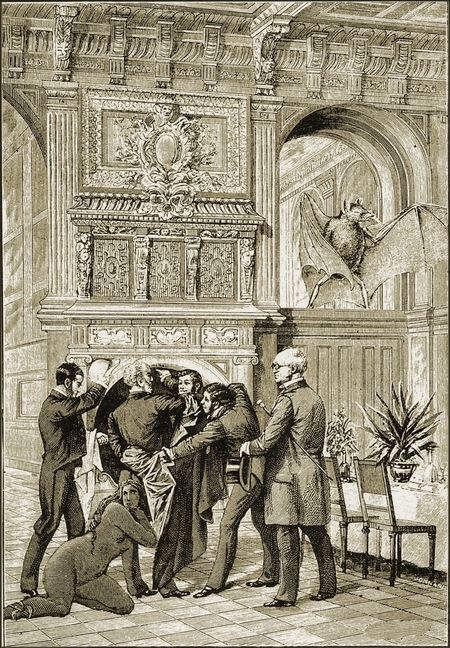
The first level of unease in «The Week of Kindness» stems from the fact that scenes of violence unfold not in the desert, on a battlefield, or in a fantastical hell, but within recognizable bourgeois interiors. Ernst constantly employs rooms, living rooms, bedrooms, offices, salons, and stairwells. These spaces are saturated with markers of social order: furniture is placed correctly, walls are decorated, characters are often dressed in historical or formal attire, and the compositions resemble illustrations from 19th-century novels.
Yet, it is precisely this «respectable» facade that makes the violence so unsettling.
If monsters were operating within a fantasy world, the audience might perceive the events as a fairy tale or a myth. But for Ernst, violence is built into the fabric of the norm. The room appears cultural, lived-in, even respectable, yet inside it unfolds scenes of subjugation, assault, persecution, injury, or death.
Therefore, the interior functions here as a stage for revelation. It reveals not coziness, but the falseness of comfort.
Ernst’s interior is not a cozy home, but a bourgeois set dressing behind which violence is revealed.
Home as a Trap: Doors, Windows, Stairs
It is important to consider not just the «house, ” but its architectural elements: doors, windows, stairs, and passages. In conventional interior logic, these elements govern movement and freedom. A door allows exit, a window connects the house to the outside world, and a staircase leads from one space to another. However, in the „Kindness Week, ” these elements often cease to function as an escape. They become part of the trap.
Ernst’s door often doesn’t offer salvation; rather, it signifies a point of invasion. When a threat appears in the room, the viewer typically seeks an exit. However, the doorway is often already occupied by a figure, a monster, a witness, or the scene of violence itself. The door ceases to be a promise of rescue. It becomes a frame through which danger enters the home.
The window also changes its function. Instead of providing air and light, it often transforms the interior into a space of observation. The window creates a sense that internal life is no longer protected. The house becomes transparent, vulnerable, and exposed to view.
Water Inside the Home: The Interior as a Flooded Space
The motif of water is particularly significant because water literally dissolves the boundary between the interior and the exterior. In the section dealing with water, Ernst illustrates how the element permeates spaces where it shouldn’t belong—rooms, bedrooms, and living areas.
The flooded interior is an image of a home that has lost its foundation.
In such an interior, the human being can no longer rely on the space. The home ceases to be a structure of protection and transforms into a space of drifting, drowning, and loss of control.
Water also changes the meaning of intimacy. The bedroom is usually associated with sleep, physicality, rest, and private life. But when the bedroom is filled with water, the intimate space becomes a place of catastrophe. The person is vulnerable not outside, but in the most private room of the house itself.