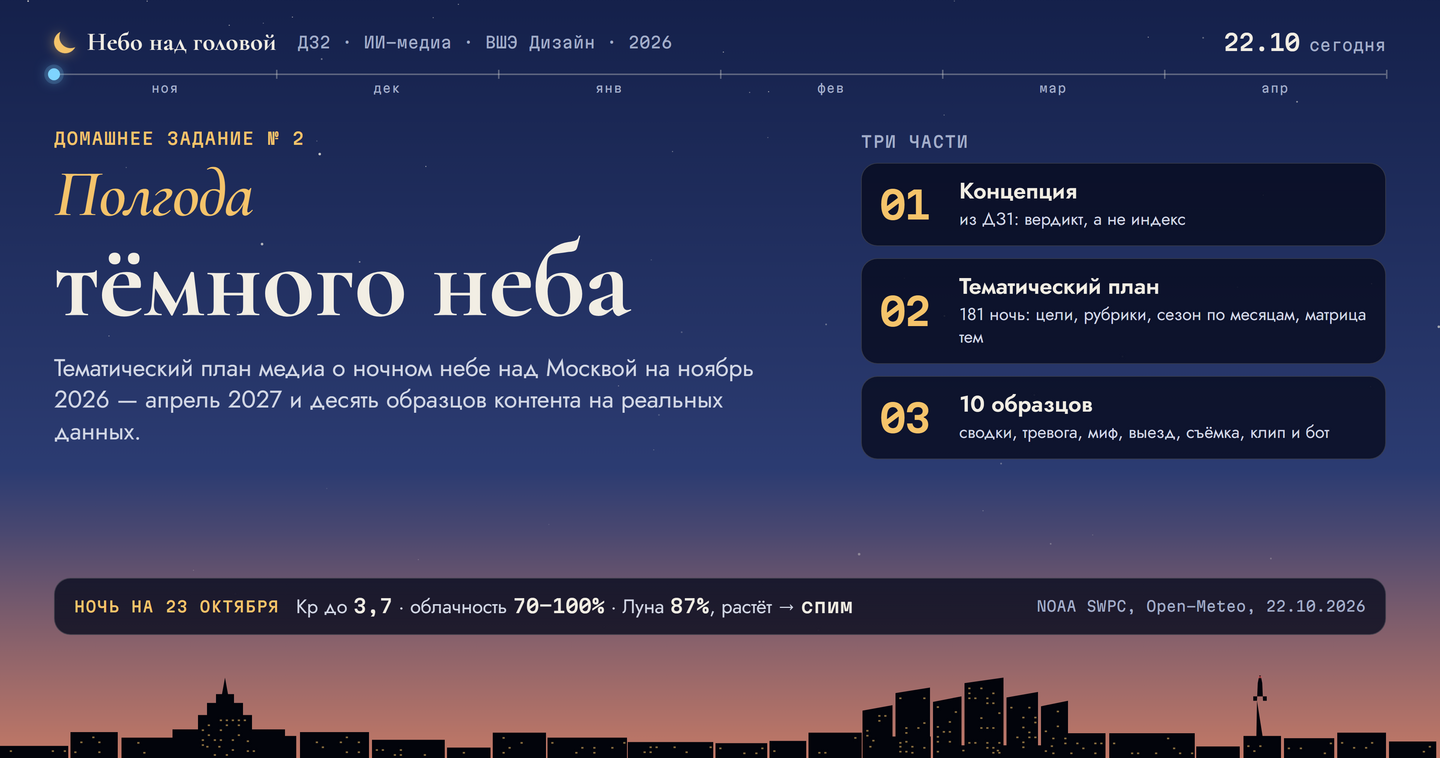
This is the second homework assignment for the media piece, «Sky Above”—an AI-driven media project focused on the night sky over Moscow. Every day at 5:00 PM, it answers a single question: should we look up tonight? The presentation is divided into three parts: the concept from the first assignment, a thematic plan for the season of dark nights—spanning from November 2026 to April 2027—and ten content examples. The sample pieces are based on real data, including reports from October 22nd and 24th, and an alert from the stormy night of October 10, 2026.
1. Media Concept
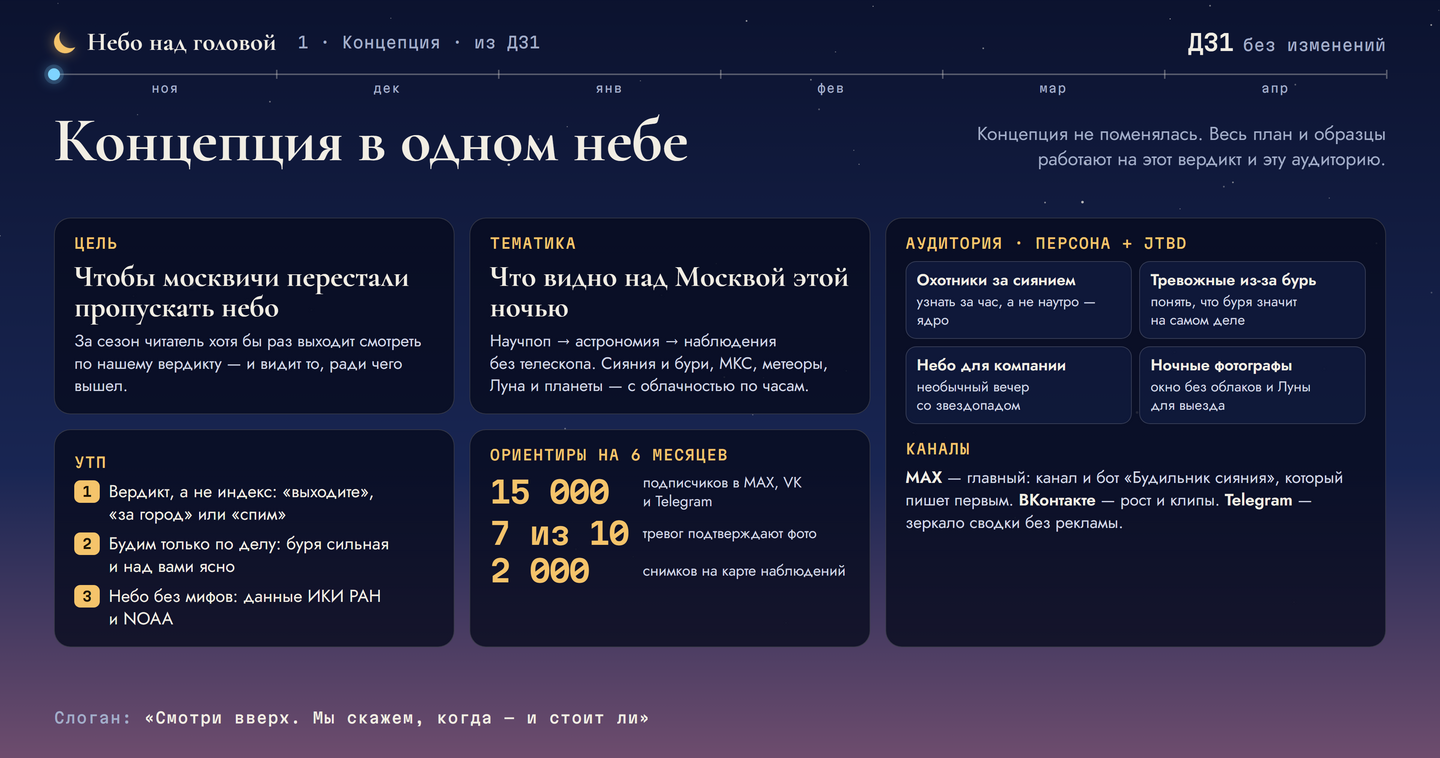
The concept remains unchanged from the first assignment. The goal is to make Muscovites stop ignoring the sky: during the season, the reader should at least check our verdict once and see what prompted them to look up. The theme is what is visible over Moscow tonight—auroras and geomagnetic storms, the ISS, meteors, the Moon, and planets, along with hourly cloud cover.
The audience consists of four segments: radiance hunters (the core), storm-anxious individuals, community stargazers, and astrophotographers. The main channel is MAX with the «Radiance Alarm» bot; VKontakte is for growth and clips; Telegram serves as a news feed mirror. Our unique selling proposition (USP) is delivering verdicts, not just indices; we only post what matters; a sky free of myths.
2. Six-Month Thematic Plan
The plan is built in steps based on a lecture about content marketing: first, goals and metrics; second, topics and schedule. Seasonal goals include achieving 15,000 total subscribers across MAX, VKontakte, and Telegram, having 7 out of 10 glow alerts confirmed by reader photos, and collecting 2,000 images for the observation map. Each goal has a monthly checkpoint—for instance, 2,500 subscribers by November and 10,000 by February.
Funnel: VK Clips and urban media placements introduce people to the media; the daily digest provides value, while photos and «saw / didn’t see» check-ins drive engagement, and the bot brings readers back. Monetization starts in December: affiliate tours for glow (Tripster pays 10% of the tour price, Sputnik8 pays up to 10%).
Media Rhythm — the week’s almanac. Every day at 5:00 PM, there is «Today in the Sky, ” and based on events, „Alert: Radiance.“ Once a week: Monday is „Sky Week, ” Wednesday is „Myth of the Week, ” Friday is „Dark Sky, ” Saturday is „How to Capture, ” and Sunday is „Reader Photos, ” plus two VKontakte clips. The „Radiance Alarm“ bot operates 24/7. Over the season, there will be 181 daily summaries, 130 weekly posts, and 52 clips, in addition to broadcasts during nine event nights. There are zero posts stating that „a storm will affect your health.“
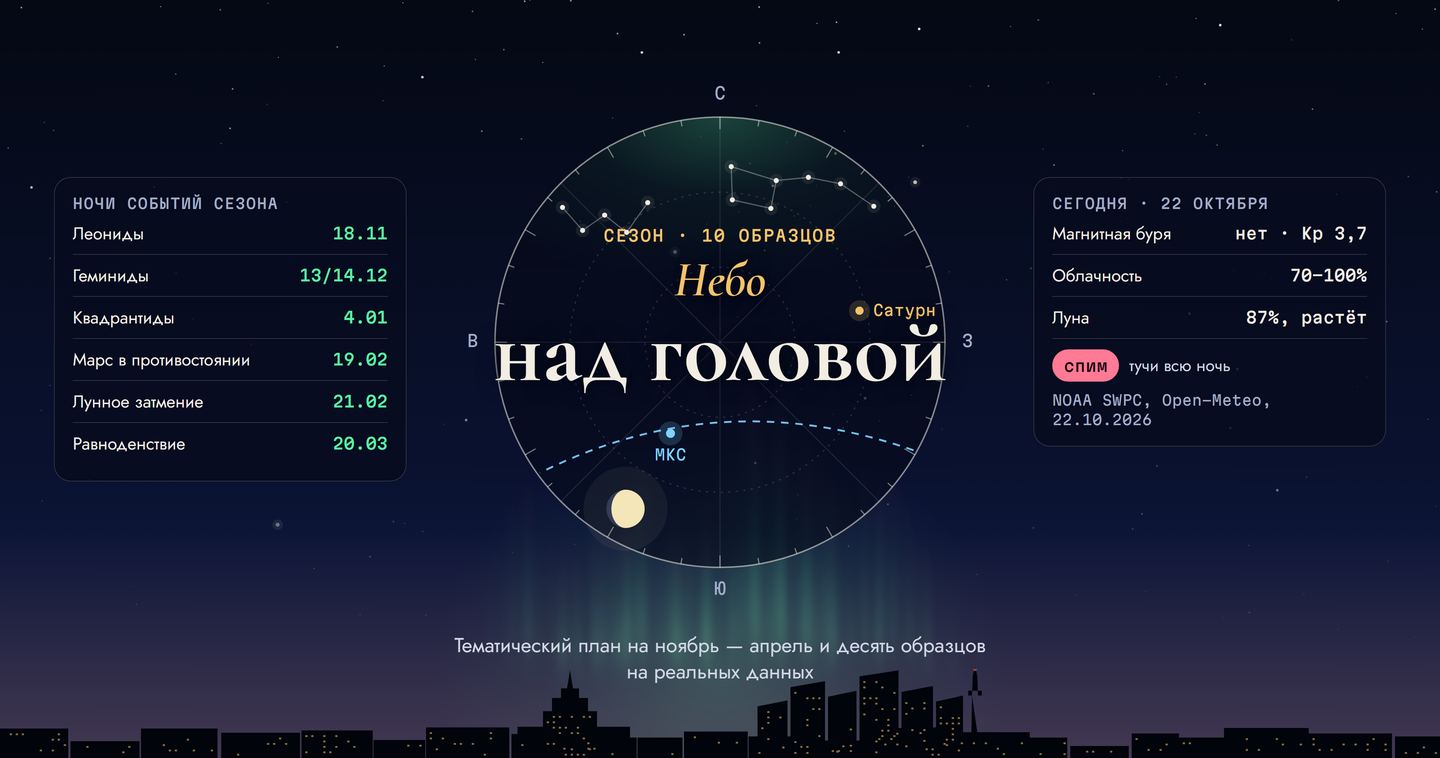
Each month has its own theme and its own nights of events. November is «Catching Windows in the Clouds”—typically there are only three clear days, but on November 18th at 2:45 AM, it’s Leonid Peak. December is „The Longest Nights”—the Geminids on the night of December 14th (up to 150 meteors per hour, Moon 15%), the winter solstice on December 21st, and the year’s largest full moon on December 24th. January is „Holidays Under the Stars”—the Quadrantids on January 4th and Comet Encke at the end of the month.
February — «Month of Planets»: oppositions of Jupiter on February 11 and Mars on February 19, and a half-shadow lunar eclipse on the night of February 21. March — «Season of Auroras»: storms are more frequent around the spring equinox on March 20, and on the new moon of March 8, there is a dark window. April — Cosmonautics Day and season summary. Auroras are not scheduled: the robot captures them every day.
Content matrix, as presented in the lecture: seven columns horizontally and five vertical themes (sunrises and storms, meteors, the Moon and planets, the ISS and space, light pollution and excursions). The intersection represents a potential post title, totaling 35 topics. We check each theme with the question, «Will this help us not miss the sky?» Ten topics that have already become finished examples are highlighted with a gold border.
This is what Week 16–22 November looks like in the «channels × days» grid. A daily summary is posted across all channels; in MAX, there are weekly segments about Leonid, and the bot sends two push notifications during the peak night, but only if the forecast is clear. On VKontakte, there are two clips, a guest post in a city media outlet to introduce the new audience, and a cross-post with a science communication channel. The Leonid peak is on November 18th at 2:45 AM, and that same evening, the Moscow Planetarium will host a lecture titled «Our Amazing Sun.»
The release goes out in an hour. At 4:00 PM, the robot collects the Kp index for three days (NOAA SWPC andIKI RAS), cloud cover by layer (Open-Meteo), Moon data, and ISS data. At 4:20 PM, the AI forecaster determines the hourly verdict, and at 4:40 PM, the AI editor drafts the summary using a template and a stop list. At 5:00 PM, a human verifies the verdict against the sky and publishes it. Every aurora alert is confirmed by a person, and at night, readers send photos and marks indicating «saw / did not see”—this refines the threshold for Moscow. The editor spends about six hours a week on this.
3. Content Samples
Ten examples—posts from the content matrix. Three of these are based on real robot data: summaries from October 22 and 24, 2026, and an alert from the night of the October 10 storm. The others rely on the IMO, NAOJ, and «Astronomical Calendar» schedules. The formats vary: summary card, push notification, list of nights, myth, checklist, bot interface, and a vertical clip complete with script and storyboard. Below each slide is the post text.
Example 1. «Today in the Sky, ” Thursday, October 22, 5:00 PM — real-time data. Magnetic activity: Kp up to 3.7; no storm. Moon is 87%, waxing. Cloud cover is 70–100%, expected to be overcast by 10:00 PM. Verdict: sleep in. There is nothing to watch today: clouds will obscure the sky until morning, and there is no storm. Clouds are also predicted for Friday. Clear skies are forecast for Saturday evening—but the Moon will be nearly full; details will be available tomorrow at 5:00 PM.
Example 2. «Tonight in the Sky, ” Saturday, October 24, 5:00 PM — Robot Forecast. KP up to 3.0, clear from 10:00 PM to 1:00 AM, Moon 98%. The robot suggested the verdict „look at the stars, ” but the editor corrected it to „look at the Moon“: with an almost full moon, only the brightest stars are visible. Post text: the first clear evening of the week, the best time for the Moon is 10:00 PM–12:00 AM; traveling outside the city for the stars is not worth it—wait for the new moon on November 9th. The revision aligns with the verdict rules: we do not promise stars when the Moon is over 80%.
Sample 3. «Week of the Sky,» Monday, November 16th, 10:00 AM. Monday: Before dawn, Mars is 1,2° from Jupiter in the east. Wednesday, November 18th: Peak Leonid shower at 2:45 AM, up to 15 meteors per hour under a dark sky; the Moon will already be setting by the peak. In the evening—a lecture, «Our Amazing Sun,» in the Planetarium. Every morning—Venus, the morning star, is brightest in half a year. November 20–21—Mercury will be low in the southeast before dawn. Cloud cover for each night will be in the 5:00 PM briefing, and if the Leonid night is clear, the bot will wake you up at 2:30 AM.