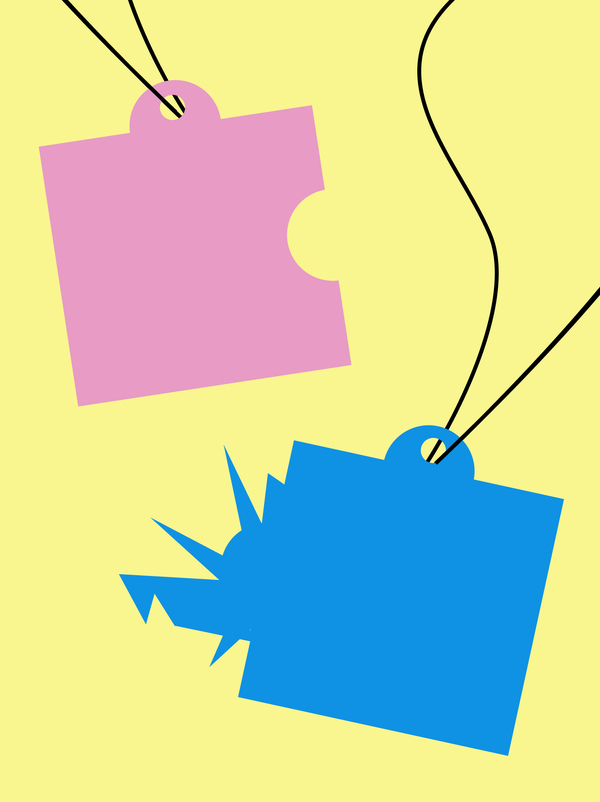
«Doesn’t Quite Fit» — matching pendants for people who understand that closeness doesn’t always mean perfect alignment, and aren’t afraid to say so.
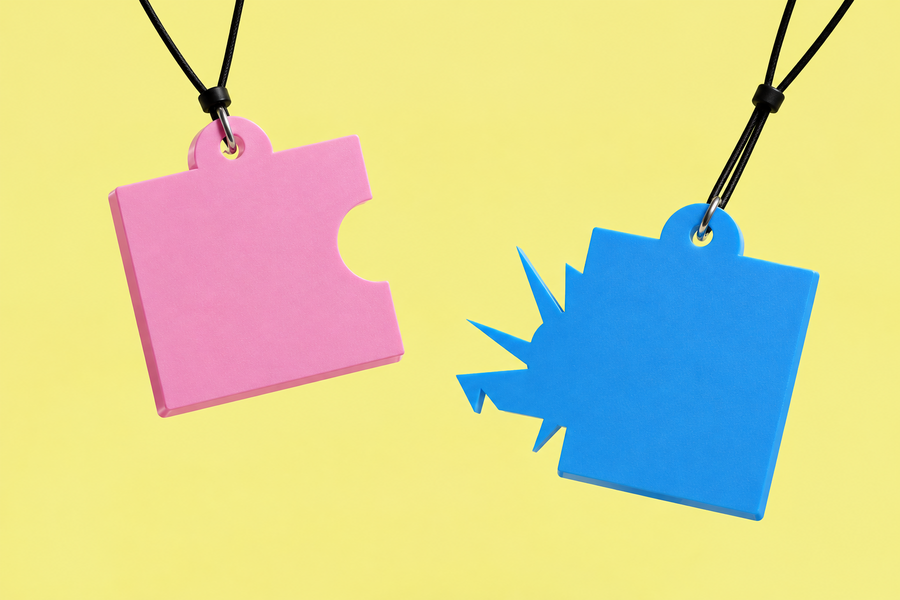
The project was developed as part of the diploma work Off&Set for the HSE factory. It is a set of two puzzle-shaped pendants that do not fit together. The pink piece has a circular cutout, while the yellow piece features a jagged, spiky explosion instead of a protrusion. The pieces pull toward each other, but their edges do not align. The visual language is based on simple geometry, two contrasting colors, and one conflicting element that disrupts the conventional logic of paired jewelry.
The core concept of the project is to reject the ideal image of a perfect pair. Typically, matching jewelry promises «two halves of a whole.» «Doesn’t fit» suggests something different: relationships can be complicated, people can be sharp and uncomfortable with one another, and that doesn’t make the connection any less genuine. The title works on two levels. It’s the colloquial «doesn’t fit» when things aren’t working out, and the literal sense—the pieces don’t glue or snap together.
Form IdeaThe puzzle—a familiar symbol of perfect alignment. In this project, it is deliberately broken. The cutout remains smooth and open, while the tab is transformed into a sharp, serrated contour. When the pendants are brought close to each other, gaps remain between them—and these gaps constitute the piece’s meaning.Usage Scenarios: Gift or Exchange: The pendants are given not as a sign of perfect love, but as an honest marker of connection. They are suitable for friends, partners, parents, and children—any loved ones who experience conflict. Wearing: Each person wears their piece on a cord or chain. It is a symbol of connection across distance, but without the promise that everything will always be smooth. Meeting: The pendants can be brought close, but they do not connect completely. This awkward gesture itself becomes a ritual and a prompt for conversation. Storage: When the pendants are not being worn, they rest side-by-side in packaging, unconnected.
Specifications:
Size of one piece: [~40×40 mm]
Size of the yellow piece with the serrated protrusion: [~55×40 mm]
Thickness: [3 mm]
Diameter of the lace hole: [~4 mm]
Weight of one piece: [~6 g]
Set includes: [2 pendants, 2 lanyards, packaging]Materials:
Body: [3mm thick colored molded acrylic], matte, pink, and yellow.
Lanyard: [waxed cotton cord, 45–50 cm] with fastener.
Hardware: [steel connecting ring].
Packaging: [cardboard box in which the pendants are placed side-by-side but not touching].Manufacturing Method:
The pieces are laser-cut from an acrylic sheet using a vector outline, including the serrated edge. The edges are sanded, and the sharp corners of the teeth are slightly rounded for safety. The lace holes are cut in the same laser pass. The pendants are assembled with lanyards and rings. The finished set is packaged in a box.
Cost per unit at a run of ~50 sets (100 medallions):
Mockup preparation and test cutting: [~3,000 RUB] (one-time cost). Production per set: [~320 RUB/pc] Total unit cost per batch: [~380 RUB]
Breakdown of the cost per set: acrylic ~[40 RUB], laser cutting ~[70 RUB], tooth sanding and rounding ~[40 RUB], two lanyards with hardware ~[110 RUB], packaging ~[60 RUB].