Navigation Menu
- Concept
- Art Nouveau in France
- Modernism in Belgium
- Secession in Austria
- Conclusion
- Sources
Concept
Art Nouveau is a style that emerged at the crossroads of centuries, in an era often termed the fin de siècle («end of the century»). It became an artistic manifesto of transition, embodying mixed feelings in the face of advancing industrialization: helplessness, weariness, and nostalgia for fading traditions.
Despite its relatively brief period of prominence (roughly 1890–1910), Art Nouveau left an enormous mark on art history. It served as the catalyst for the emergence of styles such as Art Deco, with its geometric rigor, and Expressionism, with its nervous energy, largely defining the visual language of the entire 20th century. As Elena Okhotnikova notes, «The art of this period essentially attempts to create an artistic, visual Esperanto so that everyone can understand everyone» [1]—meaning Art Nouveau moved away from elitism to become a universal and comprehensible language of art.
The characteristics of Art Nouveau permeated all spheres of human life: into architecture with its flowing, «organic» facades, into poster graphics that transformed city streets into open galleries, into the design of theatrical programs, and even into jewelry and glassblowing. However, the focus of my visual research is primarily painting and graphics. It was on the flat surface that Art Nouveau artists could most freely experiment with line, color, and the human figure, without being constrained by the rigid rules of academism.
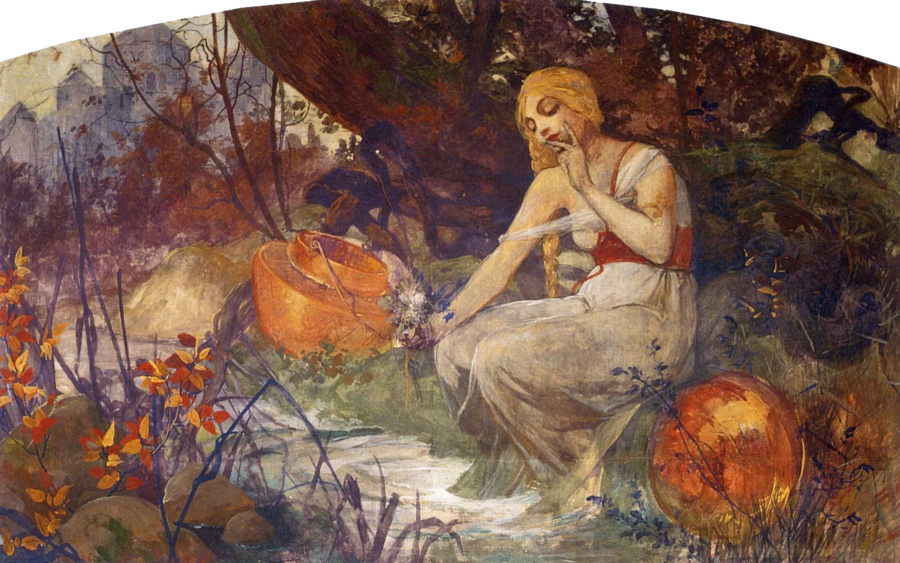
Alphonse Maria Mucha, «The Prophetess,» 1896
Modernism possesses several distinguishing characteristics. Firstly, there is the asymmetrical, flowing line; secondly, modern artists moved away from volume, emphasizing the decorative nature of the style; and thirdly, the artists did not merely copy nature, but transformed its forms into decorative patterns—stylized scrolls and interweavings replaced leaves and flowers, and ornamental lines substituted for natural hair. Moreover, the autonomy of the artwork was important to Modernism, for instance, when a poster becomes a standalone piece of art rather than mere advertisement. Modernism itself also varied depending on the country of its origin.
My visual study is centered on a comparison of Modernism in three countries. For each of these, I selected several key artists. In France, these include Alphonse Mucha, Henri de Toulouse-Lautrec, and Eugène Grasset. In Belgium, they are Pierre Livremont and Gisbert Combaas. In Austria, they are Gustav Klimt, Koloman Moser, and Karl Moll. After analyzing their work, I draw conclusions about the national characteristics of the style and conclude with an overall summary.
Art Nouveau in France
Alphonse Mucha is the most famous artist of French Art Nouveau. His works are easily recognizable: women with voluminous hair that curves and flows into botanical patterns, and delicate pastel tones.
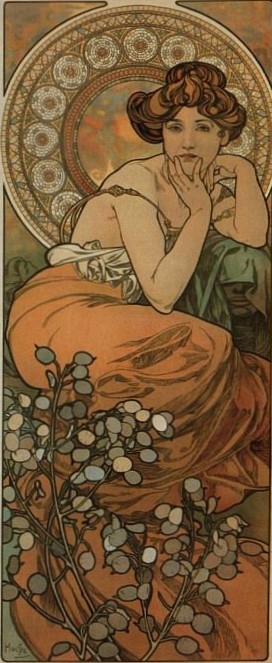
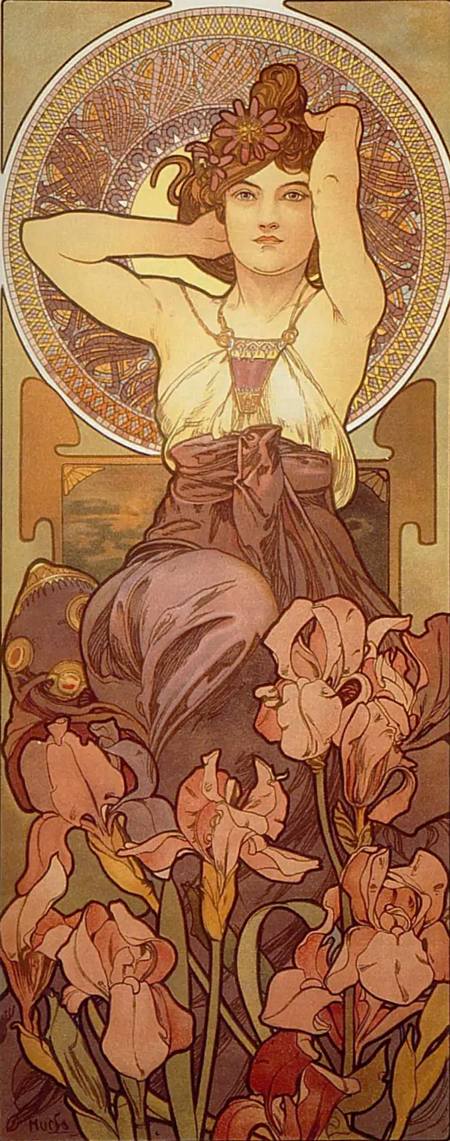
Alphonse Marie Mucha, Precious Stones series «Topaz, ” „Amethyst, ” 1900
In this series, each stone embodies a female figure. For topaz, Mukha chose an orange-yellow palette, and for amethyst, he chose lilac and violet. The women’s hair flows in smooth lines, reminiscent of plant stems. The fluid depiction of the women and the thematic subject matter unite sensuality and luxury throughout this body of work.
Alphonse Mucha, «The Language of Colors, ” 1900
The female profile and flowers are intertwined in a way that makes them difficult to separate. The colors are muted: ochre, dusty rose, pastel green.
Alphonse Marie Mucha, «The Seasons» series: «Spring,» «Summer,» «Autumn,» «Winter,» 1896
Four female figures personify spring, summer, autumn, and winter. Each is rendered in a distinct color: spring is a tender green adorned with blossoms, summer is gold with poppies, autumn is amber with grapes, and winter is a cold, bluish hue with frosted branches. The line throughout is smooth and enveloping around the figure. This work showcases the key characteristics of French Art Nouveau: asymmetry, stylization of nature, flatness, and the transformation of the female body into an ornament.
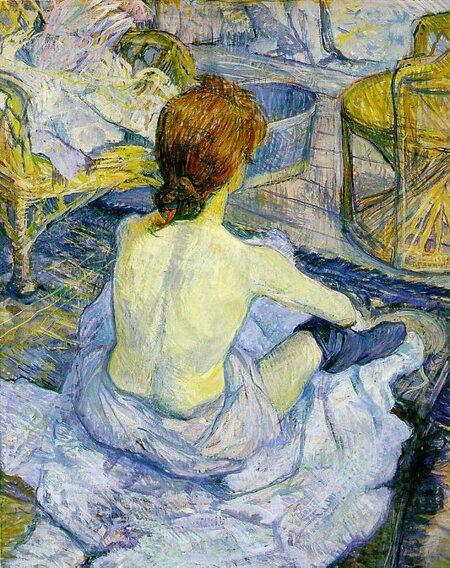
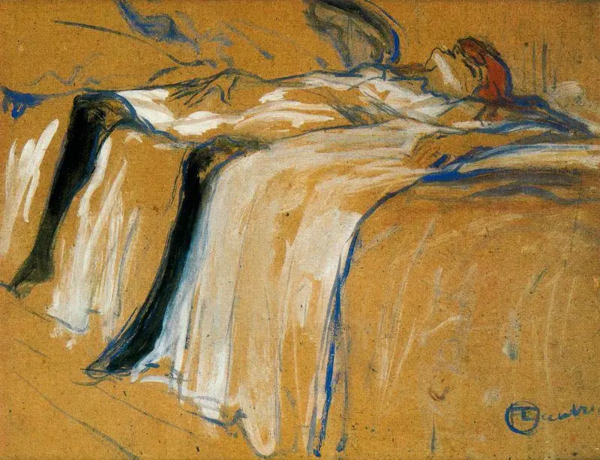
Henri de Toulouse-Lautrec, «The Toilet,» 1889, «Alone,» 1896
Unlike the idealized women of Mucha, Toulouse-Lautrec portrays real, everyday life. Lautrec’s line is sharper, almost caricatured, and the colors are restrained.
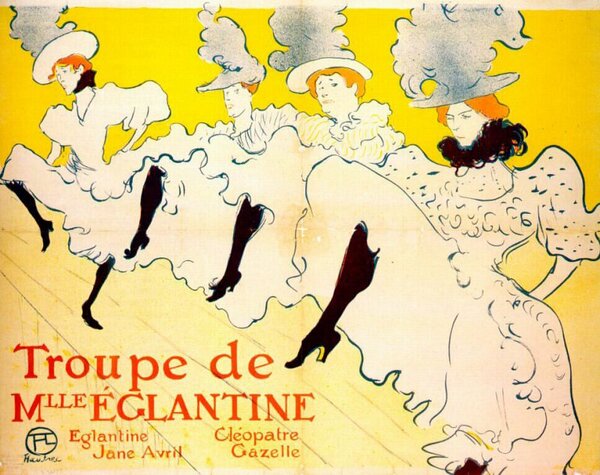
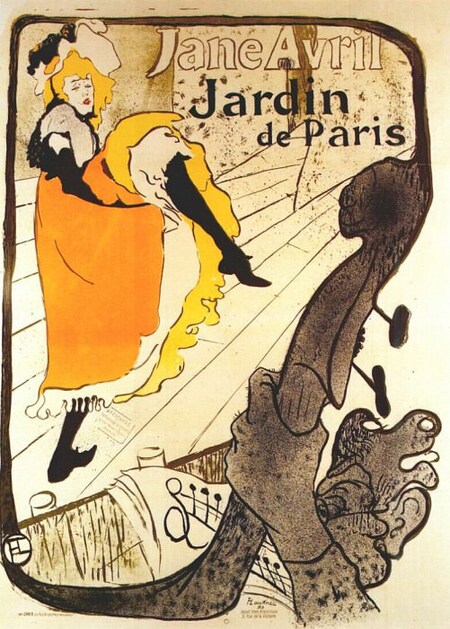
Henri de Toulouse-Lautrec, «La Goulue of Montmartre,» 1896; «Jeanne Avril in the Garden of Paris,» 1893.
Two theatrical scenes transformed into posters. Lotrek employs bold color patches (yellow, red, black), simple outlines, and eschews excessive detail. The figures merge into a single mass.
Eugène Grassé, calendar spreads for «June, ” „August, ” and „October, ” 1896
The line work in Grasse is slightly harder, and the colors are more saturated. In «June, ” there is dense green and blue; in „August, ” golden sunflowers; and in „October, ” purple and ochre. The plants are stylized almost to the point of ornamentation, yet they retain recognizability.
Eugène Grasset, «Fan,» 1900
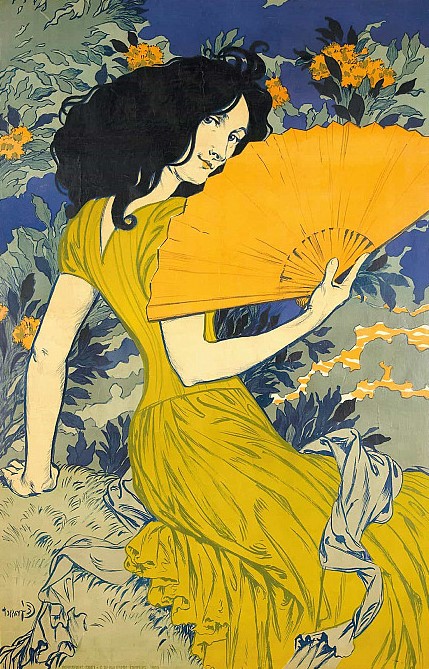
The line here is even more fluid than Muh’s, reminiscent of calligraphy.
French Art Nouveau in painting and graphic arts is characterized above all by fluid lines, pastel palettes, asymmetry, and the fusion of the female figure with floral ornamentation. Artists (Mucha, Toulouse-Lautrec, Grasset) actively worked with posters and calendars, transforming applied objects into fine art. Nevertheless, the style allowed for variations: from Mucha’s nymphs to the sharp, almost caricatured lines of Lautrec. Common features include a rejection of realism, flatness, and the stylization of nature.
Modernism in Belgium
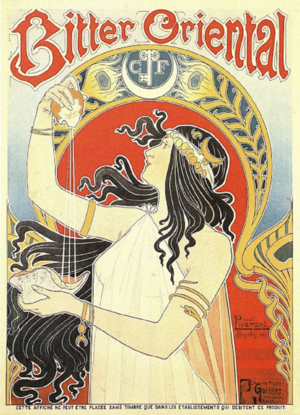
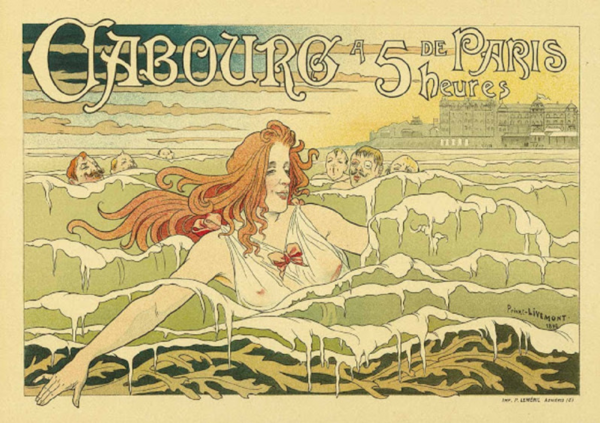
Henri Rivière-Limonta, poster «Bitter Oriental, ” 1897; poster „Cabo near Paris in 5 hours, ” 1896
Prival-Livemon’s line is less fluid and more rational compared to Alphonse Mucha. In «Bitter Oriental, ” the woman is integrated into a precise composition, and the colors are contrasting. In the „Cabur“ poster, the maritime theme is resolved through wavy lines that organize the entire sheet.
Henri Rivière-Lermont, poster «Wave,» 1897
Unlike French Art Nouveau, where nature served as ornamentation, here the wave functions as a structure—it divides the composition into several planes.
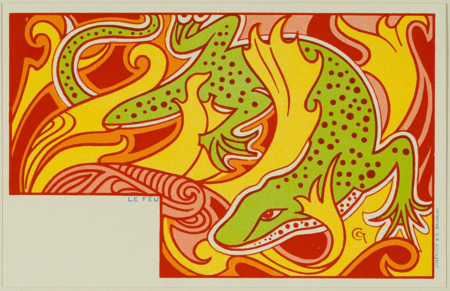
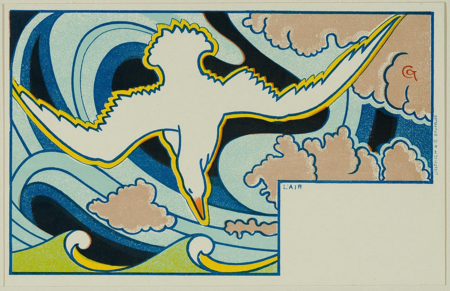
Gisbert Combaz, postcards «Fire, ” „Air, ” 1898