
Media Concept
«On Your Own»— a media guide to independent living for those moving out of their parents' home, relocating to a new city, or living alone after a transition. It compiles in one place the knowledge that isn’t taught in school but that everyone encounters when starting to live independently.
Mission: To provide individuals who are beginning to live independently with clear instructions for single living.Media Goal: To empower people starting to live on their own to confidently manage household tasks and daily decisions independently, without shame over not knowing something or panicking in various situations. The unique value lies in the narrow focus on the individual who is first learning to live alone.
Content Planning System
01. Thematic Tracks: A constant media foundation. It is not bound by dates and does not change from month to month.
· Housing and Utilities
· Daily Life
· Food
· Finances
· Documents and Health
· Safety and Emergencies
· Routine
02. Categories: A list of topics and ideas from which you can choose materials for publication.
For example: how to rent an apartment, how to remove a stain, how to create a budget, what to do in case of a leak.
Content Plan is built on a clear system; each topic has its own structure:
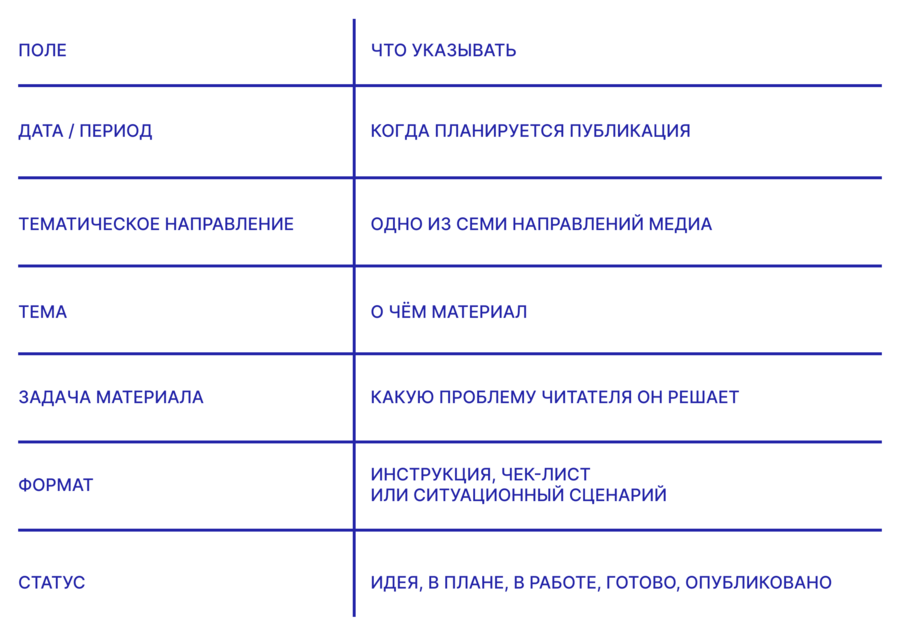
For example:
How to organize content
To keep the plan flexible, you don’t need to pre-schedule every single publication for six months in advance. It’s better to use templates and adjust or shift posts based on audience nuances, trends, requests, and so on.
Throughout the Period — Thematic Balance
Determine which topics should appear regularly in the media so that the content is not limited only to everyday instructions or only to emergency situations.
Monthly — Thematic Focus
Select the themes and issues that deserve more attention this month. If necessary, account for seasonality and current events.
Weekly — Specific Publications
Select topics, assign formats and dates. Materials can be rearranged, new ones added, or moved.
In Progress — Plan Update
Mark statuses, add new ideas, and revisit topics that require continuation or revision.
Format Selection Principle:
Formats must function across all thematic disciplines, rather than being confined to specific categories.
Instructions
A sequence of steps that helps you solve a problem independently.
Example: how to rent an apartment.
Checklist
A brief list of things to check, prepare, or do.
Example: what to check before signing a lease agreement.
Situational Scenario
A specific problem and a clear action plan for it
Example: a pipe bursts at two in the morning.
Six-Month Content Plan
How is a working content plan derived from this?
For example, the second month is dedicated to organizing daily life. Inside this month, publications are already planned:
The monthly focus is meant to organize content, not to strictly limit topics. There is also the flexibility to integrate posts into the content plan based on audience requests—for example, if someone asks for an analysis of a specific scenario, and so on.
10 Content Examples
1. Introduction Post
How to pay for utilities? What to do if a pipe leaks? How to plan weekly groceries so you don’t throw away half your fridge?
When you start living on your own, even simple tasks can seem overwhelming. Not because you can’t do them, but because someone else used to handle them for you.
«On Your Own» — a media outlet about independent living. We will explain complex things in simple terms, create helpful checklists, and analyze real-life situations.
Subscribe and build your independent life with us!
2. Guide: How to Rent an Apartment
Moving into an apartment? Don’t rush to unpack your belongings right away.
Before bringing in boxes, check the condition of the unit. This will help prevent disputes with the landlord when you move out.
Step 1. Inspect the apartment. Check the walls, floors, windows, doors, plumbing, and furniture. Turn on the faucets, the lights, and test the appliances.
Step 2. Document any defects. Take photos of scratches, chips, stains, cracks, and anything that is already broken. It is best to take pictures from various angles.
Step 3. Check the meter readings. Photograph the water and electricity meters. Clarify how and when you need to submit the readings.
Step 4. Prepare the handover report. This document records the apartment’s condition, the property inventory, meter readings, and any discovered defects. Do not sign a document that incorrectly describes the housing’s condition.
Step 5. Keep all documents safe. It is best to store the contract, the report, photographs, and correspondence with the landlord in one place.
Remember to document the apartment’s condition before moving in! In case of any damage, it is always useful to have proof that it existed before you moved in.
Keep this guide—it will come in handy for your next move!
3. Checklist — What to Buy for a New Apartment
In a new apartment, it’s easy to spend half your budget on cute mugs and organizers, only to realize later that you lack the truly essential items.Here is a basic checklist to get you started.For the Kitchen
— Plate, bowl, mug, and glass
— Fork, spoon, and knife
— Cutting board
— One pot and one frying pan
— Sponge and dish soap
— Trash bagsFor the Bathroom
— Towel
— Toilet paper
— Soap
— Toothbrush and toothpaste
— Bathroom cleanerFor Cleaning
— Microfiber cloths
— All-purpose cleaner
— Gloves
— Broom or vacuum cleaner — depending on the apartmentFor Sleeping
— Bedding
— Pillow
— ComforterThere is no need to buy everything in one day. First, acquire what you need for sleeping, eating, and hygiene, and then purchase the rest as needed.Tip: Before shopping, check what you already have in your apartment. You might not need to buy some items at all!