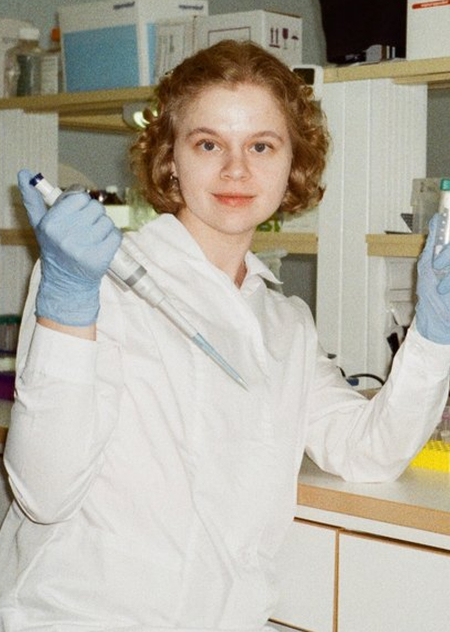
In recent years, scientists have made significant advancements in cancer treatment. In Russia, several cancer vaccines have been developed, and researchers are actively seeking new medications and treatment protocols. Molecular biologist Katerina Svirina spoke to «Tsekh» about these new studies.
What are splicing inhibitors, and how do they work?
My colleagues from the Lopukhina Research Center of the FMBA of Russia have focused our attention on a new class of drugs that are currently being used globally in various clinical trials, but usually as monotherapies—meaning they are used as a single agent for treatment. These are splicing inhibitors. To understand what these are, we must recall that our genetic information is encoded in DNA, RNA, and protein. The products of gene expression are either RNA, which regulates things on its own, or protein. Proteins perform various functions, sustaining the life of every cell and the organism as a whole. When RNA is transcribed from DNA, the RNA molecule is very long. Some even say that if you were to lay out the DNA of all cells, the length of that strand would be comparable to the distance between the Earth and the Moon. RNA contains numerous distinct regions. This sequence is extremely long, whereas the resulting protein sequence is not as long. Therefore, the cell must excise parts of the RNA that lack functional meaning or do not code for a protein. Alternatively, the cell can splice these parts together—keeping some to yield one protein subtype, or mixing others to produce a different subtype.As a result, different subtypes of the same protein can perform similar (but not identical) or completely opposite functions. This is how the cell regulates what it needs. The process of cutting sections out of RNA before the protein is synthesized is called splicing. It ensures the diversity of our cell’s proteins and the diversity of their functions.However, when a normal cell transforms into a tumor cell, this process is very often disrupted. Sometimes this occurs due to mutations that arise in the DNA itself. In these cases, the entire splicing process proceeds in a bizarre or incorrect manner. It happens that proteins can lose their activity in some way, and mutations can occur within them. Overall, a tumor cell is a kind of «organism» (in quotation marks, of course) that does everything to accumulate more damage and protein variations, becoming more mobile and aggressive. Because of this, it begins to divide more actively, acquiring new properties that allow it to become the strongest and survive within this vast chaos.
What is the essence of the new treatment method?
Research into these compounds began about 10 years ago, generating considerable excitement. They were incorporated into clinical trials as monotherapy—meaning the patient was treated with only that drug. However, it turned out that some of them were either highly toxic. Patients developed side effects that significantly impacted their quality of life. Generally, clinical trials are most frequently conducted on patients who are already receiving fourth-line therapy, meaning other treatment methods have not helped them. These are particularly severe cases. Therefore, if side effects emerge, the drugs are immediately withdrawn from the trial because the adverse effects outweigh the potential benefit to the patient. Another subset of these drugs showed promise in clinical trials, demonstrating moderate efficacy. Initially, they reduced tumor growth, but the growth subsequently resumed. Nevertheless, some level of efficacy was observed.At that point, we considered this a compelling group of molecules. Perhaps they needed to be used not as monotherapy, but in combination with something else. We conducted extensive research into the consequences of splicing inhibition to determine what occurs within the tumor cell following splicing disruption. We found that 48 hours after splicing disruption, the DNA repair processes within the cell are maximally impaired.We then hypothesized that if we first disrupted splicing to create a vulnerability in the cell and then administered platinum-group drugs, which damage DNA, a larger percentage of cells would likely become sensitive to this therapy.Indeed, this proved to be the case. This combined treatment regimen has now demonstrated effectiveness not only in cell cultures but also in mice. We have already patented this combination therapy in Russia. Further research is necessary to better understand the impact on normal, non-tumor cells and how this combined therapeutic regimen affects the entire organism.Regarding its potential, we have shown that this method is effective not only on ovarian cancer cells but also on other types of tumors, including lung cancer, breast cancer, colorectal cancer, and liver cancer. Potentially, this therapeutic regimen could improve treatment responsiveness across a wide panel of various tumors.
Read the full version of the interview on the «Tsekh» website.
Cover: © personal archive of Katerina Svirina