
«At This Spot» — an interactive media experience about personal events and memories connected to specific locations in Moscow.
The project gathers real, first-person stories and maps them onto the city map. Users select a location and discover what significant event occurred there in someone else’s life. This could be a memory of childhood, a home, a meeting, a breakup, a move, or any other important moment.
The same point may connect several stories from different people, allowing a familiar place to be revealed through diverse human perspectives. Stories can be searched not only by neighborhood but also by theme—such as childhood, home, relationships, separation, or change.
Users can not only read or listen to others' stories but also submit their own memories, either as text or voice recordings. If necessary, the editorial team assists in refining and preparing the narrative for publication.
The central concept of the project is to reveal the city not through its buildings and landmarks, but through the personal experiences of its people. Here, the map becomes a way to navigate human narratives.
Media Objective
Create a perpetual digital archive of memories of Moscow. This project helps viewers see familiar locations through the lens of others' experiences and allows authors to preserve significant events in the city’s collective memory.
Segment Urban cultural media. The initial model is B2C: individual readers and authors.
Niche Topic Personal events and memories of people connected to specific landmarks in Moscow.
Competitors
Competitor research utilized search phrases such as «personal stories of Moscow, ” „Moscow residents’ memories, ” „city memory map, ” and „Moscow through its residents.“ Official websites, project pages, editorial content, and service documentation were reviewed.
Three categories of competitors Direct—personal memory and perception of Moscow. Indirect—related tasks: exploring the city, learning about its residents, and preserving the past. Potential—projects that could develop a similar format within their own infrastructure.
Direct Competitors
01 / «Private Moscow»
A research project on the unpublished memories of Moscow residents. The publication includes oral interviews, documentation of location and time, and the search and plan for an interactive map. This is the closest conceptual overlap. For «At This Place, ” presenting short stories for everyday reading and allowing users to submit their own narratives is essential.02 / „Moscow Without Outskirts“
The Moscow Museum explores neighborhoods alongside residents, gathering memories, family photographs, and artifacts. The overarching theme is the personal memory of the city. Our project unites narratives on a shared map, with a specific personal life event becoming the core material. We can draw inspiration from the work involving personal archives and resident participation.03 / BURO. „Places of Power“
This special project reveals Moscow through the routes and habits of its characters, connecting a map, audio tours, and editorial content. Our focus is a specific memory that the author links to a location. For developing the media, the narrator’s voice and an audio format suitable for walking tours are beneficial.
Indirect Competitors
01 / PastVu
A user archive of past photographs. Participants upload images, discuss them, and pinpoint locations. It competes for exploring the past through a map. In «At This Spot, ” the narrative of a personal event becomes the main material. PastVu’s useful feature is the geographical tagging and refinement of details by participants.02 / „Moskvich Mag“
This city publication tells the story of Moscow through its people and phenomena. The intersection lies in an interest in the human side of the city. Our project organizes personal stories through a map, allowing memories associated with a single point to be compared. Editorial work with subjects and attention to everyday urban experience are beneficial.03 / „Discover Moscow“
The portal offers urban routes and materials about buildings, monuments, and historical sites. It competes in uncovering Moscow while walking. Our focus is the significance of a location in the narrator’s biography. The principle of exploring the city through its geographical context can be utilized.
Potential Competitors
01 / Yandex Maps
The service features reviews, photos, and user participation. Such infrastructure potentially allows for the creation of a distinct layer of personal narratives. For our project, this means the necessity of developing an independent editorial value for these stories.02 / 2GIS
The service combines maps, business listings, reviews, and photos. Expanding user content to include stories about locations could intersect with our scenario. The project’s differentiation is rooted in personal memory, including locations that lack a business listing.
03 / «Prozhito»
The center creates a digital archive of personal documents and a collection of diaries with advanced search capabilities. Presenting these testimonies geographically could bring it closer to our format. For «At This Place,» attention to primary sources and metadata searching would be beneficial.
Insights
Competitor analysis revealed that maps, geo-tagging, and the collection of personal memories are already utilized in other projects. Therefore, the «At This Place» media project must be built upon a combination of mechanics. The project centers not on the history of a city or location, but on a personal event linked to a specific point. The key differentiator is the ability to gather multiple, diverse memories in one place and show how the same location exists within the lives of different people. Furthermore, stories can be explored not only geographically but also by themes of human experience—childhood, home, meetings, partings, and change. The map becomes not the product itself, but a navigation tool for human stories, and by offering a simple text or voice recording submission with editorial support, we can lower the barrier to entry for contributors.
Distribution Channel
The website preserves and connects stories. Social media brings readers and authors together.
Website / Core Product Interactive map, full narratives, audio, thematic search, and participation forms. Readers gain geographical context and can explore other memories related to the same location.
Telegram / Regular Reading Short, self-guided stories featuring one image and a link to a location. Curated selections introduce archive themes and encourage return visits.
VK / Distribution and Participation Carousels of personal archive materials, thematic collections, and video clips featuring the narrator’s voice. These posts introduce the format and invite users to submit their own stories.
Local Communities / Initial Outreach Libraries, cultural organizations, and neighborhood communities can distribute collections about their local area and invite residents to participate.
Target Audience
Type: B2C
Geography: Moscow; also people who previously lived in the city or have important memories connected to it.
Age: primarily 20–45 years old.
Gender: men and women.Urban Explorers
Men and women aged 20–35 from Moscow who are interested in urban culture, love to wander, and want to see familiar neighborhoods from a new perspective. Standard listings of landmarks, venues, and historical facts are no longer enough for them—they want to see the human stories behind the locations. For them, «At This Place» becomes a way to find out what happened to other people on familiar streets, in courtyards, houses, and public spaces, allowing them to perceive a usual route in a new light.New Moscow Residents
Men and women aged 20–35 who have recently moved to Moscow and are gradually getting to know the city. They know the main routes, use maps and city services, but have not yet formed an emotional connection with their surroundings. They are interested in learning not just what is nearby, but also what events took place in the lives of other people in that space. Such stories help them feel more connected to a district and gradually build their own relationship with the city.Memory Keepers
People of various ages who have a personal or family history connected to a specific spot in Moscow. This might be a childhood memory, a first date, a move, or another significant event. Often, these stories remain only in memory or during family conversations. «At This Place» offers a way to preserve them digitally and make them part of a collective map of human memories.Creators and Researchers
Students, designers, photographers, journalists, and researchers aged 20–35 who work with themes of the city, memory, and everyday culture. For their projects, they seek out real human stories, but often face scattered sources and a lack of clear geographical context. They value our medium for its ability to find data related to a specific territory or theme, compare different memories, and use that information for further research.
Character 1

Lera, 24 years oldOccupation: SMM Manager
City: Moscow
Marital Status: Single
Income: Average
Education: Higher EducationDescription
Lera has lived in Moscow for several years; she loves walking everywhere and exploring different districts of the city in her free time. She follows city media outlets, bookmarks unusual locations, and sometimes intentionally chooses a new route for a walk. However, standard content about buildings, cafes, and landmarks quickly bores her—she is more interested in learning about the personal events that have happened to people in ordinary courtyards, houses, and familiar streets.Motivation
Lera wants to see Moscow not just through its architecture and historical facts, but through the lives of its people. She is interested in walking down a familiar street and unexpectedly discovering that this exact spot is connected to an important memory for someone else.Benefits of using the media
«At This Place» allows Lera to open a map while on her walk, view local stories, or choose an area of interest—such as childhood, encounters, or changes. She can quickly read a short story or listen to audio and continue her walk with a new perception of a familiar place.
Character 2
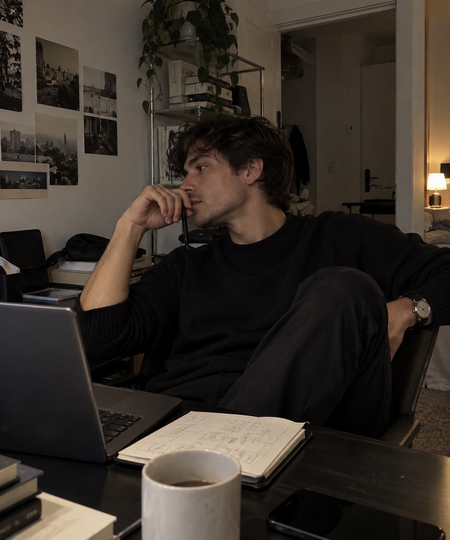
Artem, 31Occupation: Product Analyst
City: Moscow, moved from Yekaterinburg
Marital Status: Married
Income: Above average
Education: Higher educationDescription
Artem moved to Moscow about a year ago for work. He is already well-oriented in his neighborhood and knows the main routes, stores, and establishments, but he currently perceives most of the city as just a collection of streets and points on a map. On the weekends, he and his wife walk around Moscow, but they often lack the context that would help them feel connected to their new city.Motivation
Artem wants to better understand the place he now lives and gradually stop feeling like someone who just moved here for a job. He is interested in learning the stories of ordinary people and using them to better understand Moscow’s districts.Benefits of using the media
«At This Place» helps Artem discover stories near his home and along his usual routes. Instead of information about where a building is located and when it was built, he learns what happened here in the lives of other people. This makes getting to know the city more personal and emotional.
Character 3
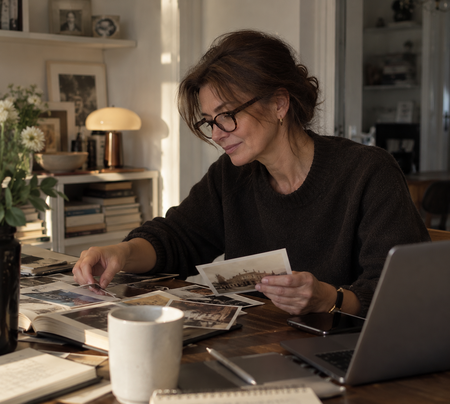
Irina, 52 years oldOccupation: Accountant
City: Moscow
Marital Status: Married, two adult children
Income: Middle
Education: Higher EducationDescription
Irina was born and raised in Moscow. She has old family photographs, including shots of the yard where she spent her childhood and her grandmother’s house, which is no longer standing. Sometimes Irina tells these stories to her children, but most of her memories are not written down anywhere. She does not maintain a blog and does not consider herself someone who writes beautifully, so publishing these stories independently is difficult for her.Motivation
Irina wants to preserve her family memories and ensure they don’t disappear along with the old photos. It is important to her to capture not just the image of a place, but also the events, people, and emotions associated with it.Benefits of Using the Media
With «At This Place, ” Irina can select a familiar spot on the map, send a photograph, and share her memory through voice, without having to write a complete text herself. The editorial team helps format the story and approves its publication with her. As a result, a personal memory becomes part of the city’s collective history.
Character 4
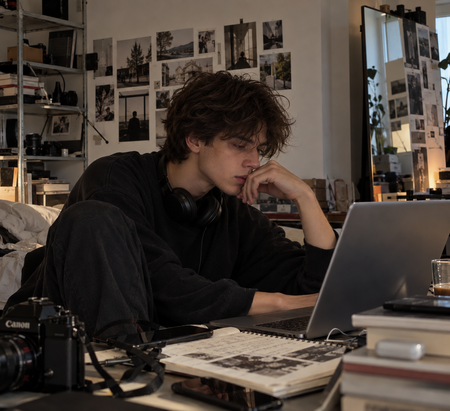
Nikita, 21Occupation: Design student, emerging photographer
City: Moscow
Marital Status: Single
Income: Below average / Average
Education: Incomplete higher educationDescription
Nikita studies design and creates academic and personal projects focused on the city, its people, and its visual culture. When he needs real stories of Muscovites, he searches for material across social media, old publications, local communities, and archives. However, the information is often scattered across various sources, making it difficult to determine the precise location of a story or identify its author.Motivation
Nikita is driven to uncover authentic human stories that can serve as a starting point for a photographic, design, or academic project. He is particularly interested in comparing how different people perceive the same location.Benefits of Using the Medium
«At This Place» aggregates such testimonies onto a single map. Nikita can select a neighborhood or a theme, find multiple stories about one specific point, view the photographs, and immediately understand who created the content. This streamlines the research process while simultaneously sparking new ideas for his own projects.
Unique Selling Proposition
Multiple Human Stories in One Place
«At This Spot» showcases not only the location’s data but also the diverse events that have unfolded there in people’s lives. A single point on the map can unite several memories, illustrating how differently one urban space can mean to various individuals.Navigating Human Experience, Not Just Geography
Users can search for stories not just by neighborhood or address, but also by themes: childhood, home, encounters, partings, and transitions. The user selects a lived experience that interests them and explores related narratives across different parts of Moscow.The Ability to Preserve Your Own Story in Text or Voice
Participants do not need to be skilled journalists. A user can submit a memory as text or record it in their voice, and an editor will help transform the account into a finished publication, coordinating the final result with the author.