Movement as a Method—Life Without Pre-made Outlines
Natalia Shendrik, an instructor in the «Communication Design and Branding» program at the HSE Art and Design School, an artist, and graphic designer—and formerly the art director for the «Golden Mask» festival and creator of the «Gogol Center» corporate identity—discusses how she avoided becoming a clown, why the dynamism in education is paramount, the role of visual culture in the urban environment, the DNA of theater, and whether we can still perceive identity—in an interview with Marina Andreykina.


From Natalia Shendrik’s social media
The Girl Who Didn’t Want to Go to Stroganovka…
Marina Andreykina: I noticed that you don’t have a classical art education. Was that a circumstance, or was it a conscious choice?
Natalya Shendrik: I studied at Stroganov Academy (in the preparatory courses—Editor’s Note) and was preparing to apply there as well. We were studying, and it was quite tedious. Then I saw an article in a magazine that was written about the School (Higher Academic School of Graphic Design—HASHGD—Editor’s Note). And I thought to myself, «That’s it! I want to go here!» The article had no contacts, nothing. My mom helped me a lot; we called the magazine’s editorial office. They gave us the director’s phone number. We called, and he said, «Enrollment is already closed!» My mom said, «Oh, really? But my daughter got into Stroganov.» I called him back—and we were told at the editorial office that the director’s name was Sergey—and I said, «Sergey, hello, my mom just called you; she told you something untrue. In any case, I really want to join you; how can I do that?» He said, «Well, come by…» and gave us another number to call. Later, I met this Sergey; he was Sergey Ivanovich Serov, the director of HASHGD, and he had a big white beard.
It was a wonderful educational institution. Very small, but amazing. Very few people graduated from there, but we practically all know each other, keep tabs on each other, and even communicate with some. HASHGD is an absolute secret password!
Where practicing designers teach
M: Seeing it in the newspaper, getting passionate, and achieving it—that’s a very specific, but definitely a great choice! So, what drew you to VASHGD?
N: The drive! Big universities back then were too bureaucratic. It was some ancient curriculum, three computers, you sit there drawing heads, that sort of thing. That’s how it was in the 2000s, at least. But here, the instructors were designers themselves—practicing professionals from the field, not just lecturers. The mindset was: we need to shape these kids—we’ll shape them now. At that time, that kind of education simply didn’t exist. In fact, the HSE Art and Design School gives that to us now, and a good number of our instructors are VASHGD alumni.
When I enrolled, the Design Biennale kicked off immediately—the «Golden Bee International Graphic Design Biennial.» From the first of September, instead of sitting in lectures learning curricula, we were going out, hanging up posters, meeting people—so we were immediately in the thick of things. It was, of course, fantastic.
All my other places of study were also quite strange, to be honest, but it was all fueled by genuine interest and passion.
For example, there was the «Workshop» Communications School; it was an advertising education. I went to work at the «Zoloto» brand boutique, where Igor Gurovich, Eric Belousov, Anya Naumova, Natasha Agapova, and Riya Tavolga worked (she teaches at our university in St. Petersburg, and she, incidentally, is a VASHGD alum). At that time, the first intake for Workshop was happening, and they offered me the opportunity to transition from my job to learn from my colleagues. After that, it became the Wordshop Academy of Communications—a respected, major institution that exists today and teaches various advertising professions. Back then, there was the first course taught by Leonid Feigin and Svetlana Maibrodskaya. They were creating the program from scratch. I probably loved that aspect the most. They invited various amazing people to teach us subjects that weren’t in my university, like philosophy. The course was called «Hero of Our Time.» For the entire year, we were creating our own «Hero of Our Time, ” based on Feigin’s concept.
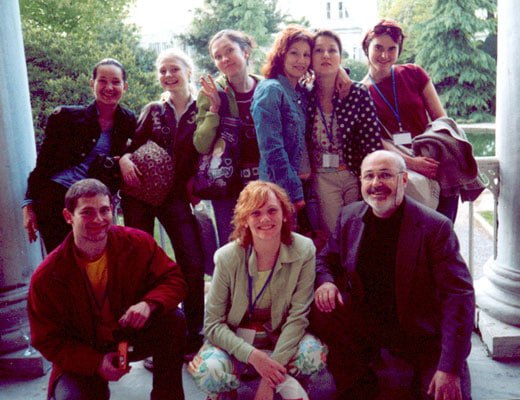
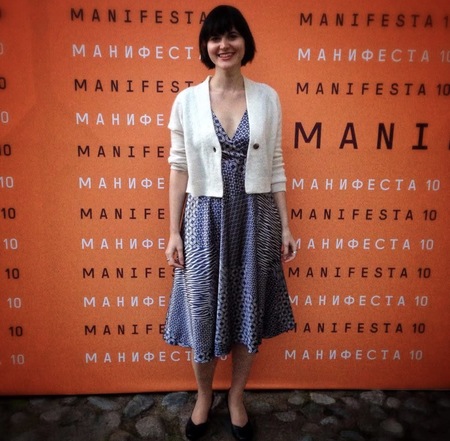
Left: VASHD team at the Istanbul Biennial, 2004 Right: At the opening of Manifestos 10, St. Petersburg, 2014
Why a Theater Leader School for an Artist, and a Few Words on the Value of Networking
I also studied with Lyona after that. I really like him as a person, as a teacher, and as a senior mentor. He had a course he called «Storytelling.» We met once a week at Vinzavod, in a small room, and we talked. We had a kind of discussion club. It was amazing.
Then there was contemporary art in the workshops at MMSI.
After that was the School of Theater Leaders (STL)—I’m the only designer who has a degree in managing state budget cultural institutions.
The Gogol Center was just starting then. I followed this process through the first two intakes of the STL (edited by me); I knew people there, and it was incredibly interesting. Then came the third intake. My friend and I thought, «Let’s go!» Lena Kovalskaya, the director of the STL, called me for a chat: «Are you sure you need this?» I said, «Yes.» «Will you attend?» I said, «Yes!» «We can’t miss classes.» «I won’t!» And I never missed anything. That was fantastic too. Although it was already the final year of the School of Theater Leaders, we met so many people there, and afterwards, we connected and worked with them, and it’s an incredible asset—a treasure trove of contacts and friendships.
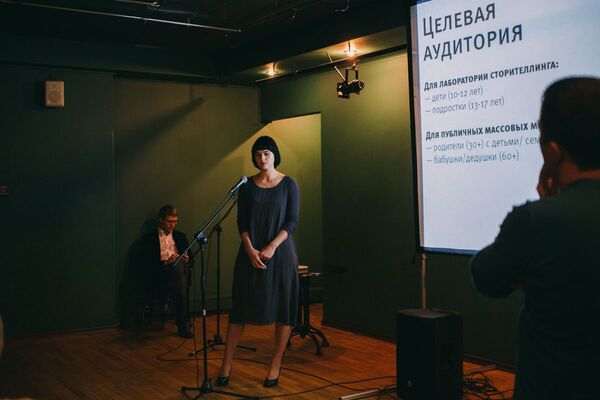
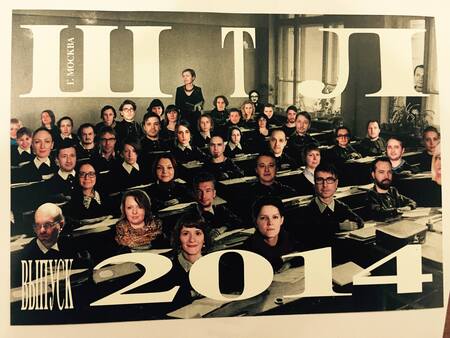
Left: Final project defense at the Theater Leader School (ShTL), 2014 Right: Graduation photo from the ShTL program
Energy and momentum as the core value of education
M: What is the most crucial value of education?
H: Momentum! Momentum, energy, inspiration for something new, I think.
If we are talking about formal education, it’s a very strong shift after school—a completely different world, two distinct worlds, involving a profession.
But if we focus on lifelong learning, then it’s a new perspective on things and, of course, new connections.
«How I started teaching at the School of Design…»
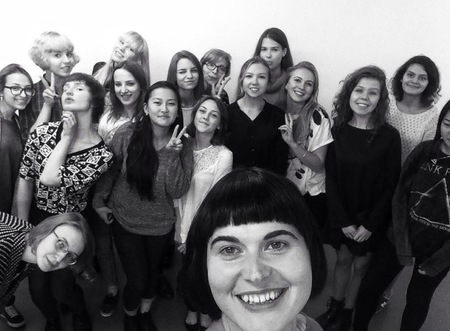
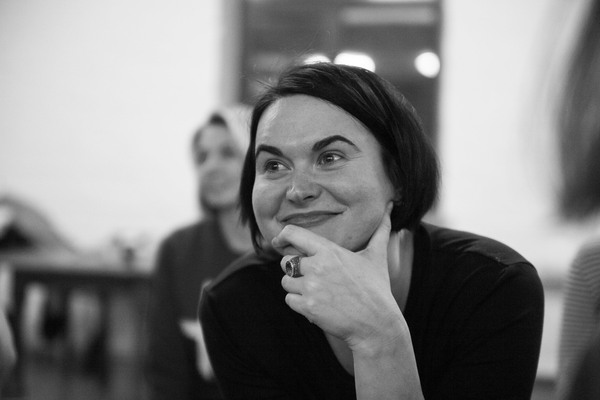
Left: With the new first-year intake of the School of Design, 2015. Right: At the show in the School of Design, 2019.
M: How did you start teaching?
N: I have been teaching at the School for 12 years, since its second year of existence. It was quite hilarious. We were launching the Gogol Center, and my mentor at the HSE Art and Design School, Boris Vladimirovich Trofimov, invited me to his class—to tell the students about how we managed it. And I was terrified of people, of an audience! Horribly! Monstrously! I told him, «Boris Vladimirovich, when would you like me to come?» He said, «Well, we meet on Wednesdays. February 20th, that’s a good date.» And February 20th is my birthday! I was turning 30. I thought, «Well, this is a challenge! I will definitely remember a birthday like that.»
I was incredibly nervous—for a week I walked around Sokolniki, I lived nearby, walked loops around the pond, and tried to figure out what I was going to say. I was terrified, unbelievably so. And I decided to invite my friend, a director with whom I was working at the time, Alexander Sazonov. So I conceptualized a performance—how the whole thing would go—that I wouldn’t just be a lecturer. First, Sasha would ask some questions, he would talk about the process from a director’s perspective, I would talk about my perspective, and then we would host a small masterclass. Basically, I came up with something out of sheer terror.
Then I survived that terror. And I liked it. Later, at a professional gathering, I loudly declared, «I went to teach here, and it was good! Hire me!» And within two weeks, my friend calls me and says, «Arseniy Meshcheryakov is looking for curators at the School of Design.» I was electrified! I really loved the University. I told everyone with complete sincerity that if anyone asks where to go to study, they should go there—such a School opened up—it’s amazing! Don’t even think twice! The people who teach there, everyone there—don’t even think about where you should go.
We met with Arseniy, talked, and just like that, I started teaching at the School of Design.
I do not repeat my lectures.
M: Have the subjects changed over the years? Or are you still taking the same course, like «Communication Design»?
N: For the past two years, it’s been «Media and Design.» I’ve been through my first, second, and third years, graduate school, and my final project defenses. The curriculum changes all the time, and the students are always different. Basically, I’m never bored.
I have this problem—I don’t reuse my lectures. I have to prepare everything from scratch every time. I can’t just read my own notes from last year. I open them, but there’s no spark. I have to rebuild everything each time. It’s really tough. I wish I had some starting materials.
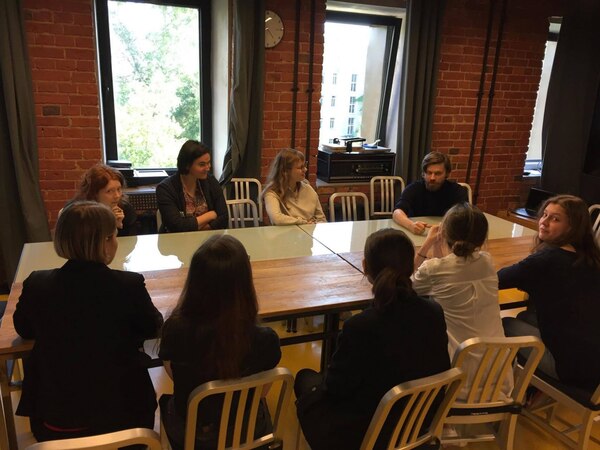
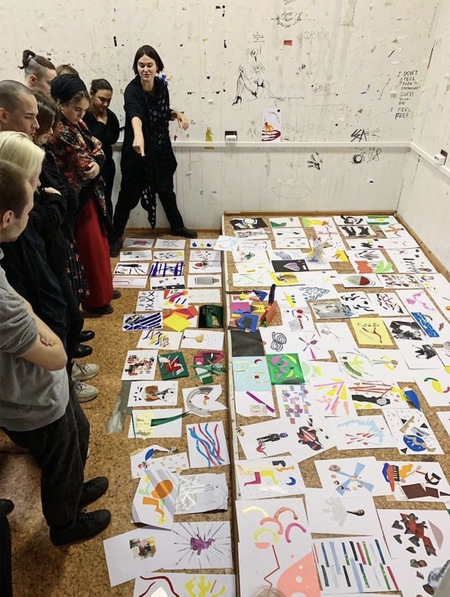
Left: 3rd Year Design School student visiting the Gulag Museum, 2018 Right: Analysis of a course project with a Master’s group from the Design School, 2020
«People are the most wonderful, the most unpredictable thing we have!»
M: Do you get the sense that the students have changed over this time? Is the connection with them established in the same way? Or if you’re in the zone, do they connect with you?
H: Well, generally, yes. It doesn’t depend on the generation, but on the group, on its level of engagement. Because some groups gel more easily than others. Every year and every group is completely different. People are always—they are the most wonderful, most unpredictable element we have. You can’t say that everyone was like that before, and everyone is like that now. There are small differences, certainly. A certain vibe is felt. But I wouldn’t want to put labels on it.
Cover art for the infotainment YouTube show, «72 Points.» Authors: Aleksandr Vasin and Natalia Shendrik
Becoming a Clown — Realizing a Child’s Dream
M: Did you want to be a designer or an artist since you were a child? What was your childhood dream?
N: My professional background is a bit unremarkable—I’ve been an artist since I was a child. In childhood, I even dreamed of being a clown. Speaking of which, I recently took clowning courses. It was interesting, and I believe it will be useful in some way. There were some very engaging exercises. When my nose started turning red, I lost interest, and I didn’t proceed to the second level. But the first level was incredibly interesting because it was about paying attention to what was happening. You don’t have to invent anything; you don’t have to make people laugh; you just watch and react. And people laugh. Simply because you draw their attention to what’s happening. That was the coolest lesson from the whole experience. I also studied scriptwriting and took acting classes as a director…
Makeup and set design for the performance «Colorful Dreams of the Sea, ” supported by GES–2
Is Comic Sans suitable for a stand-up poster?
M: After learning that the School has stand-up courses, you told me you would enroll. What font works best for designing a stand-up poster, and why isn’t it Comic Sans?
N: Comic Sans is a cliché. It’s overused and worn out. It’s the first thing your mind might latch onto when told something should be funny. But a joke isn’t the first thing that comes to mind! You need to search diligently to make it both personal to you and funny. The best joke is the unexpected—what you didn’t see coming.
Although… maybe Comic Sans can be spun in a new way… Because you didn’t expect it to be so predictable!

First-Year Undergraduate Coursework from the School of Design
A perennial question: Can one truly express oneself through design?
M: Fundamentally, is design about self-expression, or is it about solving other people’s problems? Can you express yourself through design?
N: That is a wonderful question. It is one that is always asked. And I don’t mean that it’s a cliché. It is truly the question that concerns everyone. Is design an art? This question is always raised, always discussed, always sparks debate—even fierce debate—but no one finds a definitive answer.
I think it is partly both. A designer joins a collective and begins to work with it. Whether they are handling a rebrand or working as a staff member, they certainly have their own vision, their own touch, their own skills. And the theater has its own vision. Some kind of product emerges from this symbiosis. If there were a different designer, a different product would result. If there were a different theater, a different product would result too. This cannot be called pure designer self-expression because self-expression happens in a vacuum. It depends on nothing. Design, after all, depends on many things. You discuss it with the team, the client approves it, and marketing tests it. So, yes, there is self-expression, but primarily, it is about solving problems because that is what the theater needs, what people need—it’s about communication. After all, it is always about communication—connecting certain informational nodes. Therefore, it is, let’s say, the solution to a communication problem.