I. Cap
Lina couldn’t remember the last time she had seen the sky. Not the gray haze that had hung over Moscow for nine months of the year, but the ordinary, deep blue sky. She knew it existed because she had seen it in old photographs, in movies, in paintings at the Tretyakov Gallery. But how it looked in real life—she had long forgotten. She was twenty-seven, belonging to a generation raised under a lid. That was what they called the constant smog that had enveloped the megacities by the early twenties. At first, they called it a «temporary phenomenon.» Then, they convinced people it was the «new normal, ” and eventually, they stopped talking about it because there was nothing left to say.
By 2147, the world hadn’t collapsed. It was slowly suffocating, much like people with diseased lungs. Gradually, as they grew accustomed to having less and less air, accepting it as normal. The oceans—absolutely all of them—had long been covered by a thin film of synthetic algae, a byproduct of a failed genetic experiment in 2091. The algae were hardy, aggressive, and utterly inedible. They pushed out phytoplankton, and following them, everything that depended on it. Fish didn’t disappear all at once, but in stages: first tuna, then cod, then sardines, and then everything else. By 2147, commercial fishing as an industry no longer existed. Feeding ten billion people had become an unsolvable problem.
The water acidity had risen so high that the remaining coral reefs began to dissolve like sugar in hot tea. Scientists documented this, published data, and presented at conferences. No one cared about the data. People had more pressing concerns: wars over freshwater, migration crises, and economic collapse.
Lina worked at the Institute of Epigenetics at Moscow State University. The institute occupied an old building on the Leninsky Hills, constructed in the twentieth century and since then rebuilt, repurposed, and renamed several times. Lina’s laboratory was on the fourth floor, overlooking Vorobyovy Gory. Or rather, what was left of them: a slope overgrown with dry, tough grass that no longer turned green but remained gray and prickly year-round.
She specialized in biosystems—specifically, bacteria that were supposed to break down microplastic in the ocean. Every time a new strain failed—and they failed almost every time—she felt something she didn’t want to call despair. She called it „negative result.“
Karina Volkova led the laboratory—a woman in her early fifties with a short haircut, eyes that had seen everything, and a speaking style that demanded immediate agreement or immediate defense. Karina was one of those scientists who didn’t seek fame; they sought answers. And when an answer wasn’t found, they didn’t back down—they changed the question.
In 2145, Karina proposed a new direction. She didn’t call it a «breakthrough»; she called it a «hypothesis worth testing.» The core idea was simple: analysis of ancient DNA samples, from Neanderthals to Bronze Age humans, showed that ancient people possessed segments of the genome that are completely switched off in modern humans. These segments weren’t responsible for disease, growth, eye color, or anything else related to physiology. They were linked to perception—to how the brain processes signals from the senses.
«They perceived the world more broadly, ” Karina said at a lab meeting, projecting a diagram of brain activity onto the screen. „Significantly broader. A wider range, more channels, more information. At some point, these segments were disabled. They didn’t mutate or atrophy; they were, as if, blocked. They exist, but they don’t function—like a switch that someone flipped off.“
„Who flipped it off?“ Lina asked.
„That is what I want to find out, ” Karina replied.
The project was named „Perception.“ Two years were spent developing the neuro-implant—a chip the size of a grain of rice. Inserting it was surprisingly easy: the chip was brought near the temple and lightly pressed; it adhered to the skin on its own and then activated the dormant cortical segments through it. No surgery was required—it could be removed just as easily by simply detaching it. The chip didn’t add anything new; it only removed the block, turning on a switch that someone had flipped off three thousand years ago. But who, and why—Karina didn’t know.
The initial tests on volunteers yielded strange results. Participants began to see brief images: certain places they had never been, faces they did not recognize. They heard sounds that did not exist in the lab: a low hum, a faint whistle, the distant sound of water. Karina hypothesized that this was hereditary memory—traces of ancestral experience recorded in epigenetic mechanisms and passed down through generations, much like eye color or nose shape.Lina enrolled in the program not out of curiosity. More out of exhaustion. She was tired of culturing bacteria that refused to work. Tired of looking at the gray sky. Tired of feeling the world shrinking—a little each year, like a room whose walls shift so slowly you only notice it when you can no longer turn around.
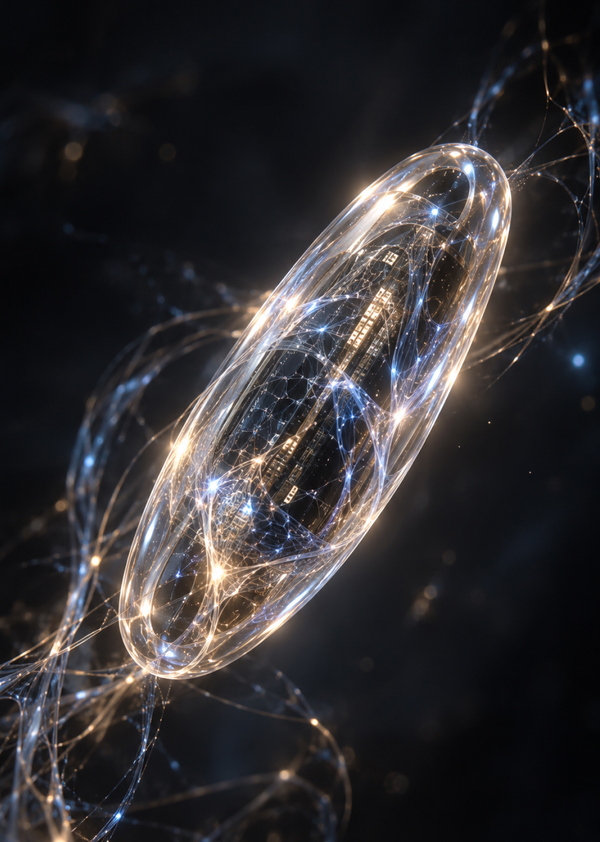
What images: a view of Moscow under dense gray smog above (a cap over the city); an old research institute building on Leninsky Hills with dim light in the lab windows; the neurochip itself in a close-up—a small glowing capsule in the palm of a hand.
II. Initial Activation
The chip was activated in the morning, in the empty laboratory. Karina sat at the control panel, while two assistants stood near the wall. Lina lay on the couch, its cool surface unpleasantly clinging to her back through the thin fabric of her robe.
«Are you ready?» Karina asked.
«No, ” Lina replied. „Turn it on.“
For the first few seconds, nothing happened. Then Lina noticed that the air in the room had changed. Not the temperature, not the humidity. Something else—as if the air had grown denser, as if it contained a substance that hadn’t been there before. Like if you had been drinking tasteless water your whole life and suddenly realized water had a flavor.
Then the colors began to appear. They didn’t become brighter—they seemed to gain depth, as if every color had acquired a third dimension. The white ceiling was no longer simply white; it became layered, filled with shadows Lina had never seen before. Following the colors came the sound. Lina heard the earth humming beneath the floor, a low, steady, continuous drone, like that of a massive organ whose pipes stretched into the planet’s core.
Lina turned her head.
And she saw it.
In the center of the room, right through the laboratory table—as if the table itself were a drawing, yet the figure standing above it was real—stood a figure about two and a half meters tall. Its body seemed carved from thin, smoky glass, permeated from within by glowing veins that moved slowly, like blood under the skin. Its elongated, slightly pointed head, lacking a mouth or nose, featured three dark lenses where eyes should have been. Long, slender plates, resembling wings or fins, extended from its shoulders down its back. In its chest, where a human heart would be, a dense node pulsed, like a second heart.
It had no face in the conventional sense, but the three dark lenses were fixed on her, and Lina did not doubt it—it was looking at her. There was no threat or fear in that gaze. There was a feeling that someone had stood nearby for a very long time and was finally being noticed.
Lina screamed. Karina deactivated the chip. The entity vanished instantly, like a light being switched off.
„What did you see?“ Karina asked.
„I don’t know, ” Lina said. „Something alive. Tall, glassy. It was looking at me.“
Karina nodded and wrote: „side effect.“ Lina wanted to believe it. She couldn’t. Because those three dark lenses were looking at her the way one looks at someone they haven’t seen in a long time. And that expression cannot be invented—it can only be recognized.
What images: a laboratory couch and the moment the chip activates (Lina with her eyes closed, the light shifts around her); the creature’s first appearance—a figure emerging directly in the middle of the room through the ordinary interior, with a slight translucent effect.
III. Ve
Three days later, Karina conducted five more activations. Three out of five saw the exact same thing, down to the pattern of the plates on its back and the rhythm of the node’s glow. Different people, different backgrounds, different ages—and one word described their shared experience: recognition. Karina decided to hold off on publishing the results and to test further.
Lina requested another activation. The second time, she didn’t scream. The entity appeared three steps away and remained motionless—Lina later realized it was waiting to see if she would run or not.
«Can you hear me?» she asked aloud.
There was no verbal response, but the plates on its back shifted subtly in angle, and Lina felt a light draft on her skin. Not wind—a touch. As if someone had answered «yes, ” only not with a voice, but with contact.
She began coming every evening. She named the entity Ve—the node in its chest glowed brighter every time she spoke the name.
Initially, they communicated through images: to the question, „Where do you live?“ she received a sensation of height and cold air. Later, Lina noticed that Ve understood simple spoken requests before she could even make a gesture. It had understood Russian from the very beginning. It couldn’t answer with words—it simply didn’t possess a voice for it.
One night, when the fog became so dense that nothing was visible within two steps, Lina went to the institute’s rooftop. Ve opened its plates, and the still air stirred. The haze parted, and for a few seconds, Lina saw the stars.
It spoke to her—with a coolness on her skin, a slight pressure of air: „You forgot that the sky exists. Not because we hid. But because you stopped looking.“
Lina now knew the main thing: it was not alone. But who the others were and where they came from, she did not yet understand.
Which images: a full-body, close-up portrait of Vae—three dark lenses, a glowing knot in the chest, plates on the back (reference available); a nighttime scene on the institute’s roof where the smog disperses, revealing the first stars.
IV. Past
Lina asked, and Ve showed—and what she learned turned out to be more than she was ready to hear.
The beings lived on Earth long before the chip restored humanity’s ability to see them. They evolved separately from humans in places where human influence was minimal, dividing into several species.
The aerial beings, of which Ve was one, were light and agile, possessing large plates on their backs. These were not wings in the conventional sense, but complex membranes made of living fibers and crystalline structures—they could change shape, connect with one another, and create air currents. By joining together, the aerial beings formed intricate structures from which their cities grew high in the atmosphere—towers and bridges of living material that were in constant reconstruction.
In the oceans, rivers, and coastal zones lived the aquals—creatures with broad bodies made of several layers of translucent liquid, inside which glowed nodes similar to those in Ve’s chest. They ranged in length from three to six meters, and along their bodies were appendages resembling fins, which the aquals used to sense and direct water movement, including subterranean flow. Their purpose was to restore ecosystems and purify water.
There were also narrower species. The lightweight aerial scouts—the fastest and most maneuverable—used air currents to travel vast distances rapidly. The terrestrial guardians—with more massive and heavy bodies—protected territory and interacted directly with the ground. The soil restorers lived underground, guiding nutrient flows to plant roots and reviving depleted soil.
The beings did not build homes—they grew, much like coral or trees, restructuring themselves alongside the world. The beings drew their energy not from combustion, but from the wind, currents, and temperature differences—from anything in motion. Their architecture was not separate from nature; it was an extension of it.
«Why haven’t we seen you?» Lina asked. «If you were always here, how did nobody know?»
Ve did not answer immediately. He showed her the past—not yesterday, but something so distant that Lina could not immediately grasp the scope. About three thousand years ago, humans and the beings already knew of each other and assisted one another. The beings knew how to preserve and restore what already existed. Humans knew how to invent what had not existed before. One needed the other.
But gradually, people grew accustomed to having decisions made for them. They stopped seeking answers on their own and simply waited for help. This dependency grew over decades, and one day it became clear: if this continued, humanity would lose the ability to cope without external care forever.
«That was our choice, ” Vae conveyed. „Not punishment, nor war. People themselves changed their perception and blocked the ability to see us. We consented because we understood that care from others, which replaces one’s own strength, is detrimental.“
The beings did not leave. They remained in the wind, in the water, in the earth—helping subtly, just enough not to create new dependence. For three thousand years, people lived alongside them without knowing it.
Lina told Karina everything. DNA analysis confirmed: the block was not a random mutation, but an intentional, designed alteration passed down through heredity. What Karina called the „switch“ turned out not to be an evolutionary glitch, but a decision made by humanity itself.
What images: A reference spread of all creature types (aerial, aqua, light scout, terrestrial guardian, soil restorer) is already on the source sheet; a city of aerial creatures high in the clouds; underwater domes of the aqua creatures; a DNA diagram with highlighted «deactivated» sections.
V. Request and Denial
Lina asked Wei directly:
— Can you help us? Not by advising us, but by doing everything—cleaning the oceans, the air, the earth.
Wei did not answer immediately. The beings had been trying to help for millennia, but they lacked the capacity. They could preserve what already existed; they couldn’t invent new things. Humans created the synthetic algae, so only humans could devise the antidote.
— You need to step up yourselves, — he conveyed. — Stop fighting each other, stop wasting what you have meaninglessly. Solve the problems of water, air, and earth together. We can help. But we cannot do all the work for you again.
What kind of images: Lina and Wei facing off in a lab or on a rooftop, a close-up of a silent dialogue—her face and his glowing knot in the frame simultaneously.
VI. Publication and Selection
Karina insisted on publishing: hiding meant repeating the same mistake—when someone decides for everyone else. The article was published in «Nature.»
The reaction was exactly what Lina had feared. Governments demanded access to the beings' technologies. Corporations offered contracts. Everyone wanted one thing—a ready-made solution that could be implemented without changing themselves.
Ve did not refuse outright. He showed his cities—he did not explain how to build them.
«You can save us,» Lina said.
«We already saved you,» he replied. «That is why you forgot about us.»
Lina understood: history was repeating itself. People once again wanted something pre-packaged so they wouldn’t have to take responsibility. She began to explain this openly, at every meeting, to everyone willing to listen: the beings' technologies were not a solution, but a new dependency, only delayed in time. Gradually, people began to pay attention to her. The first neutral zones emerged—places where people and beings worked side-by-side, but without the transfer of ready-made solutions.
Which images: the cover of the Nature issue with a hypothetical article title; a meeting hall or press conference with Lina in front of representatives from various countries; a world map with the first designated neutral zones marked.
VII. Neutral Zones
The chip quickly ceased to be a rare technology reserved for a select group of volunteers. Getting it was so simple—just bring it to your temple and press—that within a year, it could be obtained in any neutral zone. Year after year, more and more people made this choice on their own.
Neutral zones emerged where people and beings were ready to accept one another. In some places, people learned from aerial beings how to build wind corridors that lowered city temperatures. In others, they restored rivers using oceanic beings. In yet others, they simply stood side-by-side, learning to be present without fear.
Lina worked on the coast of the Black Sea, near Tuapse, where there had once been a resort, but which had since become a strip of barren sand. She planted mangroves, reeds, and sea lavender. An aqual—an elongated, translucent body made of several layers of water with internal glowing nodes and fin-like protrusions along the edges—came to the shore. Instead of watering the plants, it guided subterranean currents so that they washed over the roots without washing them away. It also helped Lina understand why her previous bacterial strains had not taken hold: they lacked a specific temperature and current. She refined the strain. Six months later, the first fish appeared off the coast.
What images: a coast with a strip of dead sand and early-planted sprouts nearby; an aqua element right at the shore, partially in the water, partially on the tidal flat; people in the neutral zone working alongside creatures of various kinds.
VIII. Apparel
The chip allowed people to see and experience the world of the creatures, but it didn’t allow them to communicate with them as subtly as the creatures communicated among themselves. In neutral zones—where people and creatures collaborated most frequently—this subtlety was missing.
So, modeled after the living structure of the creatures' own bodies, a new material was created: several layers of living filaments integrated with a neurointerface woven directly into the fabric. The garment wasn’t just worn; it connected with the wearer’s neural activity through the skin and responded to emotions, movement, and the surrounding environment by altering its density, transparency, and temperature.
It was made not for those who hadn’t yet received the chip, but for those who had been working side-by-side with the creatures for months and wanted more than just seeing and hearing—they wanted to respond with their bodies, not just their thoughts. A second skin for a second—now visible—part of the world.
What images: a figure in adaptive clothing made of living threads (a reference list with a neural interface is already available); a close-up of fabric transforming into neural fibers on a wrist; a person in such clothing next to Vae or Aqua — a juxtaposition of two similar structures, the living and the human.
IX. Finale
Several years had passed. The sky above Moscow cleared so much that one could see the first stars in the evenings without any aid. The ocean near Tuapse was catching light again, as it hadn’t in two generations. The planet hadn’t returned to what it was—the way it was only remembered in old photographs—but it had awakened, and everyone who stepped outside felt it.
This happened not because the creatures finally agreed to do all the work for people. It happened because people stopped waiting themselves. The neutral zones, which began with a single strip of dead sand, expanded into thousands of such strips around the world—and in each one, someone took responsibility for a piece of land, a river, or a shore, managing it themselves rather than passing the care along. With this came another, simpler thing: people became more attentive to one another. They called their parents more often. They didn’t put off conversations that they had been postponing for a long time. The care that had been abandoned three thousand years ago was once again the responsibility of everyone—both toward the planet and toward those nearby.
Wei and Lina stood on a shore that was once dead sand, but now a young mangrove grove was growing there. Above them, in the atmosphere, the city of aerial beings was visible; underwater, the light of domes shone.
«We never thought we could manage it,» Lina said.
«You managed it yourselves,» Wei replied. «We were only there while you remembered what you were capable of.»
Humans maintained their cities and continued to develop along their own path. The creatures continued to build theirs—in the air, in the water, and underground. No one became a savior to the other; and that was the most important thing: the planet was restored not by the creatures alone or by the humans alone, but by both worlds together, because each took responsibility for their part—for nature and for each other.
Sometimes, to see another world, one must first change not the environment but one’s own perception. But seeing is not enough. Afterward, you must protect it—with your own hands, alongside those who are dear to you. And that succeeded.
What kind of images: a final wide shot—a vibrant coastline, a city of aerial beings in the sky, and underwater domes of aqualiths all in one frame; Lina and Va stand side-by-side on the shore, viewed from behind, looking at the landscape together.