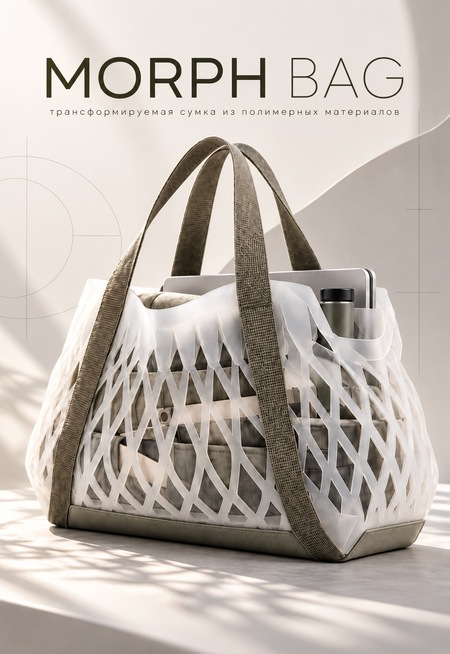
Polymer bag with adaptive volume
MORPH BAG — an everyday bag whose form and internal volume change depending on the number of items inside. The project is based on a simple question:

Most conventional bags have a fixed volume. Even if they only contain a laptop, a charger, and a few small items, the external size of the bag barely changes. If the contents increase during the day, you either have to choose a larger bag in advance or carry a separate shopping bag.
MORPH BAG offers a different principle: volume is not static—it emerges as needed.
In its nearly empty state, the casing remains compact. When items are added inside, a special perforated structure begins to unfold, increasing the surface area and allowing the bag to gradually gain volume.

Why MORPH BAG?
The name MORPH BAG derives from the word «morph"—meaning «to change,» «to transform,» or «to take on another form.» This name directly describes the object’s operational principle. The MORPH BAG does not maintain a single, fixed state. When it holds only a few items, the bag remains flatter and more compact. As it fills, the surface geometry changes, the body depth increases, and the entire silhouette transforms. Thus, the object literally alters its shape in tandem with its contents. The name reflects three core characteristics of the design: shape change, volume change, and the material’s active role in the object’s function. MORPH BAG is not merely a product name; it is a concise explanation of its entire structure.
Problem
The number of items a person carries with them rarely remains constant throughout the day.
This is particularly clear when looking at a student. In the morning, they might only need a laptop and a few personal belongings. During the day, books, class materials, a notebook, or folders are added. After university, purchases, a water bottle, or clothing might be added to the collection.
A standard bag does not adapt to these changes.
A small bag quickly becomes insufficient in capacity. A large bag solves the volume problem, but most of the time the user carries unnecessary empty space.
MORPH BAG views volume not as a fixed property of an object, but as a variable characteristic that depends on the actual usage scenario.
Idea
The main feature of the MORPH BAG is that increasing its capacity does not require extra compartments, zippers, or unfolding sections. Instead, the surface of the bag changes.
The body consists of a system of cutouts and crossbars that form a repeating cellular structure. In a compact state, the elements are close to each other. When items are placed inside, the surface bears the load. The cells gradually open, the distance between the elements increases, and the surface itself expands. This allows the nearly flat structure to gradually transform into a voluminous one.
The key here is not the significant stretching of the plastic.
The shape changes primarily because of how the surface itself is engineered.
How the MORPH BAG Works
The bag’s construction can be conceptualized as a simple loop:
The user does not need to manually unfold the bag or open additional sections. The volume emerges naturally as it fills. The more content inside, the more the central body expands. Thus, the contents directly influence the appearance of the object.
The bag exists in three primary states.
Compact State
The bag is practically empty.
The mesh structure is minimally expanded, keeping the body relatively flat. The approximate depth is about 3–4 centimeters.
This state is convenient when you need to carry only a minimal number of items or store the bag.
Everyday State
Inside, there is a laptop, charger, notebook, headphones, and small personal items. The structure is partially open. Approximate depth is about 10–12 centimeters.
This is the primary state for daily use.
Fully Expanded State
The quantity of items increases.
It may contain study materials, a water bottle, clothing, or small purchases.
The body expands to nearly its maximum designed volume.
Approximate depth is about 18–20 centimeters.These dimensions are currently design guidelines. Exact values will be determined after the manufacturing and testing of a physical prototype.
Structure and Drawings
The MORPH BAG consists of two primary systems: a transformable outer shell and a structural frame.
The exterior is made of sheet polypropylene featuring a system of cutouts. These create a large cellular structure capable of changing geometry and increasing the body’s volume.
Wide woven polypropylene straps run throughout the bag. These form the handles, continue along the sides, and connect to the reinforced base. This frame is what bears the main load from the contents.
Thus, the construction divides two functions: the cellular shell changes shape and creates additional volume, while the structural straps support the weight.
This allows the transformable surface to be lighter and more agile, without forcing the thin cross-members to simultaneously function as the main load-bearing element.
The structure’s function does not rely on the plastic’s high elasticity. The primary role is played by the specialized geometry of the surface. A system of cutouts is created in the sheet polypropylene, connected by flexible crossbars. When the surface is subjected to a load, these elements begin to shift relative to one another. The cells expand, and the overall area of the panel increases. Due to the large number of repetitive elements, the small movement of each individual cell translates into a noticeable change in the entire form. This is precisely why the polymer in MORPH BAG becomes an integral part of the object’s function. Without this surface, the bag would have lost its core operating principle.
However, within the construction, the material is used in different ways. Sheet polypropylene forms the transformable body, woven polypropylene reinforces the most stressed areas, and nonwoven material is used for internal dividers and softer elements. A single base material thus takes on several different roles: it creates the shape, allows the volume to change, helps distribute the load, and protects the contents.
Color Palette
The primary MORPH BAG option is suggested in a milky-translucent material. This color allows for better visibility of the surface thickness, the depth of the cutouts, and the change in structure when the bag is opened. Additional options under consideration include smoky gray and a cool blue-green hue. However, color is not intended to be the main design element; the material’s geometry itself creates the primary visual identity.
How is it done
Production begins with a sheet of polypropylene of the required thickness. The front and back panels of the casing are made from this material. On industrial digital cutting equipment, the external contour of the part and the entire system of perforations are cut simultaneously. It is at this stage that a simple sheet transforms into the deployable surface of the MORPH BAG. This method is particularly convenient for a limited series. It does not require the creation of a large and expensive molding tool. If, after testing, it is necessary to change the size of the cells, the width of the web dividers, or the shape of a specific zone, it is enough to adjust the digital file and produce a new version of the panel.
The reinforced elements, base, and inner pocket are cut separately. Following this, all components are assembled into a single object. Industrial stitching may be used for the woven and non-woven sections. Appropriate welding or another material joining technology can be employed to connect the polymer elements. The final method is selected after testing the specific polypropylene thickness and type.
Equipment
Producing the MORPH BAG does not require a separate, complex production line. The main panels can be fabricated using a commercial cutting plotter or a digital cutting machine. Reinforced and internal components are cut separately on standard equipment. Industrial sewing machinery, and polymer joining equipment when necessary, are used for assembly. After assembly, each sample undergoes quality control: the surface expansion is tested, the strength of the handles and connections is verified, the stability of the base is checked, and the structure’s performance under load is assessed.