Concept
Within the context of Soviet unofficial art in the second half of the 20th century, the work of Dmitry Plavinsky (1937–2012) occupies a distinct position that resists straightforward categorization through the dichotomy of political conformism and dissent. Unlike the socio-artists who deconstructed the Soviet ideological myth, or the conceptualists who worked with linguistic simulacra, Plavinsky manifested the position of an «internal émigré, ” effecting a radical retreat into deeper global cultural strata. The authorial method he developed—"structural realism» [1]—is a non-figurative analytical investigation into the deep geometry of being, where the material world is read as a multilayered sign system, and the painting itself transforms into a palimpsest and an archaeological artifact.
The morphology of the sign in Plavinsky is inseparable from the bodily, hypertrophied materiality of the carrier. The artist transcends the conventional plane of the canvas by incorporating complex relief substrates: multi-layered gesso, textured sand, and manual scratching (graffiti) [2]. In his view, the sign is not applied onto the surface but is physically «excavated» from it, simulating processes of petrification, corrosion, and natural temporal decay. The painted surface resembles a geological cross-section or a monastery wall, where every stroke and chip serves as a vessel for historical and sacred memory.
The semiotic field of research centers around four fundamental archetypes: the Book (as a universal space for fixing the Logos), the Turtle (as a biomorphic model of the cosmos and fossilized time), the Musical Score (as a visualization of a sound labyrinth), and the City (as industrial erosion). Plavinsky discovers a direct isomorphic relationship between the veins of a dried leaf, the carapace of a prehistoric reptile, a line from an Old Church Slavonic lexicon, and the topographical map of a modern metropolis. All these forms manifest a single structural matrix that germinates through the epochs.
Plavinsky’s evolutionary vector of visual language traces a dramatic transition of the sign—from the archaic darkness of the excavation to the sterility of the white cube and the abyss of the media landscape. While in the Moscow period (1960s–1980s), the Sign is tangible, sacred, and sealed within the flesh of gesso or the labyrinths of deep etching, in the New York period (1990s–2000s), it undergoes a radical confrontation with the total machine civilization of Manhattan. Ancient cosmogony clashes with the faceless barcode of network capitalism. The Sign dematerializes, transforming into a pixelated flicker on a screen, and the viewer shifts from contemplative observer to immediate witness of the breakdown of symbolic fabric.
Methodology and Material Selection Principles
This visual study is structured around a problem-thematic principle and incorporates 40 key works by the artist from major museum and private institutions (Tate Gallery, AZ Museum, MMOMA, and the artist’s family collection). The analysis of each work adheres to a unified research matrix borrowed from cutting-edge curatorial practices:
1. Material and technical substrate and embedded labor; 2. Morphological structure of the sign; 3. Method of display and the scenography of absence; 4. Optics and the viewer’s corporeal position.
Block I: Palimpsests, Scriptoriums, and the Old Russian Canon (Screens 7–17)
Исследование рукописного знака, литургических мотивов и архитектуры как текста.
Dmitry Plavinsky. Word. 1969. Canvas, gesso, mixed media. Collection of the AZ Museum, Moscow[3].
The work is analyzed as a monumental palimpsest. The sacred text from the Old Slavonic collection is not superimposed; rather, it is physically integrated into the body of the gesso. The sign acts here as an architectural monolith—the letters form a semblance of the masonry of a ruined temple. Viewer Position: Corporeal Distance. The viewer is compelled to walk around the piece, reading the relief under the angle of accent lighting within the museum, and sensing the physical resistance of the material.
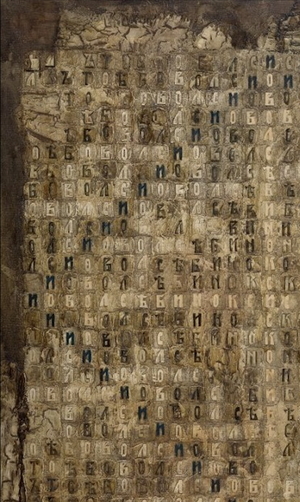
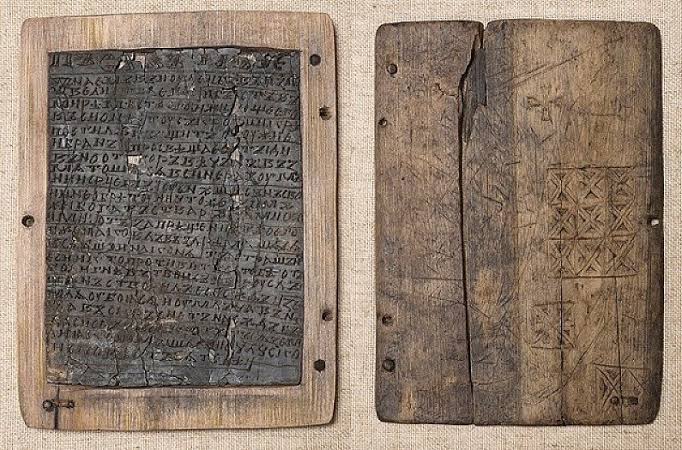
Morphological Comparison of Sign Systems: a) Dmitry Plavinsky, «The Word» (texture fragment), 1969, canvas, gesso, mixed media, AZ Museum Collection, Moscow; b) Page from the Novgorod Psalter (wax inscription fragment), 11th century, Novgorod Museum-Reserve.
Morphological Parallel Plavinsky borrows the rhythm of the semi-stave but strips the sign of its purely utilitarian textual function. The letter becomes pure form—an archaeological residue of culture, emerging through the erosion of limestone.
Dmitry Plavinsky. Moldovan tombstone. 1960s [4].
The use of muslin canvas, cast in plaster and pigmented. The painting simulates the tactility of an epitaph. The sign here marks the boundary between being and oblivion. The inclusion of this work demonstrates how Plavinsky translates two-dimensional drawing into the category of an iconographic, ritual object, devoid of academic flatness.
Dmitry Plavinsky. Gospel of John. 1970s.
Focus on the opening line, «In the beginning was the Word….» Plavinsky visualizes Logos itself as a cosmic energy structuring the primordial chaos of the canvas. The alphabetical signs organize spatial axes, transforming the painting into a mental map of the spirit.
Dmitry Plavinsky. Izborsk Fortress. 1969.
The architectural landscape of an ancient Rus' outpost is read by the artist as a natural extension of typographic culture. The powerful masonry of the fortress walls, battlements, and towers are isomorphic to the rhythmic strokes of Old Slavonic semi-uncial. Plavinsky interprets architecture not as a volumetric object, but as a sign carved into space. The entire surface of the sheet is covered in a delicate etching grid that unifies the texture of limestone, hills, and sky into a single, sacred text, transforming the landscape into a page from a giant manuscript.
Block I Conclusion: The Handwritten Sign-Object
• Substrate: Chalk, gauze, plaster, graphite.
• Semiotics: Text as an architectural monolith.
• Viewer Optics: Physical inspection of the relief, distance of sacred devotion.
• Vector: Fixing historical memory through excavation texture.
Block II: Biomorphic Structures and Fossils
Анализ изоморфизма природной формы и культурного знака. Черепаха, Ихтис, Книга трав.
Dmitry Plavinsky. Tortoise. 1969.
Plavinsky’s key stratigraphic point. The turtle shell armor is read as a natural model of a book and a time archive [5]. Each shield segment of the shell is filled with micro-signs, runic codes, and typographic overlays. Here, nature is not imitated but analyzed as a sacred text. The work requires strict top-down frontal lighting (spotlight) to reveal the tectonics of the gesso «shields.»
Dmitry Plagimsky. Sea Turtle. 1969.
Unlike the pictorial «Turtle,» the etching translates the biomorphic sign into the category of the «stroke labyrinth.» The shell’s space integrates the archaeological plan of an ancient city and the profile of a coin. The sign migrates from the biological dimension to the historical. The distance between the viewer and the print disappears—requiring microscopic examination of the line work.

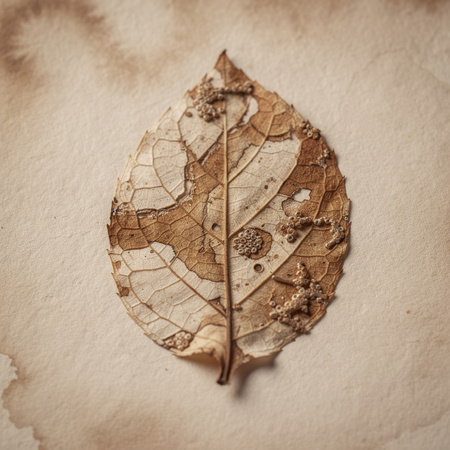
On the left is a macro shot of the veins of a dried leaf from the «Book of Herbs» series. On the right is a fragment of Plavinsky’s etching screen. Flux AI.
The research demonstrates that for Plavinsky, the etching step grid is identical to the capillary network of a living leaf. Nature generates symbols that the artist «decodes» using an etching tool.
Dmitry Plavinsky. Cosmic Sheet. 1975.
The magnified leaf is interpreted as a cosmological symbol. The work is explored as a geological palimpsest: the organic vein structure is embedded in the gesso layer, simulating a fossil preserved within a limestone slab. The painting functions as a fragment of an excavation, sealing the macrocosm within the microstructure of decay. The artist moves beyond formal ornamentation, equating the leaf’s capillary network with trajectories of cosmic orbits and sacred texts. The organic death of the leaf transforms into the eternal preservation of cultural code.
Block II Outcome: Biomorphic Sign-Structure
• Objects: Turtle, Fish, Leaf.
• Visual Code: Isomorphism between biological veins and etched lines.
• Viewer Optics: A transition from macroscopic contemplation of form to micro-investigation of the «print labyrinth.»
Block III: Musical Structures and Stroke Geometry
Дематериализация знака. Вариации на темы Баха и Шостаковича.
Dmitry Plavinsky. Building the Gospel. 1976 [6].