CHRISTOPH SCHULZ
SMILE PLEASE!
A Conversation With George Pusenkoff
So it’s a smile then that moves across the countenance of the Mona Lisa. But only a very faint smile; it sits in the corners of the mouth, and almost imperceptibly the features alter like a breath of wind that grazes the water, something moving across the soft surfaces of the face. An interplay of light and shadow comes about, a whispering dialogue that one never tires of listening to.
Heinrich Wölfflin
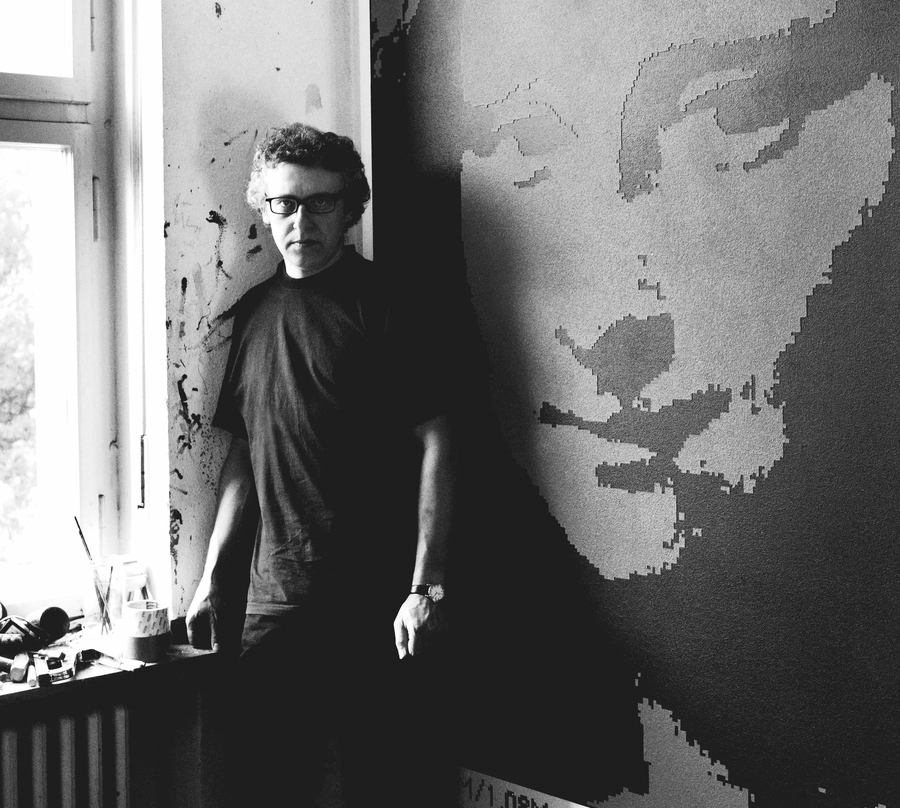
In the studio, Cologne, 1998
HISTORICAL AND BIOGRAPHICAL
Schulz: A large part of your work consists of pictures about pictures, pictures with pictures — or of pictures. Yet one motif has played a particularly central role since the beginning of the 1990s — one to which this book is dedicated: Leonardo da Vinci’s Mona Lisa. After the Mona Lisa had been seen for a few months in the United States in 1963, as the result of an agreement between the American president John F. Kennedy and the French government, it went on another journey in 1974, this time in a different direction — first to Tokyo, then to Moscow, where it was exhibited in the Pushkin Museum. Can you recall the circumstances that brought about this unusual journey?
Pusenkoff: It was clearly a political gesture. At this time Russia had signaled efforts pointing toward more freedom and democracy. In this context, an agreement was signed between the Russian government and the Americans in which, among other things, it was agreed there would be no further underground tests of atomic bombs. The loan of the Mona Lisa was of course not a direct part of a comparable political agreement with the French, but there was certainly an implicit connection between the two events. In Russia, politics was always closely bound up with culture.
The Mona Lisa thus came to Moscow on June 14th, was exhibited for 45 days in the Pushkin Museum and was taken down again on July 29th.
Every step was accompanied by an official act, speeches were held, people applauded. One knew the press would report throughout the entire world that the most important painting in the history of Western art was being exhibited in Moscow — as a matter of course and without risk. This was a demonstration of Russian normality. The message to the West was clear: If we like, we can also play your little democratic games.
The visitors cue in front of the State Pushkin Museum in Moscow during the exhibition Mona Lisa in Moscow, 1974
Schulz: What memory do you have of this event? Is there anything personal you connect with it?
Pusenkoff: I of course visited the Mona Lisa at that time. For me, as a young Russian artist who could not simply travel to France to see the Mona Lisa there, this was an important event. Every day a new line formed before the Pushkin Museum. Every visitor could look at the picture for exactly nine seconds. The procedure reminded me very much of the visit to Lenin’s mausoleum, where I went as a child with my parents: One stood in line, was swallowed up by the building, hustled past the body lying in state and excreted from the building at another location. The ritual was quite comparable, only that the dramaturgy of the Pushkin Museum was friendlier. But here, too, there was only a single exhibit.
From the series Mona Lisa Goes Russia: In front of the State Pushkin Museum, 2001, Moscow. L-Print, 120×150 cm
Schulz: How did the Russian artistic community and in particular the Moscow art scene react to the visit of the Mona Lisa?
Pusenkoff: The whole thing was indeed more like a visit, an event, than an exhibition, and a group of non-conformist artists took this as an occasion to stage an independent exhibition, which of course was promptly forbidden. Thereupon, those in charge modified their plan in such a way that theoretically there was no longer a reason to forbid their request: They wanted to show their pictures on a fallow field under the open sky. Thereupon, the civilian police and the KGB moved in with bulldozers and on this off all days, the 2nd of September, the open space was to be planted with small seedlings.
Then began the battle between the pictures and the bulldozers — a central occurrence for Russian art that is documented in many books.
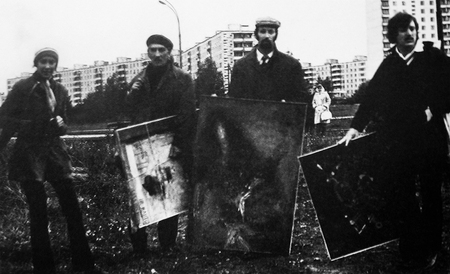
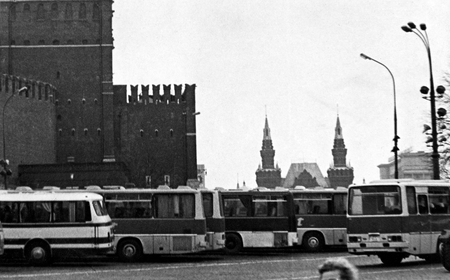
Left: Bulldozer exhibition, Moscow, 1974.
Right: Moscow, the Red Square 1974
Schulz: Was there a specific reception of the Mona Lisa that was perhaps different from that in West European art — particularly in Russian art of the 20th century?
Pusenkoff: The picture was known, of course, but the whole history attached to the picture, particularly in the 20th century, was completely unknown. At the end of the 1920s and the beginning of the 1930s, the social transformation of life in Russia began, and with it there also came an extensive and consequential politicizing of art. Dialogue with the West was strictly forbidden. Artists were trapped in a sort of vacuum and had no idea how to orientate themselves. From this point on there was in essence no more contemporary art in Russia. With only slight exaggeration one could say that as a result, the absence of external influences made most artists into socialist artists, for there was no other orientation than that of Russian «reality». What was missing was the knowledge required to take part as a contemporary artist in an up-to-date international discourse. Sotz Art became the only non-conformist alternative. But it was also a reflection of and reaction to Socialist Realism. For me it is Pop Art with a satirical look at Socialist Realism and social reality in Russia.
From the series Mona Lisa Goes Russia: Orechovo-Zuevo. Bus Stop, 2001.
L-Print, 120×150 cm (detail)
Schulz: What about the small collage from Malevich in which the Mona Lisa appears?
Pusenkoff: That Malevich took up and made a theme of the Mona Lisa as an art icon as early as 1914 — that is to say, even before Duchamp with his L.H.O.O.Q — was truly an interesting and exciting discovery. Both works are ironic commentaries. Beneath the Mona Lisa on Malevich’s collage a scrap of newspaper is attached with the words «Apartment for rent!» In a figurative sense, this means that the place of the Mona Lisa has become free, that one can occupy it anew.
On one of the Russian journeys in conjunction with the action Mona Lisa Goes Russia, I found private rental notices posted on street-lanterns. I placed my Single Mona Lisa 1:1 alongside and photographed them. That was an homage to Malevich.
Schulz: If the socialistic transformation of life also meant that the Russian avant-garde disappeared from the scene, where did you get your knowledge of Malevich?
Pusenkoff: One couldn’t completely suppress him. Knowledge of his pictures and his artistic position circulated in the form of anecdotes, and before the revolution his works were also printed and published. And if one had contact to a museum, for example to a curator, with a little luck one might get into the storage through the rear entrance of the museum.
Exhibition at the Richard Demarco Gallery, Edinburgh, 1989
Schulz: In 1978 there was an exhibition in Duisburg’s Wilhelm Lehmbruck Museum with the title Mona Lisa in the 20th Century, which showed that in the 1960s and ‘70s the Mona Lisa was an extremely cherished motif in the visual arts, political graphics, caricature and even advertising. Interestingly enough, other than Malevich no other Russian artist was represented there. Was this because the Mona Lisa was of no interest at this time for Russian art or because here in the West one didn’t know enough about the current Russian scene?
Pusenkoff: The art scene was split into conformists and dissidents, whereby the latter naturally constituted the considerably smaller group. At this point in time the Mona Lisa was not of topical interest to the one or the other. She was neither friend nor enemy, she was simply there. She was an important picture in an important museum and to that extent for both sides an unquestioned constant in art history, but one which played no particular role at that time — or only when it was exhibited in Moscow as a political event.
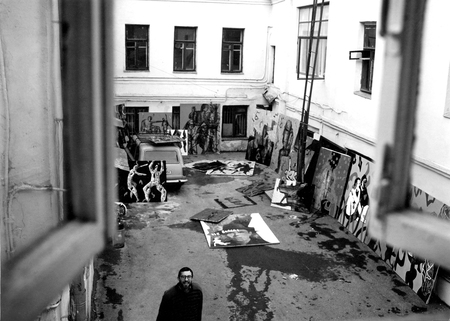
Left: In the courtyard of the artist’s studio, Moscow, 1986.
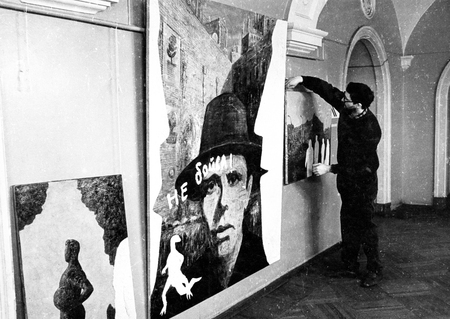
Right: Exhibition during the Rock-Art-Parade ASSA, Moscow, 1987
Schulz: If it was not a theme in art, was it perhaps present in everyday Russian life, in the consciousness of the people, precisely in its function as «picture of pictures»?