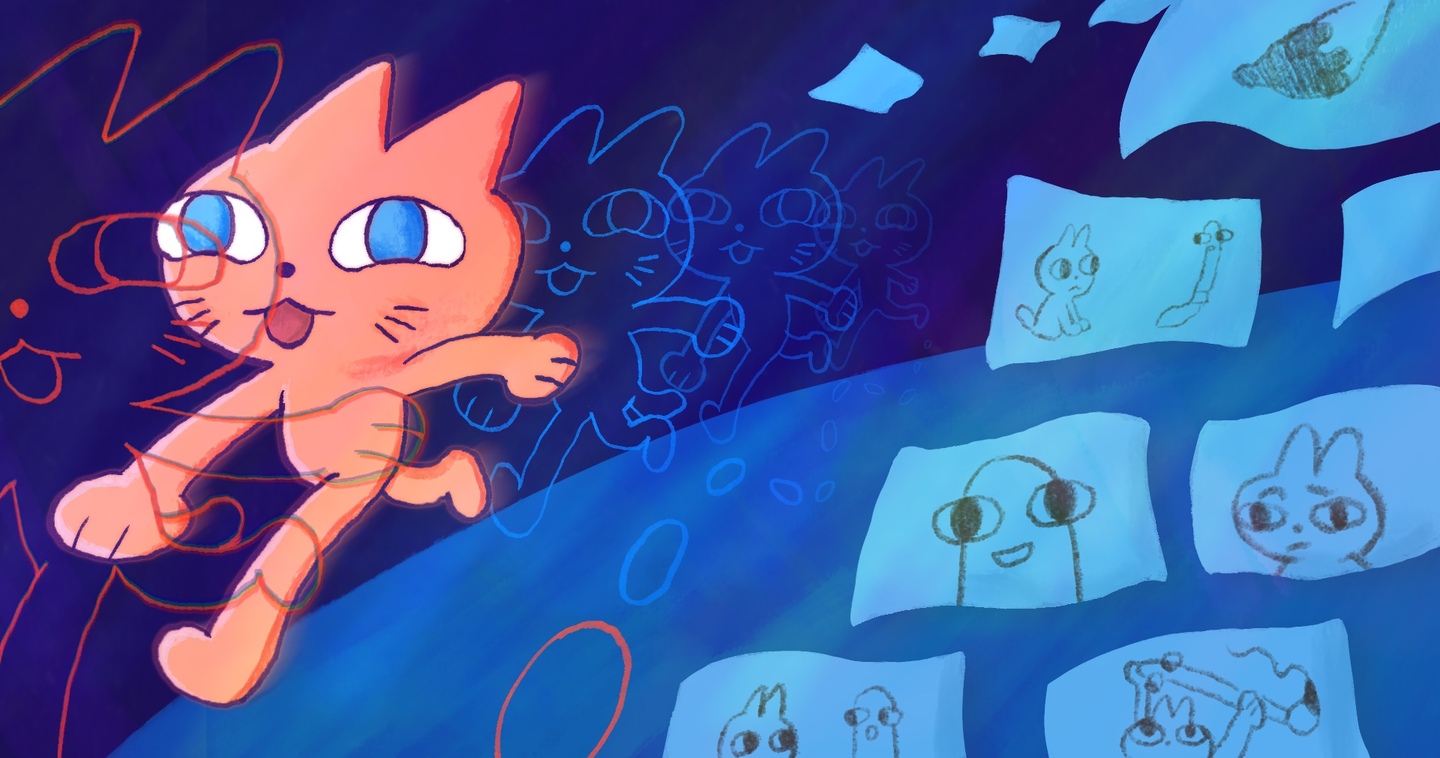
1. Ideation.
Another example is the animated film «Piper.» Its creators observed a small bird on the beach that was afraid of the waves. Initially, it was simply an observation of animal behavior. The animators then decided to try and convey the bird’s fear and curiosity through movement. Only during the creative process did it become clear that these elements coalesced into a complete short film.
Sometimes, an idea emerges from an experiment. Many abstract short films started with creators trying to animate a shape to sound or rhythm. They didn’t know what the cartoon would be about, but they understood that they wanted to test how a line reacts to music or how a form can change over time. For example, in the film «Dots, ” Norman McLaren didn’t begin development with any specific idea or plot. He was interested in observing how simple dots could move to music. He drew the dots directly onto film and watched what would happen if he changed the distance between them, the speed of movement, and the rhythm. But in the process, it became clear that the dots were beginning to look like living beings that communicated and played with each other.
Often, an idea emerges from a personal experience or feeling that the author wishes to share with the viewer. In the film «Five Minutes to the Sea, ” Natalia Mirzoyan reflected on her day at the beach and the introspection of observation. „Once, I saw two old people cautiously entering the sea—he with a cane, and she in funny floral trunks (unfortunately, we didn’t illustrate the flowers in the cartoon; it was too complex). The old woman had a small packet in her hand, and she was sprinkling water on her husband’s back. It was both funny and touching, and very cinematic, ” she shared in an interview with „Seans“ magazine.
Sometimes an idea arises from constraints. In coursework and short films, creators often set simple parameters for themselves: one character, one action, a short time frame, or a single location. For instance, when completing an animation exercise focused on special effects. These set conditions dictate the characters and the plot.
Many creators admit that they truly grasp the concept of their animated film only when it is nearly finished. The initial idea doesn’t always arrive first. Sometimes, it emerges at the end as a conclusion drawn from the work already done. Therefore, creators do not wait for a sudden epiphany—they start working. They observe the world around them, sketch, animate, and employ various techniques for idea generation.
One of the most well-known methods is a mind map or thought map. The author writes a single word in the center of the page, for example, «cat» or «school, ” and then begins adding associations around it. From one word, others emerge: actions, images, emotions, and objects. The map gradually expands, and among the many branches, an interesting connection may unexpectedly appear. This method helps to view an idea not as a single thought, but as an entire field of possibilities.
One of the most well-known practices is freewriting. The author sets a timer and, for several minutes, writes down everything that comes to mind without stopping or correcting the text. It is important not to think about quality or logic. This method helps bypass inner censorship and often leads to unexpected thoughts and images that can be developed later.
Many creators use cards. Individual cards record images, actions, words, or situations, which are then randomly combined. Screenwriters and authors often use this method to discover novel combinations and avoid cliché solutions. You can use a random word generator or ask a friend to send two random emojis and then invent a story based on them.
Assignment. Let’s Play «Gibberish»
2. Script and Storyboarding.