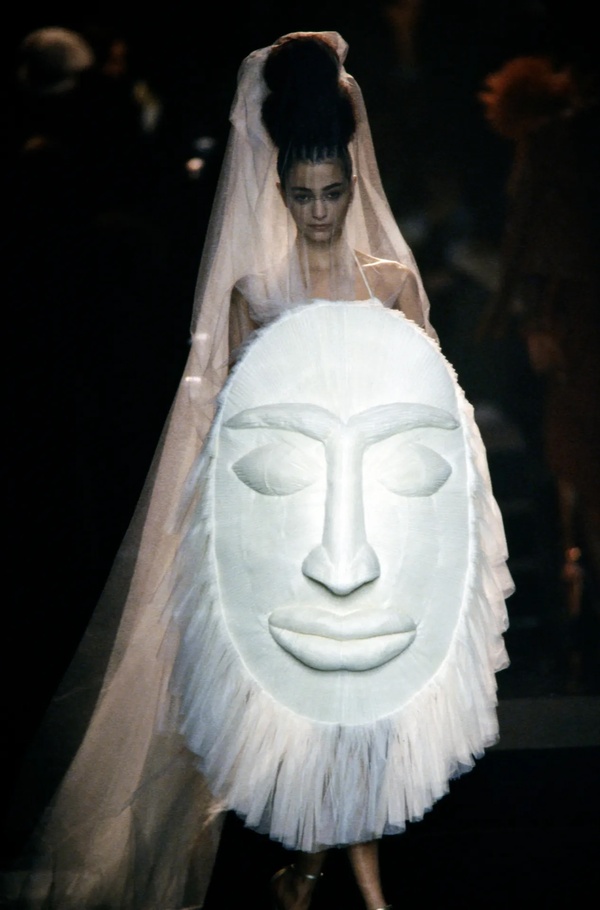
Exoticization in fashion is not merely drawing inspiration from another culture, but a method of presenting it in a way that constructs a depersonalized, idealized image of that culture.
«East, ” „Africa, ” „tribal”—these words are used in fashion not as ethnographic concepts, but as a set of visual symbols targeted at a Western consumer. Behind these symbols lies not knowledge of a culture, but rather a fantasy of it.
The mechanism of exoticization is well-described in postcolonial theory—primarily in Edward Said’s 1978 work on Orientalism. Said demonstrated that Western culture constructed an image of the „Orient“ as a space that was sensual, irrational, and archaic—in contrast to its own rational modernity. Fashion adopted this logic before it was articulated in theory: Paul Poiret’s „Eastern“ collections in the early 20th century, „African“ prints in 1970s mass-market items, „ethnic“ accessories in 1990s collections—all of these were built upon the principle of using symbols from other cultures as decorative elements.
The distinction between exoticization and cultural exchange lies in the relationship to the source. Exchange implies research and communication—a mutual give-and-take. Exoticization, however, requires only a sign; the real culture is never studied.
Today, exoticization as a strategy is increasingly criticized publicly, but it has not disappeared entirely. Increasingly subtle forms are being employed—such as „travel inspiration“ or „cultural dialogue”—where the logic of appropriation is masked as global openness.
Photo: Jean Paul Gaultier SS2005.