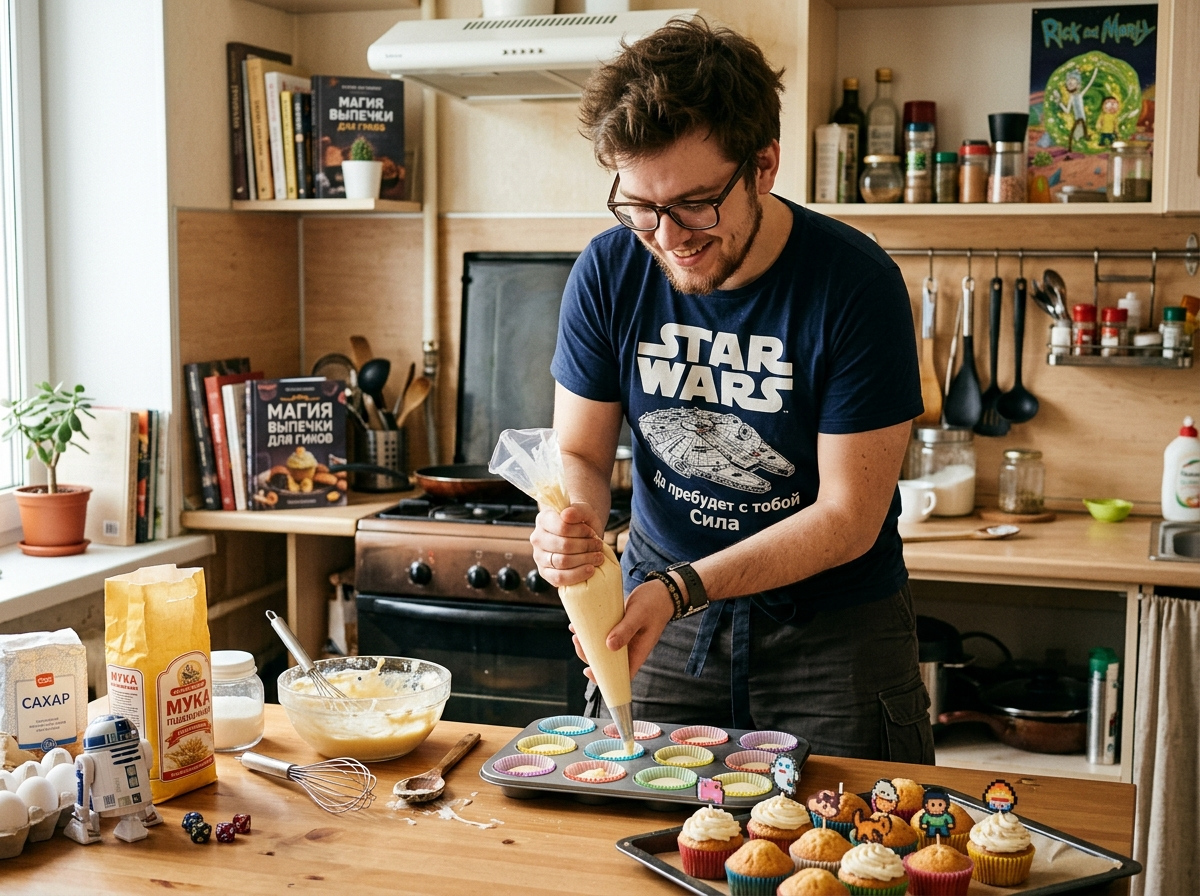
Миссия кексы: краткий курс для гиков
Course Topic
Baking basic homemade cupcakes from scratch for beginners with no culinary experience. The course explains the entire baking process—how to properly prepare ingredients and equipment, mix the batter, select fillings, bake the cupcakes, and correct common mistakes.
Course Abstract
This is a short, hands-on course for enthusiasts who want to learn how to bake but aren’t sure where to start. Participants will go from choosing ingredients and setting up the «system» to receiving finished cupcakes. The culinary processes will be explained in plain language—using algorithms, checklists, experiments, and error analysis. No baking experience or special knowledge is required—just basic kitchen skills, a willingness to try, and readiness to complete several practical assignments. In the finale, every participant will bake a batch of cupcakes, present their result, and upload a photo of their creation.
Learning Outcomes
After completing this course, participants will be able to independently prepare basic muffins according to a recipe, adhering to proper technique and safety guidelines. Participants will learn to: prepare the workspace and necessary ingredients; use kitchen scales, measuring spoons, and an oven; differentiate between dry and liquid ingredients; mix batter correctly; select and add filling; portion batter into molds; determine when the muffins are ready; analyze errors if the muffins did not rise, dried out, or remained undercooked; photograph the result and present it to other participants.
Target Audience
This course is designed for adult beginners—generally aged 18 to 40—who are interested in technology, gaming, design, engineering, programming, popular science topics, or other facets of geek culture.
Entry Requirements
Prior baking experience is not required. Participants will need: an oven; kitchen scale or measuring cup; a mixing bowl; a whisk or mixer; a spoon or spatula; a muffin tin or paper liners; oven mitts; the basic ingredients listed in the course. It is helpful to know how to use an oven and observe basic kitchen safety rules. If you do not have this experience, the necessary steps will be explained in the first module.
Course Format
The course is designed for self-paced completion with concise educational materials and practical assignments. Possible formats include: 5 learning modules; 6 short video lessons; step-by-step instructions; checklists; mini-quizzes; practical assignments; photo uploads; a final mission; feedback on results. The course can be taken on the educational platform, in an online class, or in a closed channel format with assignments.
Duration and Scope
Recommended duration — 1 week. Total volume — approximately 4–5 hours: 1.5 hours for material review; 30 minutes for quizzes and preparation; 2 hours for hands-on practice; 30–60 minutes for finalizing the outcome and reflection. Each lesson lasts 10–15 minutes. The practical assignment is completed after studying the relevant material.
Course Structure
Module 1. Launching the Mission: How a Cake is Structured
The participant will familiarize themselves with the course and learn what components make up a cupcake. Topics include: what a cupcake is; how a cupcake differs from a muffin and a sponge cake; the role of flour, eggs, sugar, butter, and baking powder; how ingredients affect the dough’s structure; and what tools will be needed. The practical assignment is to inventory the kitchen and check for the availability of equipment and ingredients.
Module 1. Initialization: Preparing the Kitchen for Launch
Course: «Mission: Cupcakes. A Quick Course for Geeks»
Level: Beginner, no baking experience required
Module Duration: 45–60 minutes
Format: Short text lessons, illustrations or videos, interactive assignments, a test, and practical work
Module Outcome: The participant has prepared the ingredients, equipment, and workspace for baking the first batch of cupcakes.
1. Module Placement in the Curriculum
The first module focuses on preparation. Participants are not yet mixing batter or turning on the oven. First, they become familiar with the task, check the equipment, gather ingredients, and organize their workspace. This approach is especially important for beginners. During the cake making process, some actions must be performed quickly and sequentially. If flour must be sought after the eggs are added, or if the mold is discovered only after the batter has been mixed, the probability of error increases. Within the course, preparation is viewed as project launch: first, the participant checks the requirements and resources, and then moves on to execution.
Module Structure
Mission 1: Kitchen Initialization
Before launching the first batch of cupcakes, we will check the system: ingredients, equipment, safety, and workspace.Welcome to the first mission.To bake cupcakes, you don’t need to be a pastry chef, understand complex techniques, or purchase professional equipment. However, you must prepare everything necessary in advance and understand the function of each ingredient.
In this module, you will:
become familiar with the course’s final assignment;
verify the available equipment;
assemble the basic ingredient set;
learn the purpose of each ingredient;
learn to measure ingredients correctly;
prepare your workspace;
and pass the readiness check for baking.
Screen 2. Mission Briefing
What You Will Do
Lesson Text
At the end of the course, you will independently prepare a batch of 8–12 muffins.
The finished muffin must:
maintain its shape after being removed from the mold;
have a fully baked center without raw dough;
be soft but not wet;
have a pleasant taste and aroma;
be safe to consume;
and conform to the chosen recipe.
For the final assessment, you will need to upload:
a photo of the finished batch of muffins;
a photo of one muffin cut in half;
a short report on the preparation process;
a description of one successful element;
a description of one element that could be improved.
The muffins' perfect appearance is not a mandatory requirement. The main goal of the course is to learn how to manage the process and understand the final outcome.
Important Message
An error in the first batch is not a mission failure—it is diagnostic information. If the muffin turns out dense, dry, or fails to rise sufficiently, we will determine the possible cause and adjust the process.
Mini-Task
Answer the question: Why do you want to learn how to bake muffins?
The participant is invited to select one or more options:
I want to learn to make things with my own hands;
I want to impress friends or colleagues;
I want to master a simple dessert;
I love to experiment;
I want to better understand food preparation processes;
I want to have fun;
Other option.
Free-Text Field
My personal goal for the course:
For example: «I want to bake chocolate muffins by myself and share them with my friends.»
Your answer will be saved in your personal account and shown to you at the end of the course.
Lesson 1. Cake Architecture Duration: 10–12 minutes Lesson outcome: Participants will understand the components of a basic test and the function of each one.
Screen 3. The Cake as a System
A cupcake can be conceptualized as a system where each element has a specific function. The basic recipe includes: flour; sugar; eggs; butter; milk; baking powder; salt; additional filling or flavoring. Changing the amount of one component can alter the entire outcome. For example, too much flour will make the cupcakes dense, and an excess of liquid may prevent them from baking properly. Baking is similar to executing a program: not only are the correct components important, but also their quantity, the order in which they are added, and the execution conditions.
Screen 4. Flour — The Framework