Concept
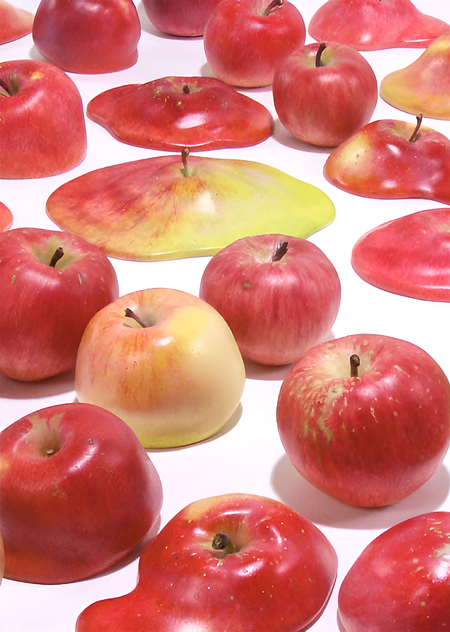
Everyday objects surrounding people are often perceived as purely utilitarian, familiar, and visually unremarkable. Our lives are filled with items whose form strictly conforms to function, and whose tactile properties are predictable. However, contemporary artists and sculptors intentionally disrupt this ingrained logic of perception. It is precisely this phenomenon—the radical reinterpretation of the mundane through the alteration of its material nature—that served as the main impetus for this investigation. I gathered works where familiar objects of mass culture and daily life lose their conventional functionality and transform into vessels for new visual meanings.
The relevance of this research lies in its ability to look beyond the conventional geometry and texture of everyday objects. While mass production strives for standardization, the artists I have chosen offer a deeply deconstructed, tactile perspective on material culture. Visual techniques such as distortion of scale, hyperbolization of detail, and the use of unexpected materials for the subject object present a fresh view of how contemporary art interacts with the mundane.
For the purpose of my visual investigation, the materials are the works of artists who employ a diverse range of techniques, including sculpture, assemblage, textile art, and experimental ceramics. I selected this circle of masters because they possess a unique plastic language that transforms the object through texture and form.
I have discovered that the artists' works can be categorized into four sections. Each group of artists demonstrates its own method of transforming the original nature of the object. This division into groups is based not only on the visual approach but also on the underlying concept the artist instilled in their work. The first section is Absorption. We can still see the object’s primary form, but it is enveloped, infected, and consumed by foreign matter. The second section is Transformation. Here, the artists alter the very form, essence, and nature of the object. The third section is Imitation. The artists use the properties of various materials to replicate an object’s form and view it from a new perspective. The final section is Deformation. This involves the controlled disintegration of form and a move beyond the everyday perception of the object.
The core question I asked myself throughout my research was: «What conceptual and semantic motivations guide contemporary artists as they radically transform everyday objects, and what metaphor have they embedded in their technique?»
The research is based on primary sources such as interviews with the authors, their personal records, and biographies. This allows for the identification of the creators' internal triggers and the tracing of a direct link between their personal motivation and their work.
Rubric: 1. Absorption 2. Transformation 3. Imitation 4. Deformation
Absorption
Kohei Nava
Kohei Nawa. «PixCell — Toy-Sushi #2 (Akami)» 2006.
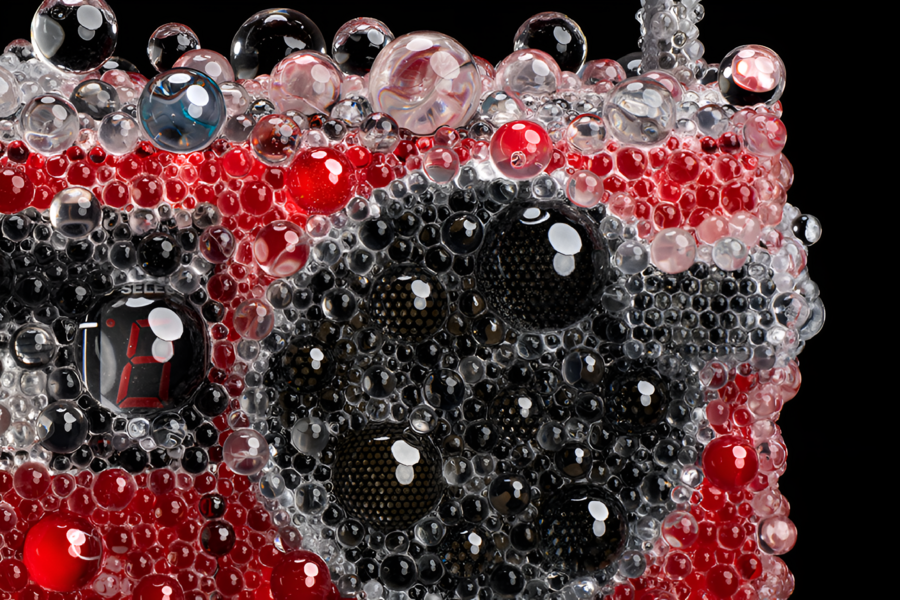
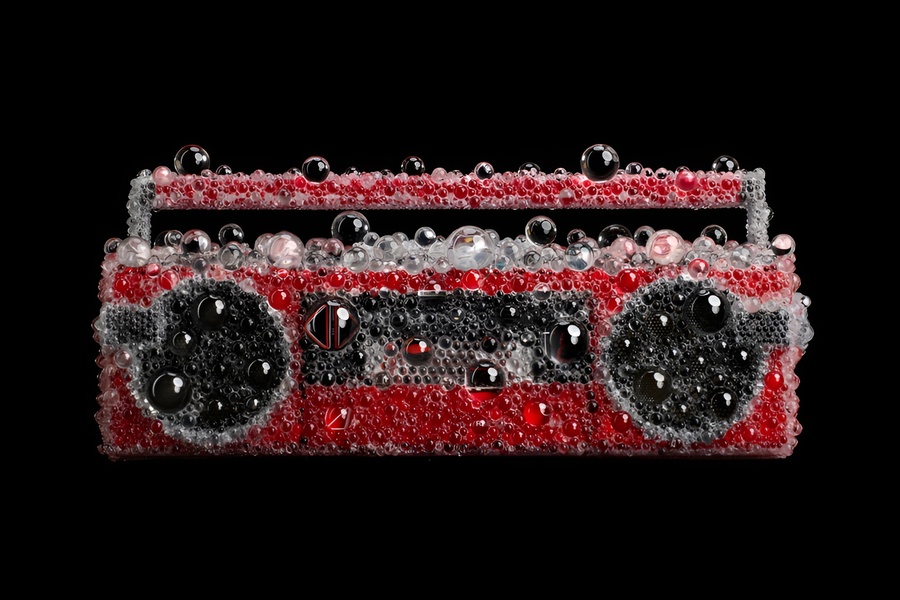
Kohei Nawa. «PixCell-Boombox» 2023.
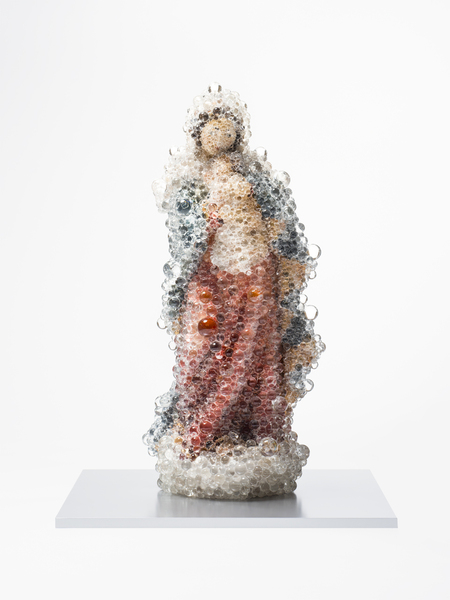
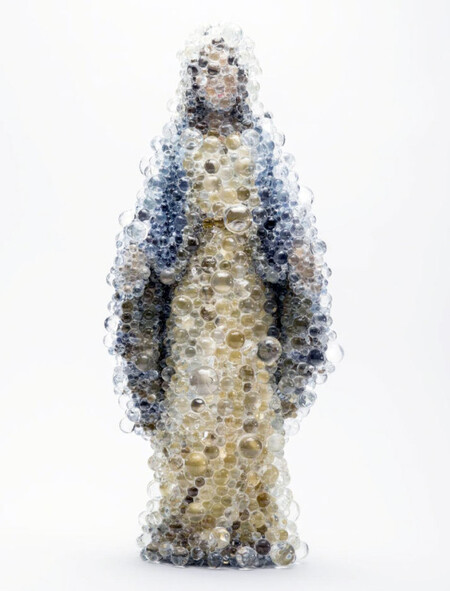
Kohei Nawa. «PixCell-Maria#19» 2017, «PixCell-Maria #16» 2015.
«The leitmotif in Kohai Nava’s work is the so-called „PixCell“ concept (a term he coined by combining the words „Pixel“ and „Cell“). PixCell is a concept that merges organic cells with pixels—the smallest units of digital imagery. Through these manipulations, Nava redefines existing objects and alters our perception and interaction with them. In the captivating series „Prism, ” „Liquid, ” „Glue, ” and „Nausea, ” Nava transforms the very nature of objects into something (seemingly) nonsensical. In this way, he activates the viewer’s sight, creating several metaphorical systems of representation.“ [1]
Stephanie Kilgast
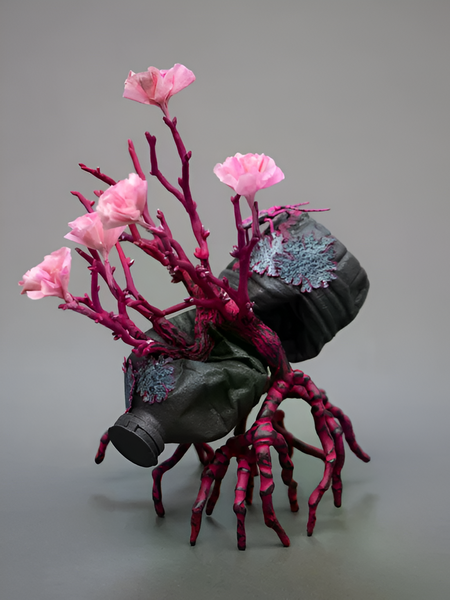
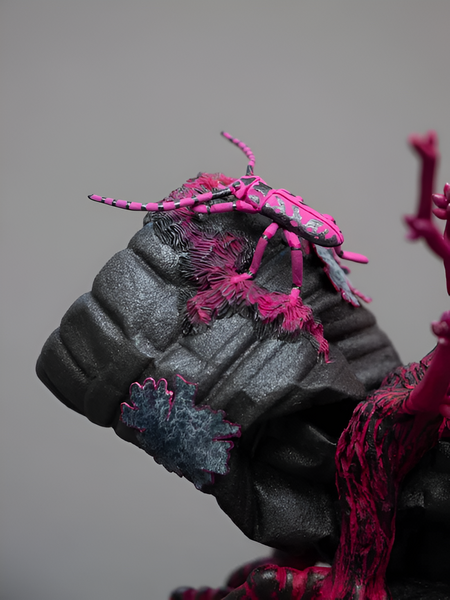
Stephanie Kilgast «BLOOM» 2024.
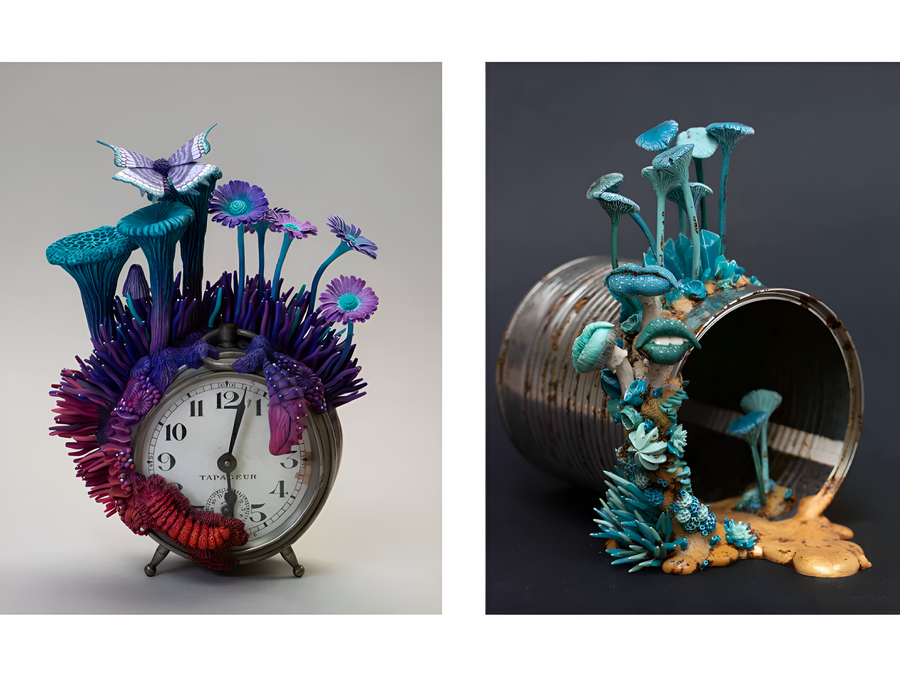
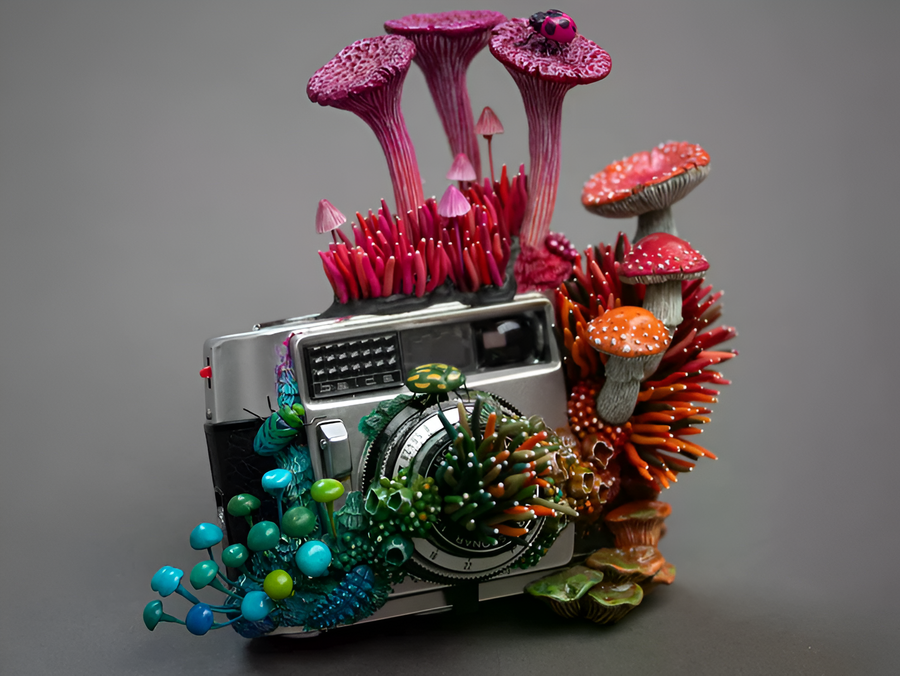
Stephanie Kilgast «SNAPSHOT» 2024, «CYCLE» 2025, «RUST» 2017.
«My works are dualistic; they contain as much darkness as they do hope. It is a story about the impact of our activities on the environment. A narrative of nature recovering from what we leave behind. A story of the beauty and resilience of the natural world.» [2] «Kilgast collects man-made objects from anywhere—from trash bins to charity shops—giving them new life as sculptures in his artworks.» [3]
Bouquet de Friez
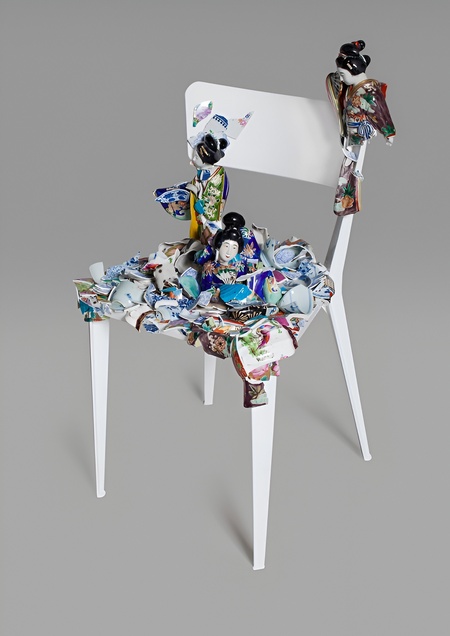
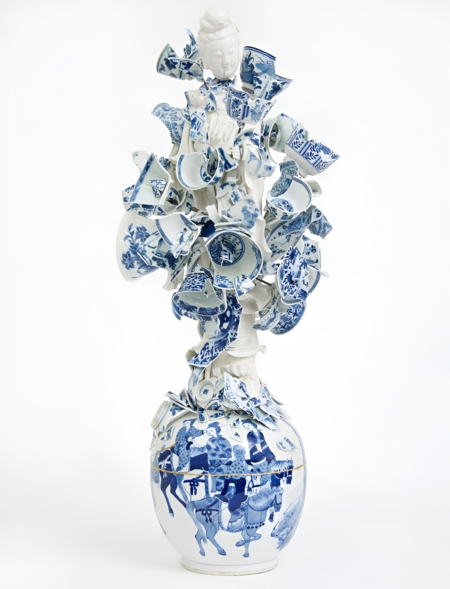
Bouke de Vries «Dutch Chair» 2016, «Goddess of the Fragments» 2014.
«Bouquet de Fris calls some of his porcelain sculptures ‘three-dimensional still lifes.’ ‘I compose these works as if, after a painter finishes a canvas, the ceramics shatter and crumble, and I breathe new life into them.’ He never shatters entire pieces; rather, he restores already damaged ones, creating new figures that emphasize the beauty of their former forms.» [4]
Metamorphosis
Philip KupferSchmidt
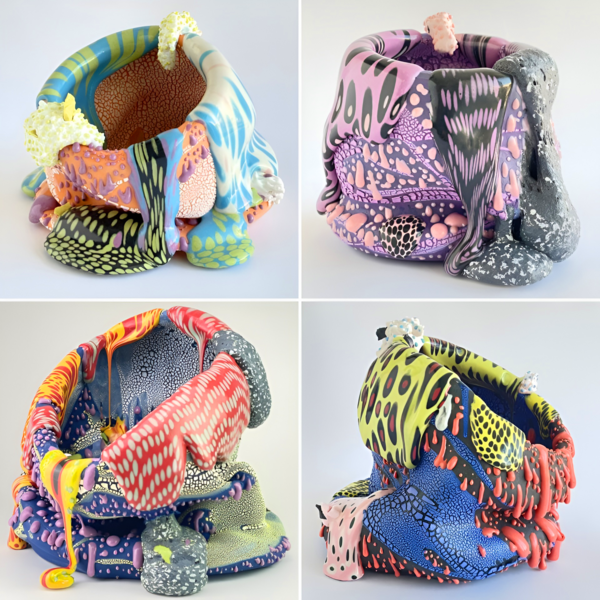
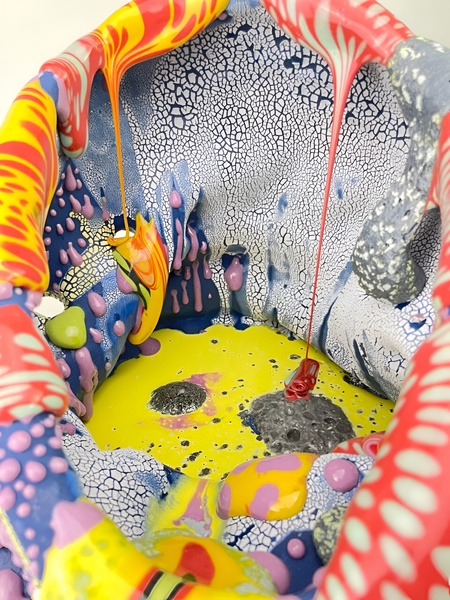
Philip Kupferschmidt, «Slouching Ceramic Vessels» 2023.
In his studio, Philipp KupferSchmidt creates massive ceramic vessels from which vibrant glaze drips and spreads. After the piece is thrown on the potter’s wheel, the artist deforms, stretches, and crumples the walls of the vase or pot, which he then covers with thick drips or large blobs of glaze. Many of the sculptures seem to sag under the weight of the liquid; their sides fold and warp, adopting distorted forms. «I explore the interaction of color and texture, which, overall, I hope creates the impression of an otherworldly realm—as if a person were reduced in size and moving within the confined space of the vessels.»
Yayoi Kusama
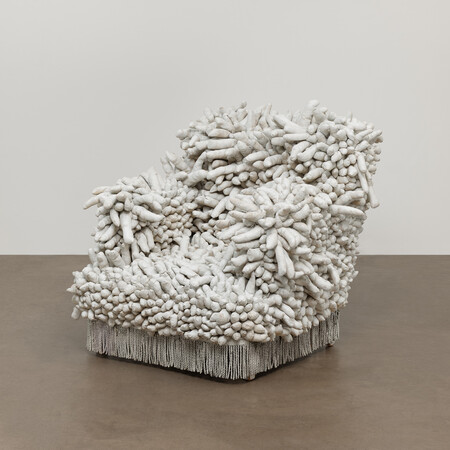
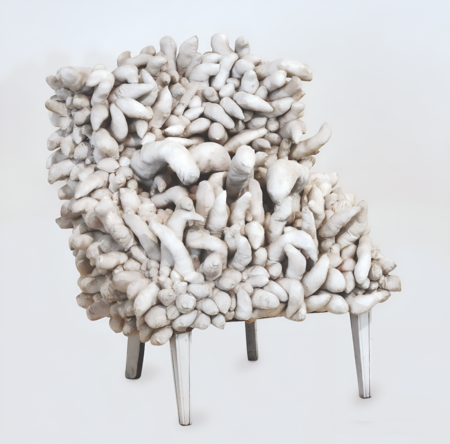
Yayoi Kusama «Accumulation No. 1» 1962, «Untitled Chair» 1963.
«Soft sculptures, which she began developing in 1961 while living in New York, became an integral part of Yayoi Kusama’s long-standing practice. Her initial series incorporates pieces of furniture and everyday objects entirely covered in countless soft phallic forms, which were hand-stitched and machine-sewn. These sculptures—testaments to the artist’s ambivalent attitude toward sexuality—are often viewed as a precursor to the feminist movement that emerged in the mid-1960s in the United States, as well as a reflection of her psychological state. Beyond their undeniable cathartic effect, they also express Kusama’s organic vision of the world as an indivisible whole, where objects and all living things are constantly transforming and intermingling with one another."[6]
Max Hooper Schneider
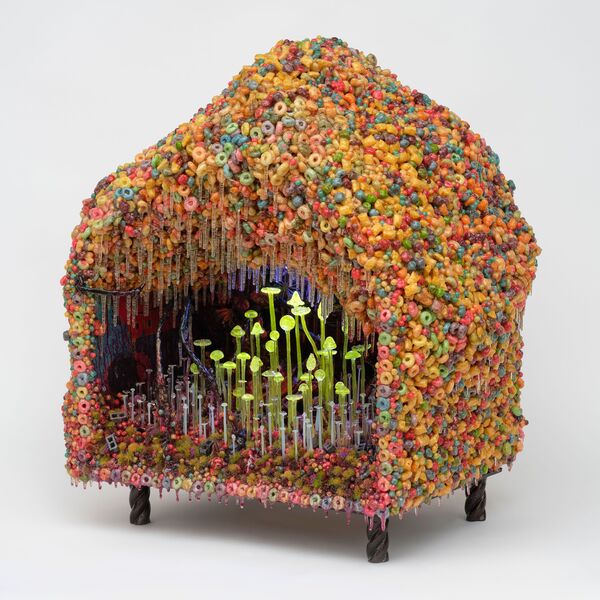
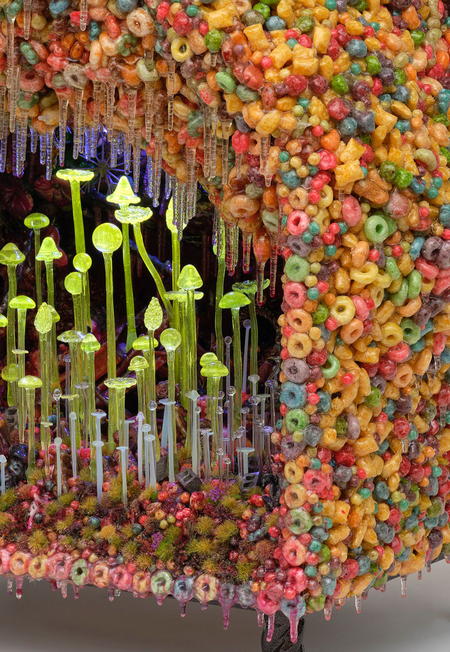
Max Hooper Schneider «CerealCave» 2023
Fruity Cheerios overgrown with lint or plastic plants suitable for an aquarium, miniature dioramas created in Max Hooper Schneider’s Los Angeles studio—these pieces merge ecology and technology within a disquieting posthuman future. Schneider’s creativity revolves around the concept of trans-habitat, which he describes as «a relentless advance in which bodies… are continuously created, transformed, destroyed, and reconstituted.» His works imply this cyclical process, where otherworldly organisms subsume formerly mundane objects, and humans seem to be displaced from their role as central actors.» [7]