media startup «Art in Motion»
Internship Context
As part of the practical course, «Launching and Managing a Media Startup, ” I visited the exhibition „From Beijing to Moscow: A Dialogue of Cultures“ at the State Tretyakov Gallery—a collaborative project with the National Museum of China, one of the world’s largest museums with a collection of over 1.4 million artifacts. The exhibition brought together Ming and Qing dynasty painting and calligraphy, reconstructions of traditional interiors, decorative and applied arts objects, and thematic sections dedicated to the role of writers, scholars, and officials in Chinese artistic culture.During the tour, several key observations became evident:Non-Western art is practically absent in digital media formats that resonate with a younger audience—existing content is either overly academic and inaccessible or superficial and lacking context.
The exhibition space deliberately slows the viewer down: visitors stop not at the labels, but at the works themselves—the artist’s gesture, the texture of the scroll, the structure of the ideograph holds attention without any digital accompaniment.
Audiences increasingly seek meaning rather than facts about art: not „when it was written, ” but „what it meant to contemporary viewers“ and „why it matters now.“
Short-form video as a tool for cultural mediation has barely been utilized regarding non-Western traditions—despite obvious interest in Asian culture in Russia and globally, this niche remains open.It was these observations that inspired the idea of Art in Motion—a media platform for short vertical videos that makes non-Western art accessible and vibrant for a broad, young audience.
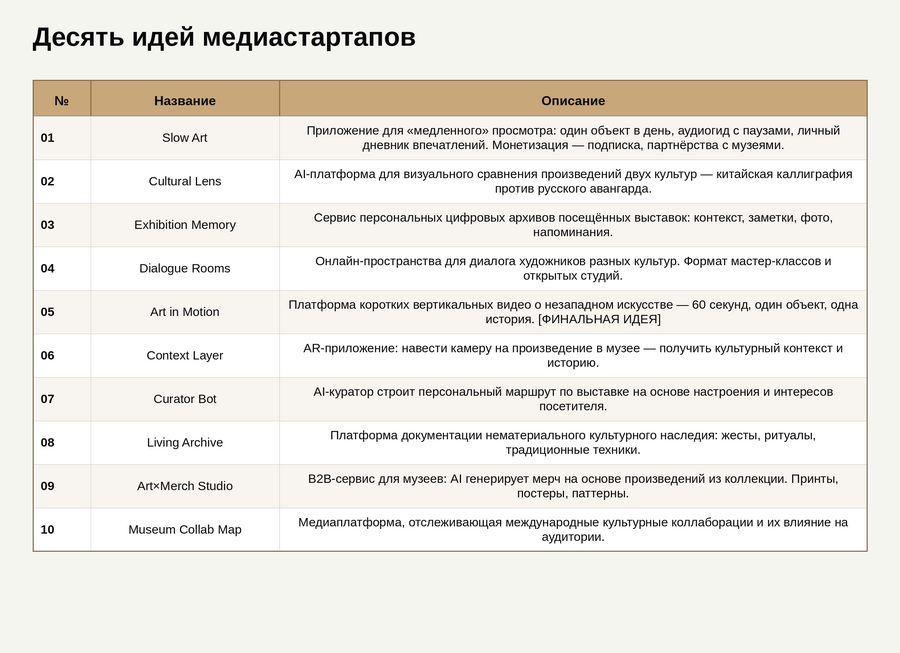
list of 10 media startup ideas
Idea 1 — Slow Art
Essence: An application for «slow» art viewing—one object per day, an audio guide with pauses, and a personal impression journal. It is not an image gallery, but a practice of attentive perception: the user receives one artifact in the morning and returns to it throughout the day.
Target Audience: Urban dwellers aged 25–45 interested in culture and mindfulness practices; users of applications like Calm and Headspace.
Problem: Digital consumption of art has become superficial, and museum applications are overloaded with content rather than designed for deep engagement.
Source of Inspiration: At an exhibition in the Tretyakov Gallery, the physical space deliberately slowed the viewer down, leading to the realization that this quality of attention is missing in digital formats.
Idea 2 — Cultural Lens (AI Cultural Comparison)
Concept: An AI platform for visually comparing works from two distinct cultures—for instance, Chinese calligraphy versus Russian avant-garde, or Japanese woodblock prints versus European Impressionism. The user selects two traditions and receives a structured analysis of their similarities, differences, and mutual influences.
Target Audience: Students in the humanities, instructors of Art History and Visual Arts, and educational technology platforms.
Problem: Comparative cultural analysis requires expert-level knowledge, which is often inaccessible to the general public—textbooks exist, but an interactive tool does not.
Idea 3 — Exhibition Memory (Visit Archive)
Core Concept: A personal digital archive service for visited exhibitions—context, notes, photos, reminders, and recommendations for upcoming events. It helps users build a personal history of cultural consumption and revisit their impressions.
Target Audience: Regular museum and gallery visitors, cultural journalists, and individuals with a rich cultural life.
Problem: Impressions from exhibitions fade within days—there is no tool that helps preserve and reflect upon what has been seen.
Idea 4 — Dialogue Rooms (online artist discussion)
Essence: An online space for real-time dialogue among artists from diverse cultures—workshops, open studios, collaborative projects. The platform connects practicing artists from different countries, facilitating cultural exchange without requiring physical travel.
Audience: practicing artists, art school students, and cultural institutions and foundations.
Problem: International cultural exchange remains a privilege of residency programs and grants—most artists lack access to international peers.
Idea 5 — Art in Motion (short videos about non-Western art)
Core Concept: A media platform for short vertical videos about the artistic traditions of the non-Western world—60 seconds, one object, one story. The narrative is built around the cultural context and meaning of the artwork, rather than chronology. Formats: TikTok, Reels, YouTube Shorts.
Target Audience: Urban youth aged 18–32 who consume content vertically and are open to non-Western traditions but do not know where to find them.
Problem: Non-Western art is virtually absent from mainstream digital media in a format easily digestible by a young audience—existing content is either overly academic or superficial.
Idea 6 — Context Layer (AR in a museum)
Concept: An AR application that overlays cultural context directly into the museum space—you point your camera at a piece and instantly receive its history, connections to other eras and artists, an explanation of its technique, and its symbolism. It functions as a visual alternative to an audio guide.
Audience: Museum visitors aged 20–40 who own smartphones and are open to digital enhancement of their cultural experiences.
Problem: Standard audio guides and QR codes provide factual information, but they fail to deliver context or emotional engagement—the gap between the artwork and the viewer persists.
Idea 7 — Curator Bot (AI exhibit guide)
Concept: An AI curator that builds a personalized museum tour based on the user’s mood, interests, and available time. It can integrate into a museum’s app or operate as a standalone service—the user answers three questions and receives a route featuring 8–10 exhibits.
Target Audience: Casual museum visitors, tourists, individuals with limited time, and those who feel lost in large exhibitions.
Problem: Most visitors don’t know where to start or what to focus on—the standard tour fails to account for personal context.
Idea 8 — Living Archive (Intangible Heritage)
Essence: A documentation platform for intangible cultural heritage—gestures, rituals, traditional techniques, and oral practices. Collaboration with ethnographers, museums, and bearers of tradition: video, text, and interactive distribution maps.
Audience: Ethnographers and anthropologists, cultural institutions, educational organizations, and the general public interested in traditional cultures.
Problem: Intangible heritage is disappearing faster than it can be documented—existing archives are fragmented, inaccessible, and not adapted for a broad audience.
Idea 9 — Art×Merch Studio (Museum Merchandise)
Concept: A B2B service for museums and galleries—AI generates merchandise based on collection artworks. The museum uploads an image, and the system creates prints, posters, and patterns for apparel and accessories, taking into account copyrights and brand identity.
Target Audience: Museums, galleries, and cultural foundations interested in developing a merchandise line without an in-house design department.
Problem: Most museums produce uniform, low-quality merchandise—there is no tool that allows for the rapid and high-quality transformation of a collection into a commercial product.
Idea 10 — Museum Collab Map (Map of Cultural Collaborations)
Core Concept: A media platform that tracks, visualizes, and analyzes international cultural collaborations—such as joint exhibitions, exchange programs, and co-published works. It features an interactive map with filters by country, collaboration type, and outcome.
Target Audience: Curators, cultural managers, researchers, journalists, and institutions planning international projects.
Problem: Information regarding cultural collaborations is scattered and unsystematized—there is no single resource to track trends or find potential partners.
Idea Scoring
Selection and justification of «Art in Motion»
Selected Idea: Art in Motion—a platform for short videos on non-Western art.
Art in Motion was chosen as the final concept for four interconnected reasons.
Observation from the Exhibition At the «From Beijing to Moscow» exhibition, it became evident that non-Western art—including Chinese calligraphy, scroll painting, and traditional interiors—makes a profound impression through direct engagement. However, in the digital media environment, this art is almost absent in formats accessible to a younger audience. Existing content is either overly academic and dense or superficial and lacking cultural context.
Market Logic Short-form vertical video is the dominant content consumption format for the 18–35 age group. TikTok, Instagram Reels, and YouTube Shorts collectively boast over 3 billion active users. Yet, art content about non-Western traditions in these formats is virtually nonexistent—the space is open.
MVP Simplicity The Minimum Viable Product (MVP) is a channel on a single platform featuring regular 60-second videos. It requires no extensive technical development, can be managed by a small team of two to three people, and allows for hypothesis testing within four to six weeks. This is critical: the idea can be tested without needing significant startup capital.
Global Potential Asian culture maintains consistent popularity across Russia, Europe, the United States, and Southeast Asia. The vertical video format does not require adaptation for different markets—one video performs globally. This makes Art in Motion scalable from day one.
Media Startup Description: Art in Motion