Concept
The subject of this visual study is Henri Matisse’s «Jazz» series and the expression of Eastern art principles within it. The research focuses on the similarities between Matisse’s artistic thought and Eastern painting: the approach to line, color, space, and the method of conveying emotional states through imagery.
Interest in this topic stems from the fact that the «Jazz» series holds a unique place in Matisse’s later work. The cycle’s pieces were created between 1943 and 1947 during the war, while the artist was ill, and forced to abandon traditional painting. Instead of a brush, Matisse began working with shapes cut from paper stained with gouache, transforming color and silhouette into the primary expressive means. In these works, his artistic language becomes extremely concise: realistic depth disappears, figures are simplified to conventional silhouettes, and the composition is built upon the rhythm of color patches and the movement of line.
These principles draw the «Jazz» series close to the Eastern painting tradition. In Japanese woodblock prints and ancient Chinese painting, the flatness of the image, decorative quality, expressive line, and the desire to convey not the external appearance of an object but its inner essence play a vital role. Eastern art is characterized by a rejection of excessive detail and an emphasis on the image’s emotional impact. These features prove closely aligned with the artistic language of late Matisse, especially in the «Jazz» series, where the image ceases to be a description of reality and becomes a means of communicating an inner state through form, rhythm, and color.
Information Curation Principle
The principle of material selection is based on choosing works in which these artistic characteristics are most vividly expressed. The study centers on pieces from Matisse’s «Jazz» series, as well as selected early works, which allow us to trace the formation of his interest in the decorative plane, localized color, and conventional representation. Examples from Japanese woodblock prints and Chinese painting are used for visual comparison, drawing on the principles of concise form, rhythmic composition, and the emotional expressiveness of line.
Rubrication Principle
The research is divided into three parts. The first is dedicated to the historical context: the spread of Japonism in Europe, the formation of Matisse’s artistic language, and the creation of the «Jazz» series amidst the artist’s war and illness. The second part examines the technique of cutting from colored paper and its comparison with Eastern art, which is based on the work of silhouette, line, and plane. The third part analyzes the symbolism of the «Jazz» series, where circus and decorative imagery acquires a dual meaning and begins to associate with the anxiety, violence, and sense of instability of wartime.
Key Question
The key question of this study is how the artistic principles of Eastern art manifest in the «Jazz» series and how they influence Matisse’s visual language. The study hypothesizes that the «Jazz» series does not demonstrate a direct borrowing of Eastern motifs, but rather a deeper similarity in artistic thinking—a rejection of realistic depiction and an aspiration to convey the emotional essence of the image through color, rhythm, and stylized form.
Navigator
- Concept
- Categorization
- Historical Context
- Artistic Methodology
- Duality of Images
- Conclusion
- Bibliography
- Image Sources
Historical Context
Henri Matisse was one of the key artists of 20th-century European modernism and a leader of Fauvism. His work is tied to the search for a new artistic language based on the expressive power of color, line, and the decorative plane. At the end of the 19th and beginning of the 20th century, European art was heavily influenced by Japonisme. After Japan opened to Europe, artists began actively studying Japanese Ukiyo-e woodblock prints, adopting their flatness, local color, asymmetrical composition, and rejection of deep perspective. These characteristics significantly influenced the development of modernism and were partially reflected in Matisse’s early work. Simplified forms, decorative qualities, and conventionalized space gradually emerge in his works, yet the artist drew inspiration not only from Eastern art but also from antiquity, Islamic ornamentation, African sculpture, and his own explorations in color and form.
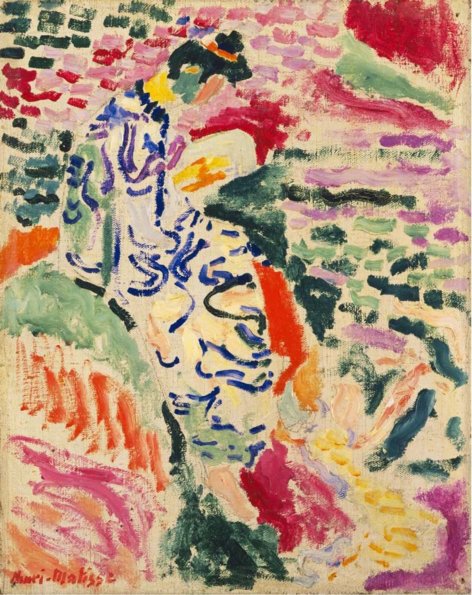
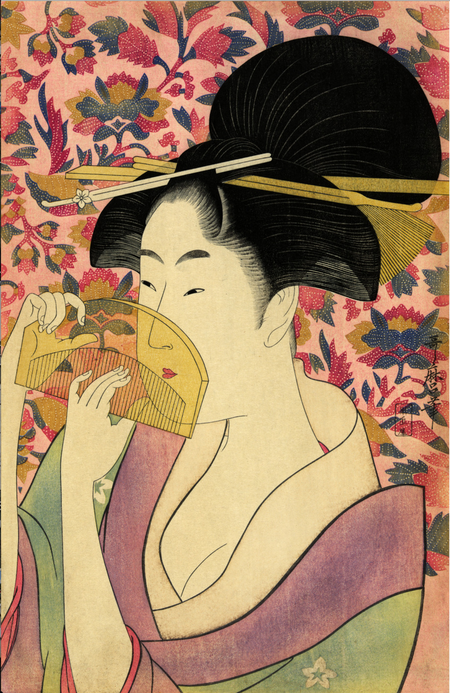
1 Henri Matisse — «Japanese Woman by the Water» — 1905 2 Kitagawa Utamaro — «Comb» — 1785
The «Jazz» series belongs to Matisse’s late period and was created between 1943 and 1947 during the German occupation of France. This period was marked by political instability, war, and personal struggles for the artist. Matisse’s family was connected to the French Resistance. The Nazi regime classified modernist art as «degenerate»; Matisse’s works were removed from exhibitions and expelled from German museums. The artist himself was in poor physical health following a serious illness with cancer and surgery. Because of this, he could no longer work with traditional painting materials and began creating compositions using forms cut out from paper colored with gouache. All of this became a crucial phase of his late work and formed the basis of the «Jazz» series, in which the artist ultimately transitions to extremely simplified forms, planar composition, and the expressive interaction between color and silhouette.
Horse, Rider, and Elephant — 1943
Initially, the «Jazz» series was linked to circus and theatrical imagery, which resulted in numerous dynamic scenes featuring acrobats, clowns, and riders. Later, the book’s concept broadened, evolving into a free combination of various visual motifs. The title «Jazz» is not connected to a specific musical theme, but rather to the principle of improvisation and rhythm—both artistic and musical. The gouache paper cutout technique enhances this feeling: the forms appear fluid and spontaneous, and the line assumes the character of gesture and movement.
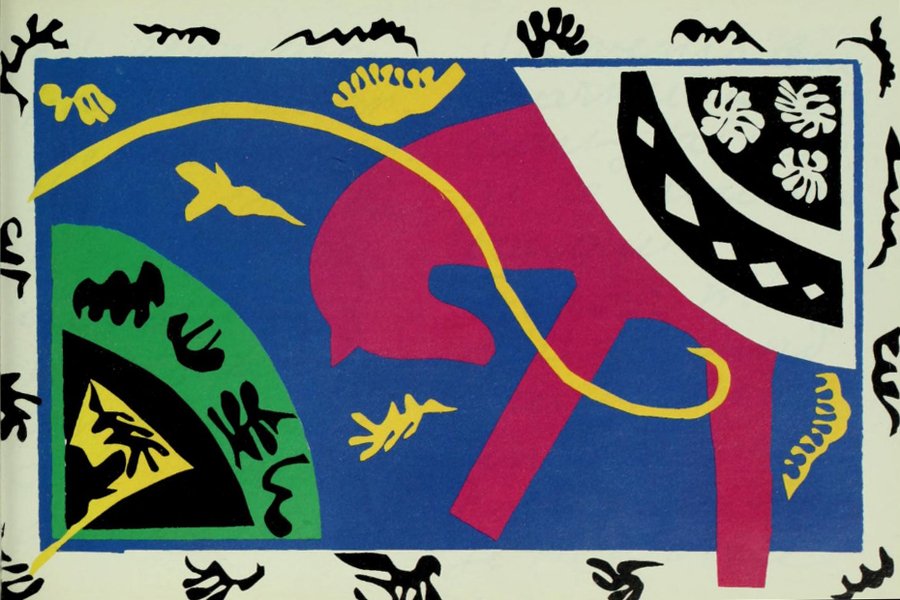
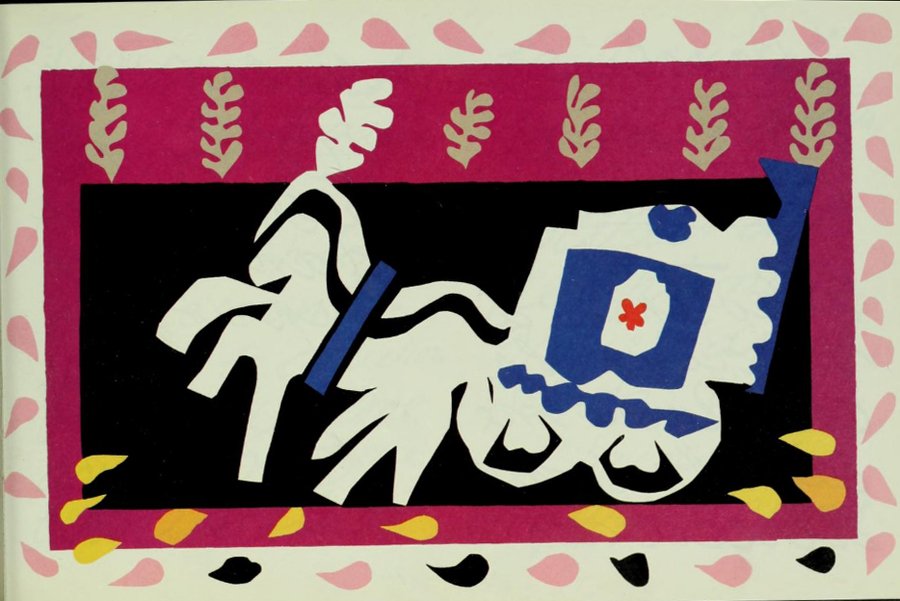
1 Pierrot’s Burial — 1943 2 Liturgy — 1944 3 Horse, Rider, and Elephant — 1943
The vibrant and vivid imagery I used originated from memories of circuses, folk tales, and travels.
Artistic Method
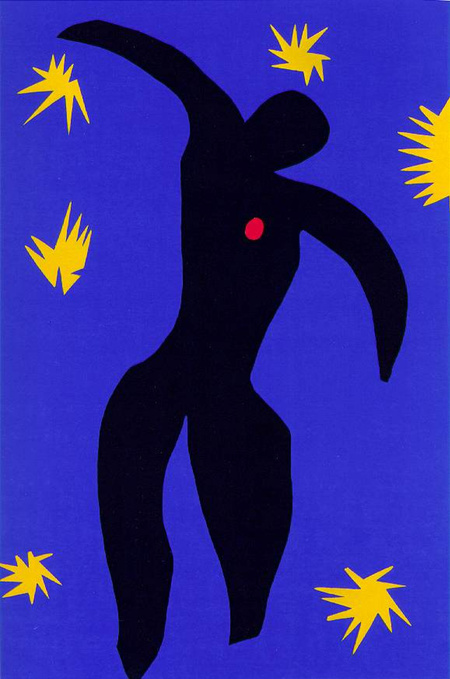
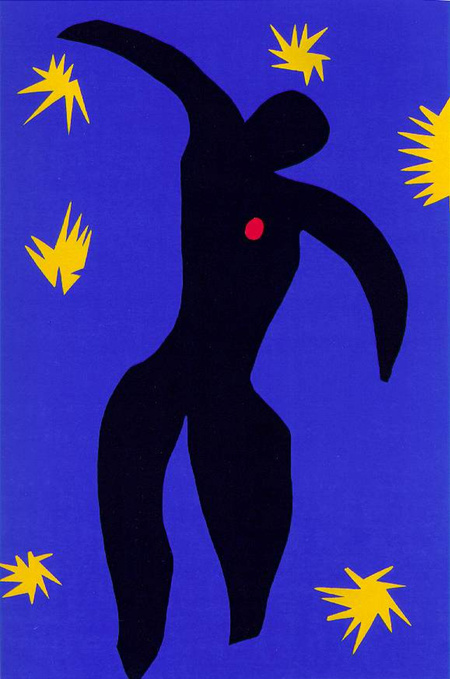
Henri Matisse’s statement, «Accuracy is not truth, ” becomes a key to understanding his artistic method. This is particularly evident in the work „Icarus“ from the „Jazz“ series. The human figure here is reduced to a simple black silhouette, lacking anatomical detail. The body appears almost abstract: facial features, volume, and realistic plasticity are absent. However, it is precisely because of this conventionality that the image becomes emotionally expressive. The outstretched arms and tense posture evoke a sense of falling, flying, and simultaneously internal anxiety. The red dot in the center of the figure is perceived as a heart or a wound, while the surrounding yellow shapes resemble flashes of light or explosions. The depiction does not aim to precisely show the mythological Icarus—it conveys a state of danger, vulnerability, and internal tension.
Despite the decorative nature of the scene, the composition is filled with a sense of instability: the figures seem to be balancing between play and peril. Matisse deliberately avoids realism because the emotional impression was more important to him than precise representation.
„Icarus“ — 1943
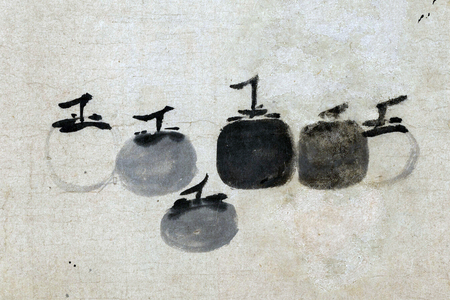
A similar principle is found in Song Dynasty Chinese painting, where the artist strives not for external resemblance but for the transmission of «qi”—the inner vital energy of the image. For instance, in the scrolls „Six Jujube Berries, ” the objects are depicted with extreme conciseness; yet, it is this minimal form that allows the viewer to focus on the rhythm, balance, and internal feeling of the composition. As with Matisse’s works, the image ceases to be a description of an object and becomes a means of conveying a state of being.
Muqi — „Six Jujube Berries“ — 13th century
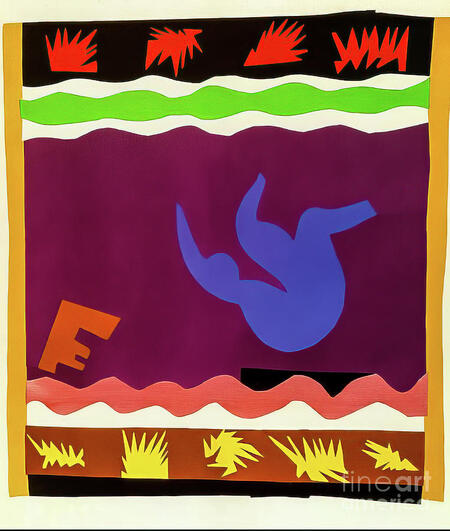
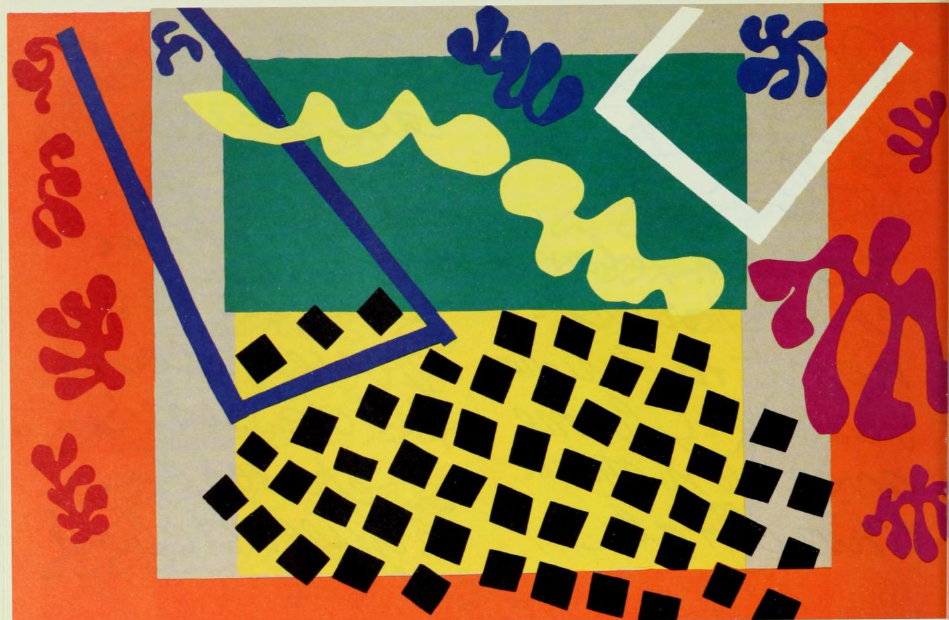
Matisse largely rejects traditional European perspective. Space in his compositions becomes flat, and figures exist not within a realistic environment, but on the surface of the paper. This is especially evident in the work «Toboggan, ” where forms are arranged like colored cutouts, creating no sense of depth. Diagonal elements generate movement, yet the space remains conventional and decorative. Because of this, the viewer’s attention is focused on the interplay of rhythm, color, and form.
„Toboggan“ — 1943
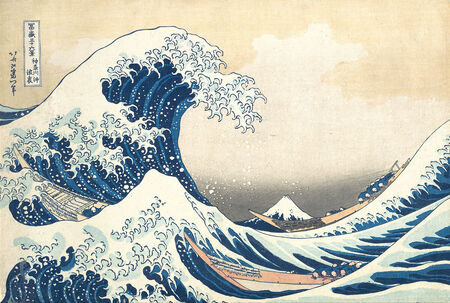
This approach connects Matisse’s later work with Japanese Ukiyo-e prints. In the works of Katsushika Hokusai and Utagawa Hiroshige, space is also constructed through planes of color and compositional rhythm, rather than through academic perspective. For instance, in «The Great Wave off Kanagawa, ” space is perceived more as a decorative system of interrelated forms than as a realistic scene.
Katsushika Hokusai — „The Great Wave off Kanagawa“ — 1830
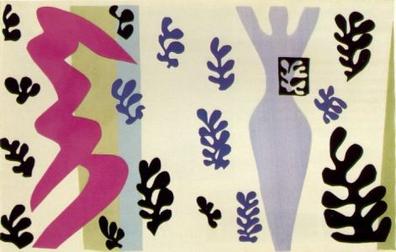
Simplifying the form becomes Matisse’s way of intensifying the image’s expressiveness. In the «Jazz» series, figures are often reduced to silhouettes and symbols, yet it is this simplification that makes the compositions more emotionally charged. In «The Scythe, ” the human figure almost loses its individual characteristics, transforming instead into a rhythmic system of colored lines. Despite the minimal detail, the composition retains a sense of tension and danger. Matisse achieves this effect through paper-cutting techniques. Thus, the form ceases to be descriptive and begins to function as an independent visual sign.
„The Scythe“ — 1943
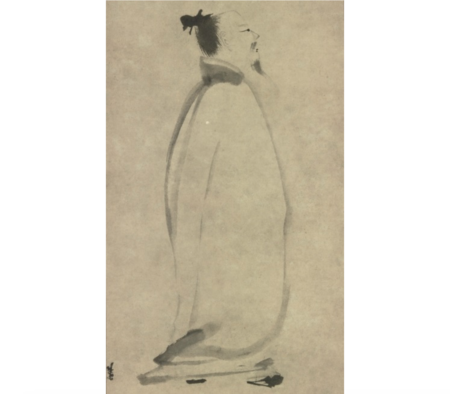
This principle aligns with Eastern artistic tradition, where conciseness was considered a demonstration of mastery. In Chinese calligraphy and painting, a few lines could convey the character of movement, mood, and the inner energy of an image. Such a concentration of expressiveness is particularly noticeable in the work of the artist Liang Kai, where figures are depicted with rapid, almost schematic strokes.
Liang Kai — «Li Bao on a Stroll» — 13th Century
An artist must master creativity—they must be in harmony with its rhythm—and this can only be achieved through serious effort that allows them to attain mastery. This will subsequently enable them to express themselves in their own language.
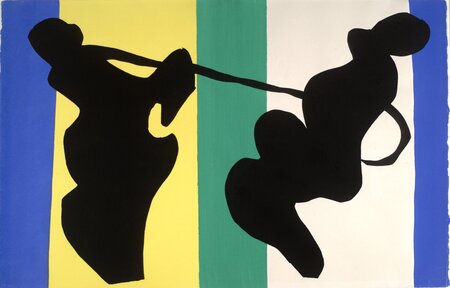
In the «Jazz» series, color ceases to be a means of realistic representation and becomes the primary carrier of emotional state. Matisse utilizes pure local colors and sharp contrasts, allowing the compositions to powerfully affect the viewer. In the piece «Cowboy, ” vibrant, contrasting colors create a sensation of movement and improvisation. Color here is detached from reality—it does not describe the subject but rather shapes the emotional rhythm of the composition. This effect lends the images a simultaneously celebratory and anxious quality. Through color in „Jazz, ” Matisse conveys tension, freedom, anxiety, and the energy of movement.
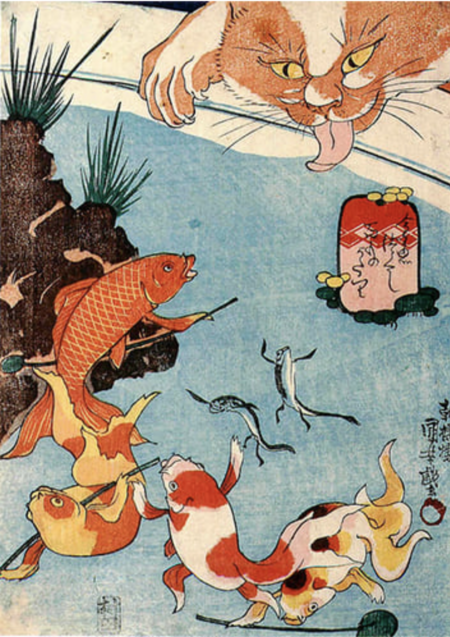
This understanding of color can be likened to Japanese woodblock prints, where local color was employed not for naturalism, but to amplify decorative qualities and emotional impact. This is especially noticeable in the later works of Utamaro Kuniyoshi, where contrasting patches of color create compositional dynamism.
Utamaro Kuniyoshi — «Cat Threatening Goldfish» — 1939–1942
The «Jazz» series is constructed not as a sequence of specific narratives, but as an emotional visual experience. Even when Matisse references circus imagery, acrobats, or mythological figures, the images are perceived more as states and sensations than as illustrations of events.
This is particularly evident in «Icarus.» The work simultaneously evokes the myth of Icarus’s fall, a circus flight scene, and the feeling of wartime catastrophe. The imagery remains highly stylized, yet the emotional impact is stronger precisely because of this abstraction. The viewer perceives not a specific story, but a feeling of solitude, danger, and falling.
This understanding of art is akin to Eastern painting, where the image was viewed as a means of conveying the artist’s inner state. In Chinese tradition, the value lay not in copying the world, but in the ability to express mood and vital energy through minimal artistic means.
In «Jazz, ” line, color, and form begin to function as emotional categories. The rhythm of the compositions resembles musical improvisation: figures move, collide, and lose stability. Because of this, the series is perceived as a visual expression of the artist’s internal tension and emotional experience.
Duality of Images