ЛЕКЦИЯ 3. ЦВЕТ И ФАКТУРА
Color as part of the visual identity
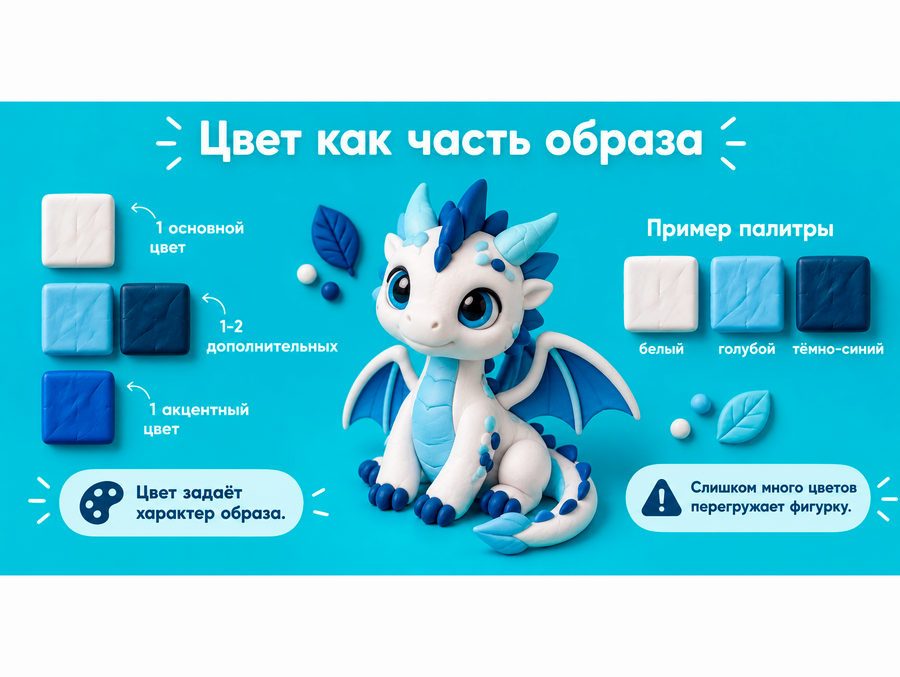
Color helps make a figure more expressive and immediately defines its character. Before starting, it is best to determine the main palette in advance.
Color Mixing
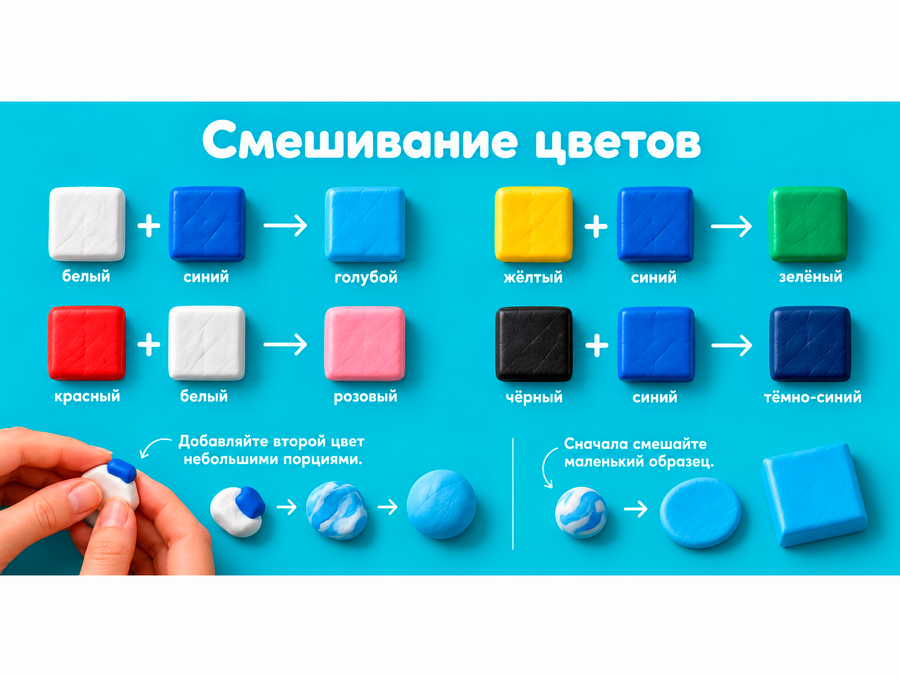
Polymer clay of various colors can be mixed together. Key examples: — white + color → a lighter shade; — black + color → a darker shade; — yellow + blue → green; — red + white → pink; — blue + white → light blue.
Important
Add the second color in small portions. It is easy to achieve a darker or more saturated shade, but it is much harder to reverse a color that has become too dark.Creating Tones
For the figurine, it is better to use several close shades rather than just one color. For example:
blue → cyan → light blue
This allows you to delineate different parts of the character:
— body;
— horns;
— wings;
— fur;
— scales;
— decorative elements.
The Golden Rule:
Shades must differ enough so that details do not merge into one another.Smooth color transition
Sometimes it is necessary to transition from one color to another.
For this:
- take two colors;
- join them at the edges;
- roll them out;
- fold them;
- roll them out again;
- repeat several times.
The result is a smooth gradient.
What is texture?
Texture—it is the character of a figure’s surface.
It helps convey the visual material of an object.
For example:
— fur;
— scales;
— leather;
— fabric;
— wood;
— stone;
— feathers.
Even a simple figure becomes more engaging if different parts possess varying surfaces.
How to Create Texture
Texture can be created using:
— stacks;
— needles;
— toothpicks;
— metal tools;
— sponges;
— brushes;
— pre-made textured surfaces.
The Key
The texture must be applied systematically. Random lines often look like surface damage rather than part of the material.Where to use texture
There is no need to texture the entire figurine. It is better to highlight certain individual areas! For example, on the little dragon: — Body: smooth; — Back: scaled; — Wings: smooth; — Tail: several decorative plates; — Head: distinct small elements.
Practical Assignment
Create a small character sample or an individual figurine element.
Requirements:
- Select a palette of 3–4 colors;
- Mix at least one new shade;
- Create at least two different textures;
- Use one smooth color gradient.
- A cute creature;
- A tail;
- A bag or some other object.
What to Remember
Color should help read the form, not complicate it.
— First, a primary palette is chosen, and then secondary shades are developed.
— Texture is used only where it is genuinely necessary.
— The fewer elements, the more crucial their neatness and cohesion become.