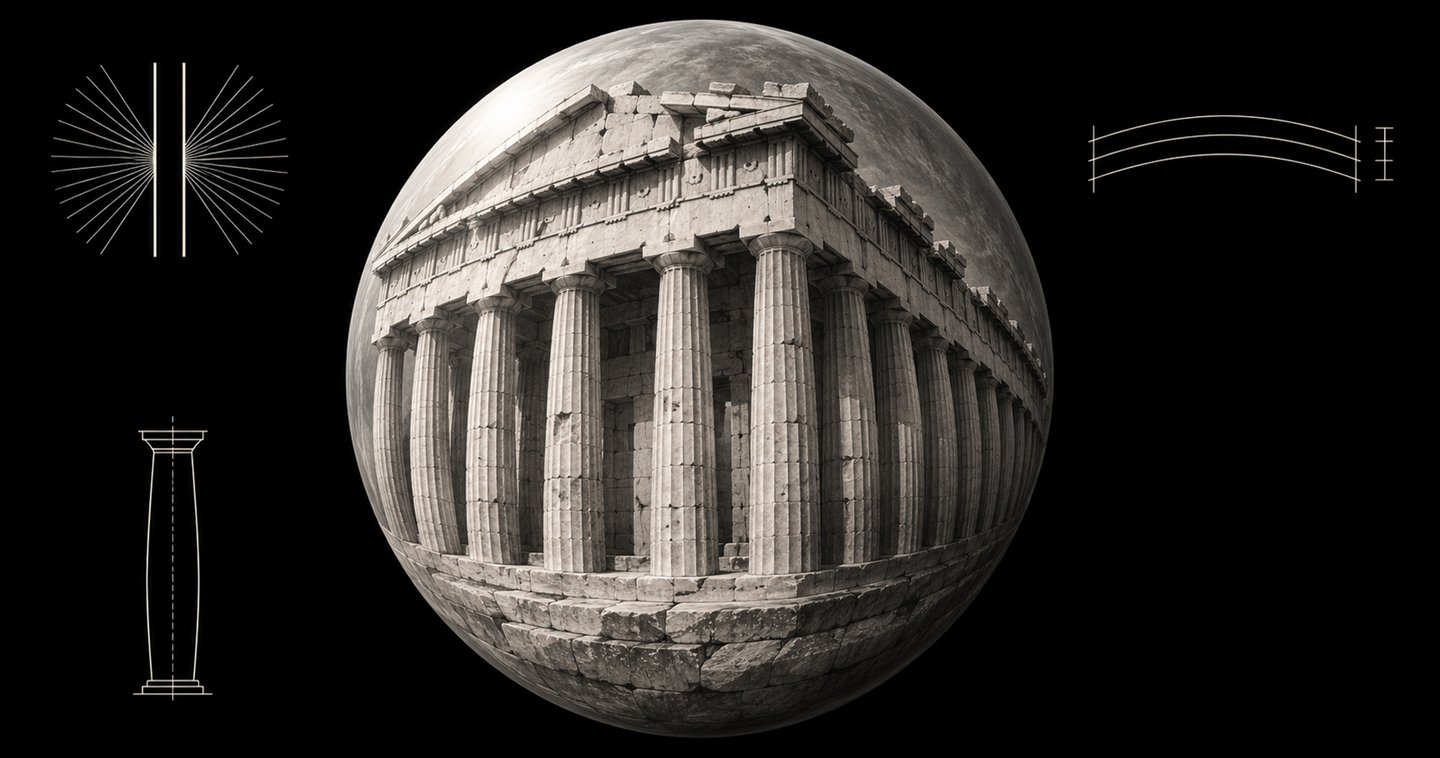
The Parthenon is round!
It isn’t perfectly circular, of course. Some individual elements feature rounded corners. But since mathematics teaches us that any curve can be divided into segments of finite length that are circular arcs, one could say that the Parthenon strives to be circular.
I have a deep love for mathematics and an appreciation for all its branches, so I was delighted to take on a topic connected to mathematics. And don’t worry—there won’t be complex formulas. The subject of my visual study is «The Curvatures of the Parthenon.» This term refers to the deviations of the contours of architectural elements from a straight line. Immediately, the question arises: could the Greeks have accidentally allowed such a deviation when building the temple simply because they were unfortunate enough to not have lived before the invention of the laser level? I must say right away that no. The difference between the lowest and highest points of the stylobate reaches nearly 120 millimeters. This deviation is unnoticeable when viewing the temple because it is small relative to its size, but it would certainly not have gone unnoticed by the architect or the stonemason. If even that doesn’t convince you, I can add that the profile of the stylobate forms a smooth, systematic curve, and its bend is coordinated with the curve of the lower steps of the crepidoma. Such an outcome is impossible through error, and the Greeks possessed sufficient knowledge of geometry to have designed it intentionally. The theory that these curvatures are the result of an error is not seriously considered by scholars, and this study will not examine it either.
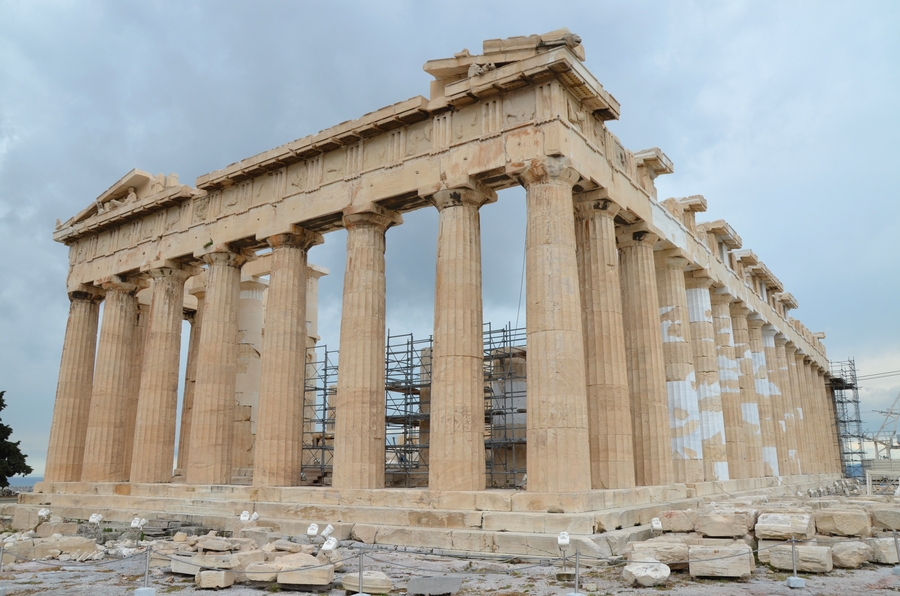
Parthenon. Athens, 447–438 BCE. Architects Iktinos and Callicratides. Photo: Carole Raddato, 2014.
Nevertheless, in the four sections of my visual research, I will examine four main hypotheses regarding the origin of the curvatures and explore the arguments for and against each, drawing on articles by art historians and mathematicians and physicists who are passionate about art, as well as comparing the Parthenon with other Greek temples.
While it is true that the curvatures are not unique to the Parthenon, and it was not the first temple built utilizing this technique, why am I focusing my research on it? As many researchers whom I will cite later emphasize (for example, Elizabeth Rankin in the article «Geometry Enlivened: Interpreting the Refinements of the Greek Doric Temple»), the Parthenon represents the culmination of a long architectural tradition, integrating numerous techniques that had previously appeared in isolation. Furthermore, there are interesting studies of curvatures from the perspectives of geometry and optics that examine them specifically using the Parthenon as an example. But don’t worry. By studying the Parthenon through comparative analysis, we will look at many remarkable monuments of Greek architecture. So, let us move on to examining the first hypothesis.
Optical Hypothesis
Human visual perception is susceptible to numerous distortions, which cause figures of ideal form to not be perceived as ideal by the viewer. Conversely, a conscious disruption of an object’s geometry can help create the impression of an ideal form for the viewer. This approach is actively used in contemporary industrial design—something you are likely familiar with—but it has actually been known since ancient times. The optical hypothesis suggests that curves were created specifically to compensate for visual distortions and to evoke the impression of ideal form in every architectural element.
Parthenon. Athens, 447–438 BCE. Eastern steps of the crepidoma and stylobate. Photo: Twospoonfuls, 2022.
Curvature of the stylobate and architrave of the eastern facade of the Parthenon. F. K. Penrose, 1888, Plate X. Scales: horizontal 1:100, vertical 1:2.
Direct your gaze to the bottom edge of the step. Even years later, it is evident that its profile curves upward. This is confirmed not only by visual observation but also by precise height measurements.
Temple of Hephaestus in Athens. Columns of the exterior colonnade. Photo: Sharon Mollerus, 2009.
The Temple of Hephaestus in Athens. The entablature above the colonnade. Photo: Sharon Mollerus, 2009.
Temple of Hephaestus in Athens, circa 460–415 BCE. General view. Photo: Sailko, 2008.
The Temple of Hephaestus also features numerous deviations from strict geometry—from the entasis of the columns to the curvature of the entablature. Nevertheless, at a macro level, it is perceived as a geometrically perfect structure.
Edges of the steps of the Parthenon (top) and the Temple of Hephaestus (bottom). Photo: Frédéric Boissonnas, 1910; Vislupus, 2015. Fragments and montage; the lower shot is stylized to look archival.
The stylobate, however, should be leveled so that there is an addition in the center […]; otherwise, if it is aligned strictly to the level, it will appear concave to the eye.
It is interesting to note that the perception of a geometric profile heavily depends on its surroundings. Many popular optical illusions found online are based on the visual distortion of shape size and curvature influenced by the lines surrounding them. And, of course, there is research that applies this logic to the Parthenon.
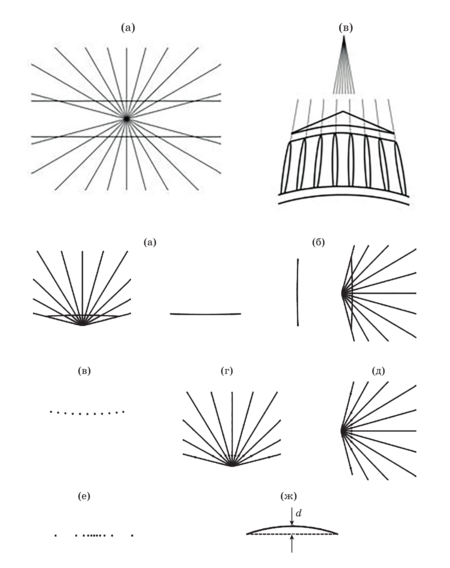
In a 2021 study, Bondarko and colleagues demonstrated optical illusions that affect perception and which may explain the perception of the Parthenon.The diagram shows how straight horizontal lines against a background of diverging rays can appear curved. This is the Gering illusion. The authors connect this arrangement of lines to the architecture of the Parthenon. In the experiment, three participants compared the curvature of solid lines and lines mentally drawn through points, both with and without the fan background. The evaluations depended on the environment and orientation of the images.
It must be said that all these arguments ultimately fail to prove the theory itself. The prevalence of an architectural technique does not speak for itself regarding its purpose. Vitruvius’s work was written approximately 400 years after the construction of the Parthenon, and while optical illusions are impressive, they do not prove that the architects of the temple relied upon them. Some scholars even question the necessity of curves to create an optical effect.
More broadly, there is no evidence to support the existence or necessity of optical corrections.
Functional Hypothesis
Let’s take a brief detour from the high theory and look at the most basic explanation: every curve has a practical function. For instance, the curve at a base helps rainwater drain, and thickened columns increase stability. But is all this unusual geometry truly a practical engineering solution?
Ernst Ziller, Parthenon. Cross-section with galleries in the interior wall, 1897.
T. L. Donaldson, Temple of Apollo Epictetus in Bassae (built 420–400 BCE). Longitudinal section of a part of the temple, 1830.
Here, we would like to discuss another type of architectural curvature—entasis. This term refers to the slight bulge in a column’s profile relative to its straight tapering from the base to the top. This thickening does not fall under the concept of curvature, but it is closely related in meaning. Entasis appears in almost all Greek temples, and according to one hypothesis, this technique served a practical, engineering purpose.
…a column with a slight thickening will provide a higher strength-to-weight ratio than a column with parallel sides.
The Parthenon. Digital reconstructions of the façade and interior structure. Juan de Lara, 2025.
It is important to distinguish entasis from a simple narrowing of a column. Imagine a truncated cone built upon the upper and lower bases of the column. When entasis is present, the profile of the column will slightly protrude beyond the straight lines of this cone; the column seems to expand subtly. However, the column can still be widest at the base. This is very difficult to discern with the naked eye, especially in modern photographs where the drums of the columns have become slightly separated, but it is visible slightly better in digital reconstructions that account for all architectural details.
Temple of Apollo Epicureus at Bassae. General view. Photograph by Mark Landon, 1982.
Temple of Apollo Epictetus in Bassae. East colonnade. Photograph by Carole Raddato, 2014.