Sections
- Introduction
- Historical and Cultural Context
- Fashion of the 1920s–1930s: The Revolutionary Image of Womanhood
- Fashion of the 1940s–1950s: The Return to Femininity Through Propaganda
- Fashion of the 1960s–1980s: Standardization and the Symbolism of the «Soviet Woman»
- Semiotics and the Ideological Meaning of Clothing
- Conclusion
- Appendices
Introduction
I chose the topic, «Soviet Fashion as an Instrument of Ideology: The Image of the Soviet Woman, ” because I am interested in understanding how the state shaped perceptions of women and their role in society through clothing. The visual aspect of this research helps to better observe how ideas and norms were transmitted not through words, but through silhouettes, colors, fabrics, and accessories.
Fashion in the USSR never existed independently of ideology. It reflected societal expectations, economic conditions, and the political objectives of the state. The image of the Soviet woman was constructed through magazines, posters, films, and official dress codes. Even everyday clothing could carry meaning—it demonstrated who a woman was supposed to be: industrious, modest, and patriotic.
The goal of my research is to trace how the image of the Soviet woman evolved through fashion over several decades and to demonstrate the visual techniques employed to form this image. In this work, I will use photographs, magazines, posters, and other visual materials to illustrate the evolution of the ideal and its connection to propaganda.
This study is significant not only for understanding the history of clothing but also for seeing how visual media can influence human perception and shape social norms. By studying Soviet fashion, I can demonstrate how culture, ideology, and daily life were interwoven in the visual representation of women of that era.
Historical and Cultural Context
During the latter half of the 1910s through the early 1920s, Russian society underwent profound transformations that directly impacted women’s lives and their societal role. Following the revolution, the state aimed to create a new citizen—including a new woman—free from previous constraints. This period became the starting point for all subsequent fashion shifts in the Soviet era. Women, who previously were primarily engaged in heavy labor and domestic duties, suddenly gained the opportunity to participate in public and political life on par with men. Their labor gained value, and their rights were defended. The idea of equality became a key theme of the time, and it was reflected in every aspect of women’s appearance. The image of the woman during this period was multifaceted: she could be an active worker, a political figure, a caring mother, or a homemaker, or sometimes combine several roles simultaneously. Fashion reflected these changes. Clothing was no longer solely about beauty or expense—it became functional, comfortable, and reflective of the woman’s social engagement. Clean lines, a lack of excessive detail, and comfort became the foundation of the new style. Furthermore, the fashion and culture of that time were oriented toward the future. Women were viewed as full participants in socialist construction, prepared for both labor and public life. This was also evident in the style of clothing: practical suits, uniforms, and tailored silhouettes emphasized independence and responsibility. The woman’s role in society shaped perceptions of appearance—it needed to align with the status of a citizen and a worker. The woman became not just a part of society but a symbol of a new era where equality, functionality, and participation in national life became the norm. Thus, the historical and cultural context of the 1920s–1930s established the foundation for the emergence of a new female image and for the fashion trends that I will examine in detail in the next chapter. The fashion of these years was not merely about clothing; it was about the new roles, rights, and opportunities opening up for women in society.
Fashion of the 1920s–1930s: The Revolutionary Woman
Turning to the fashion of the 1920s and 1930s, I was particularly struck by how explicitly clothing became a tool for ideological reshaping during those decades. It was during this period that the female body underwent, essentially, a «retooling"—new functions, new habits, a new aesthetic. The Soviet government sought not merely to change wardrobes, but to cultivate a new archetype of woman—one who was active, disciplined, and socially useful. This intention is evident in everything: from silhouettes and fabrics to the visual imagery presented in films and magazines.
The first women of the «Smychka» commune. Photo, 1929.
Following the Civil War, society entered a new cultural reality. Old symbols of femininity—corsets, lace, delicate lines—were perceived as remnants of a bourgeois past that needed to be decisively rejected. The appearance of women in the 1920s became almost deliberately anti-romantic. Straight silhouettes, dropped waists, coarse fabrics, short haircuts, and emphasized busts—all of this forged an image of a woman equal to a man, an active participant in building a new world, rather than a «beautiful lady.» I am particularly interested in how this visual gesture functioned as propaganda. It did not merely reflect a change in taste—it asserted a new social role. The popularity of thinness, angularity, and active gestures was no accident; it represented the image of a warrior woman—functional and dynamic.
Even discarding ruffles and ornamentation was a political statement. A classic example is an episode from «How Steel Was Tempered,» where the heroine is accused of «bourgeoisity» for wearing an ornate dress. Thus, clothing ceased to be a personal choice and became a marker of ideological discipline. It is important, however, to remember that the revolutionary style was not accessible to everyone. Women from the elite or those involved in NEP could afford garments by Lamanova or avant-garde couturiers, while the majority sewed from canvas, teak, old greatcoats, or military cloth. But both expensive fashion and homemade attire served a single purpose—to create a visual break from the pre-revolutionary way of life and establish a new type of womanhood: rigorous, independent, and devoid of «bourgeois sentimentality.»
«How the Steel Was Tempered, ” 1973, directed by N.P. Mashchenko
Women’s magazines—notably Rabotnitsa and Krestyanka—became a crucial part of this ideological labor. They didn’t simply offer advice on managing a household or sewing clothes—they shaped the image of the «proper» Soviet woman. In the early decade, the authorities required a mass female workforce, and it was these magazines that created the model of the working woman and the engaged community member.
«Rabotnitsa»: a journal for women and family, 1923, No. 2
Journal «Krestyanka» No. 7, April 1925, published by «Peasant Newspaper,» cover by I.I. Dubasov, paper, USSR, 1925.
Her appearance was meant to be maximally functional: practical silhouettes, an absence of adornment, and neatness as an indicator of discipline. Modesty became not only an aesthetic but also a political virtue. The image of the delegate was particularly iconic. In magazines and on posters, the delegates were presented as the perfect embodiment of a new model of femininity: energetic, useful, and organizing nurseries, clubs, and cafeterias. Their clothing—simple, comfortable, and devoid of flirtatiousness—became a visual standard. This was the «fashion of action, ” the style of those who didn’t pose, but who transformed reality.
«Delegatka,» G. G. Ryazhsky, 1927
Here, the idea of «connecting the city and the countryside» emerges. The urban woman was intended to serve as a role model for the peasant woman, meaning her appearance fulfilled almost an enlightening function. Modesty, neatness, and industriousness were transformed into tools of ideological influence. Even the mother, in magazines, was depicted not as the guardian of the hearth, but as an active organizer—one who enrolled her child in a nursery and participated in public life. Thus, magazines become the arena where a new visual role for women is constructed, where functionality supersedes individuality, and ideology replaces personal style.
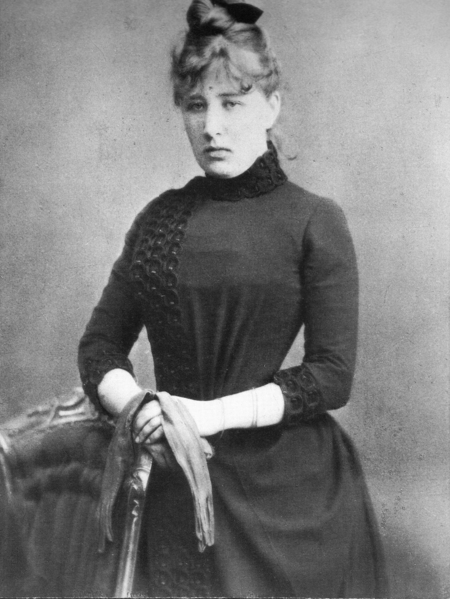
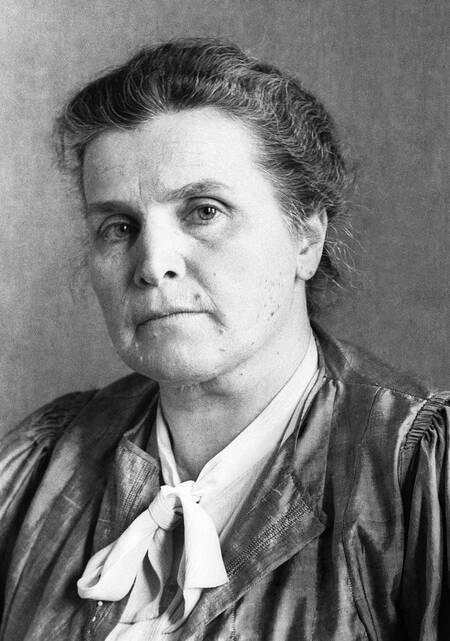
Left to right: Nadezhda Petrovna Lamanova and Vera Ignatyevna Mukhina
In the 1920s, artists and designers—such as Nadezhda Lamanova and Vera Mukina—played a distinctive role in shaping Soviet fashion. Their work was not merely the search for a new aesthetic language, but an attempt to develop clothing that aligned with the demands of the era.
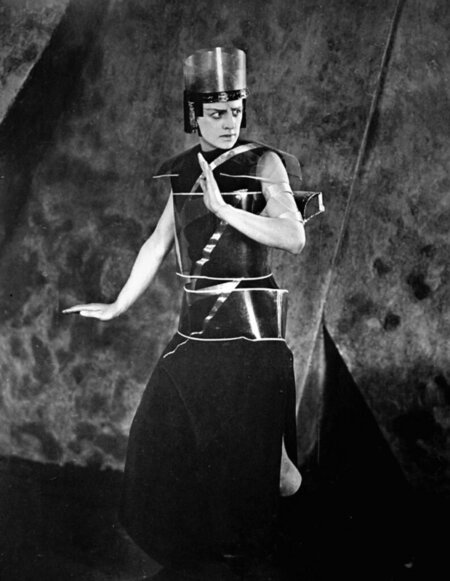
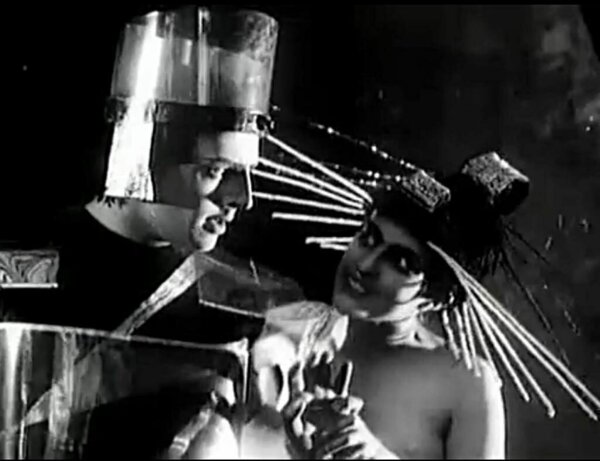
«Aelita,» 1924, directed by Yakov Protazanov. Costumes by Nadezhda Lamanova
Sketch of Vera Mukhina’s Flower Dress, 1923
Lilya Brik and Elsa Triolet in Grand Prix costumes in Paris
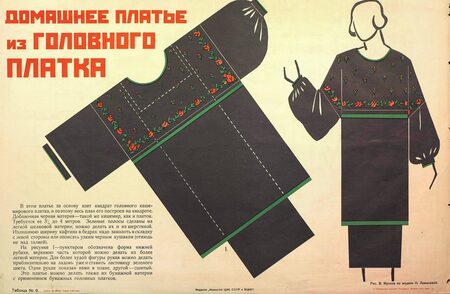
Lamanova and Mukhina aimed to create accessible models wearable by working women and peasants—simple, functional, yet modern. In their album, «Art in Daily Life, ” folk motifs were combined with Constructivist rationality. Mukhina—who would later design the „Worker and Kolkhoz Woman”—created transforming dresses, models made from towels, and military cloth in the 1920s. Her costumes clearly convey an ideological imperative: the body must be mobile, active, and engaged in labor. Even her theatrical figures are heroic, severe, and dynamic, again emphasizing the design of a new female archetype.
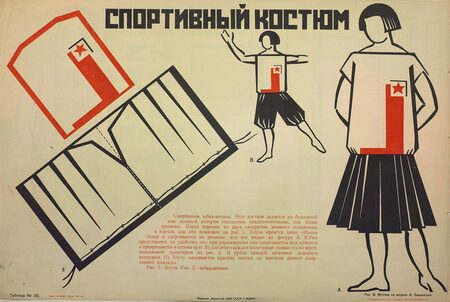
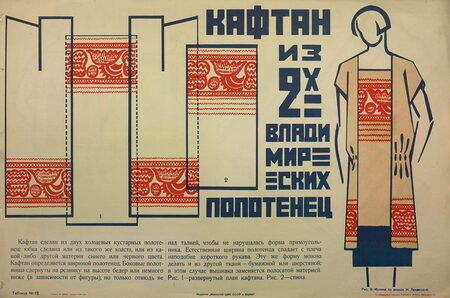
Here and following are pages from the album «Art in Everyday Life.»
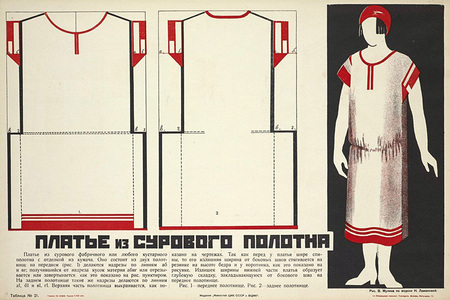
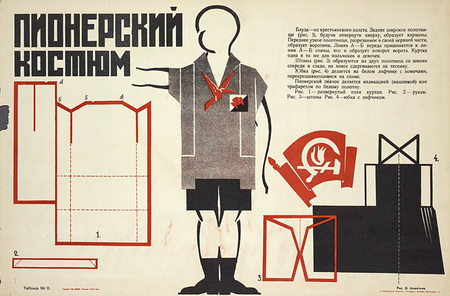
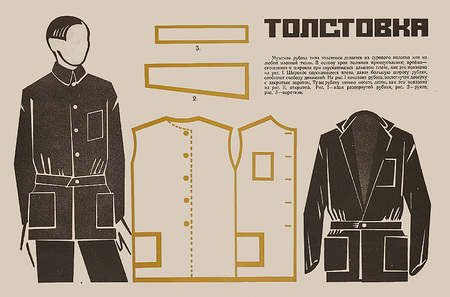
By the late 1920s, a significant turning point occurs. The winding down of the New Economic Policy coincides with the intensification of totalitarian logic. The state no longer required free, experimental fashion—it needed controlled visuality. It is at this moment that the formation of that ideological image of woman begins, an image that will become normative for the subsequent decades.
Workers at an offset printing factory, Leningrad, 1934.
In the 1930s, clothing became more feminine again, but this femininity was distinctly regulated. Due to fabric shortages, silhouettes were simplified, yet they featured a marked neatness: fitted muslin dresses, modest ruffles, and pleating. Femininity was no longer linked to individuality—it was meant to symbolize prudence, tidiness, and industriousness.