Media Concept
Educational media about documentary film that helps beginners start exploring the genre without prior knowledge, gradually moving from individual films to an understanding of documentary methods, history, and core theoretical issues.
The main channel is Telegram. Here, texts appear regularly about films, concepts, and directors, short research pieces, curated selections, video clips, polls, and timely recommendations. Telegram allows for consistent media consumption: new material comes directly to the reader, and engagement with documentary cinema unfolds gradually, through specific films and questions.The website serves as an archive and knowledge base. It does not duplicate the Telegram feed; instead, it reorganizes accumulated publications by film, author, theme, and concept.The email newsletter is sent out twice a month. It compiles publications not chronologically, but into small, curated journeys: one question, two texts, a film, and supplementary reading.
Semester Thematic Plan
Month One. What Do We Even Call Documentary Film?
The first month should introduce the reader not only to the channel but also to its method of discussing film. Instead of offering the definition, «documentary film is a film about real events, ” the goal is to immediately call that definition into question.
We start with the simplest viewer expectation: if a film is called documentary, it seems we can trust the imagery more than in narrative fiction. However, between the event and the viewer are still the camera, the director, the editing, the chosen angle, and the recording situation itself. Therefore, the first month must give the reader not a set of dates, but the primary lens of the medium—asking not just, „Is this true?“ but also, „How does the film convince me of its authenticity?“
— Introduction to the channel’s concept: why another media outlet about documentary film?; — „Does documentary film not exist?“ — an introductory post; — What is a document and what is documentariness?; — Can we trust the camera more than human narration?; — „Man with a Cinematograph“: why Vertov shows us the camera and editing; — Robert Flaherty and the problem of staging in early documentary film; — Glossary: document / testimony / representation; — A selection of „5 films that make it harder to answer what documentary film is“; — Survey: „What makes a film documentary for you?“
On the website: an introductory page „Where to Start“ is created, alongside a glossary and the first film cards.
Newsletter: „The First Question: What do we believe when we watch documentary film?“
Month Two: The Document as Testimony
After asking, «What is a document?» we can look at the period when filmmaking is particularly linked to testimony and information. Newsreel footage, war, propaganda, and the mass distribution of the camera create the expectation that a film can deliver to the viewer a piece of what happened. However, this is precisely where the problem becomes especially evident: the camera not only records an event but also chooses what will be visible and precisely how we will see it. War documentary allows us to shift the question of veracity to the question of responsibility—that of the director, the cinematographer, and the viewer themselves.
— Newsreel and the early faith in the image as testimony; — «The Battle of the Somme»: when war becomes an image; — Propaganda and the explanatory mode of documentary film; — Esfiri Shub and the editing of existing footage; — can one maintain a neutral position when filming violence; — the ethics of depicting death; — who holds power over the person captured on film; — vocabulary: newsreel / propaganda / explanatory mode; — discussion: «Are there images that should not be published?»
On the website: the «Testimony» section—films and texts on ethics, war, propaganda, and the archive.
Newsletter: «Can an image be evidence?»
The Third Month: The Camera Can No Longer Pretend to Be Invisible
By the mid-twentieth century, faith in the neutral document begins to be increasingly questioned. Advances in lightweight cameras and synchronized sound recording allow the documentarian to physically get closer to the subject, but this also makes the presence of the filmmaker more evident.The month is structured around two different approaches to this problem. One can attempt to minimize interference and observe. Alternatively, one can acknowledge that the camera changes the situation and incorporate that interaction into the film.— What is observational filmmaking;
— Direct Cinema: is it possible to be a «fly on the wall»?
— Cinéma vérité: the camera as a participant in the situation;
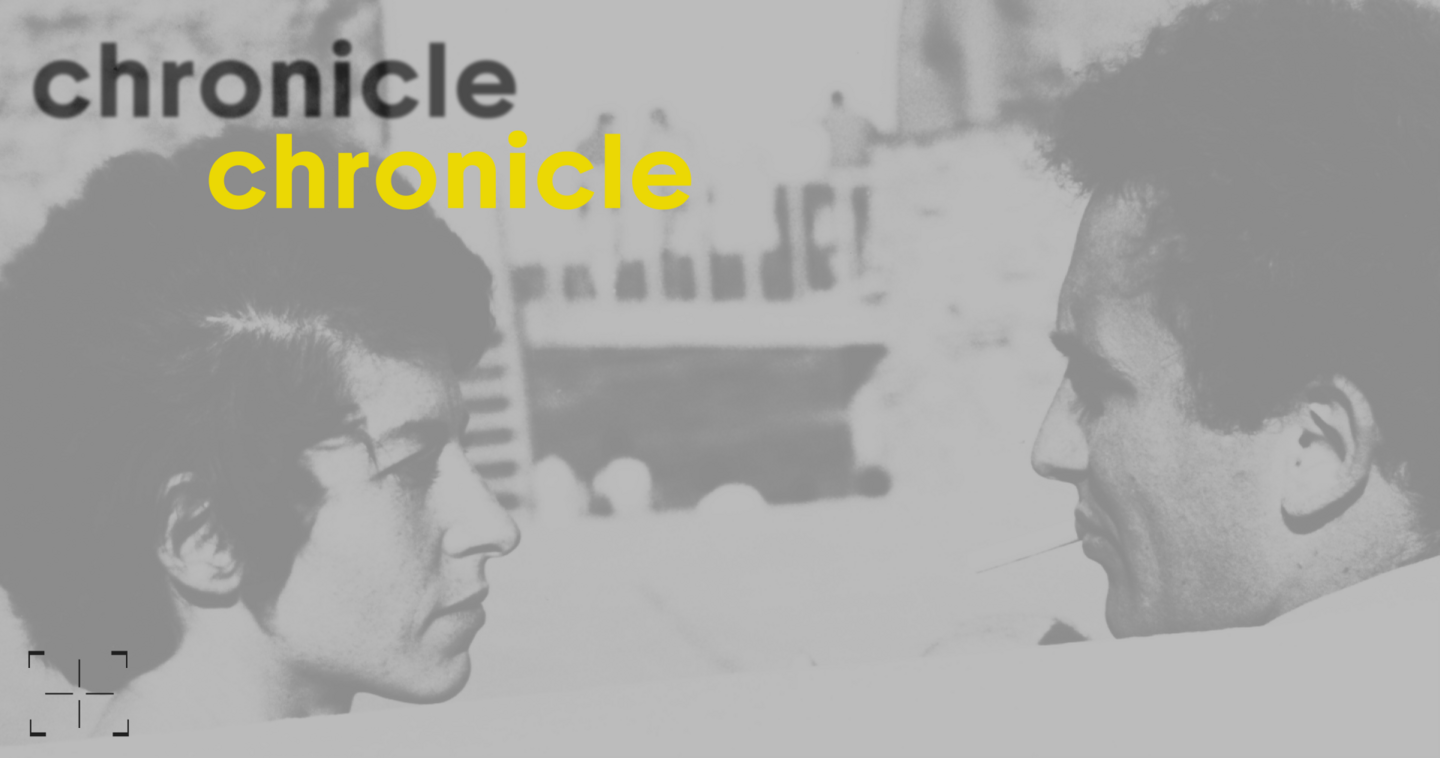
— «Chronicle of a Summer»: the question «Are you happy?» as a cinematographic method;
— Frederick Wiseman and observing institutions;
— What happens to a person when they know they are being filmed;
— Interviews—a way to gather information or a separate staged situation;
— Glossary: observation / Direct Cinema / cinéma vérité;
— Poll: «Is it even possible to forget the camera’s presence?».On the website: a large page on «Observation» and a comparison of Direct Cinema / cinéma vérité.Newsletter: «There is no neutral camera. So what should you do?»
Month Four. If the truth cannot simply be filmed, can it be assembled?
The next step involves films that no longer try to conceal their own construction. Editing, archival footage, reconstruction, and staging cease to be automatically perceived as breaches of documentation.The viewer gradually arrives at a more complex idea: a documentary film can be authentic not because the camera happened to be placed in front of a «pure reality, ” but because the film honestly explores the ways in which that reality becomes accessible.
— Editing as a means of creating meaning from documentation; — What is found footage?; — Who owns the archive?; — Chris Marker: memory as montage; — „Without Sun“: can one film their own memory?; — Reconstruction in documentary cinema; — Errol Morris and „The Thin Blue Line“; — „The Act of Killing“: what happens when perpetrators make films about their own past; — Glossary: archive / found footage / reconstruction; — Poll: „Can a staged scene be documentary?“
On the website: related pages „Archive, ” „Reconstruction, ” „Memory.“
Newsletter: „Five Ways to Tell the Story of an Event the Camera Didn’t See“
Month Five: From the World to Self
When an objective stance proves persistently problematic, an alternative path naturally emerges: the director stops concealing their own subjectivity and integrates it into the film. Personal filmmaking should be presented not as a «documentary about oneself, ” but as a shift in the author’s perspective. Personal experience, body, memory, and voice become tools for exploring the broader world. This allows for a transition toward diary film, autobiographical documentary, and the film essay.
— what is first-person cinema; — why the director’s „I“ does not necessarily make the film less credible; — diary film; — Jonathan Caouette and Camtasia; — Agnès Varda and The Gleaners and I; — Chris Marker and the film essay; — voice-over: explanation versus independent voice; — personal archive and home video; — glossary: film essay / diary film / first-person documentary; — collection: „5 Films Where the Director Becomes Part of the Research.“
On the website: the „Personal Cinema“ section, where films are connected to themes of memory, body, family, and essay.
Newsletter: „Why is it sometimes more honest to say ‘I’ than to pretend to be objective?“
Month Six. What Does Documentarity Mean Today?
The final month does not conclude the narrative; rather, it returns us to the foundational question within contemporary contexts. Today, nearly everyone possesses a camera, a vast amount of life is already captured automatically, and image archives are being generated faster than we can view them.The question shifts: if there is too much visible data, the goal of documentary film may no longer be simply to make the world visible, but rather to change how we focus our attention—to showcase a person, space, or experience that typically remains outside the dominant gaze. In this month, the historical trajectory intersects with contemporary forms: decolonial cinema, video essays, desktop documentary, and new personal practices.
— Why documentary film needs more images today; — The right to see and the right to be seen; — Who speaks on behalf of another; — Decolonial optics in documentary film; — Video essays as a form of research; — Desktop documentary and the screen as a document; — Amateur archives, smartphones, and home video; — Where to find new documentary film today; — Festivals, platforms, books, and independent media; — The final track: «10 Films—10 Different Ways of Interacting with Reality.»
On the website: a map of the entire archive categorized by key concepts and a personal track titled «What to Study Next.»
Newsletter: «Documentary Film After Documentary Film.»
Content Samples
POST 1
«Man with a Movie Camera.» Dir. Dziga Vertov
Does documentary film not exist?There is a fairly straightforward way to distinguish a documentary from a fictional film: in the former, «reality» is in front of the camera; in the latter, there are actors, a script, and fiction.Suppose we have a real person before us. They genuinely exist, genuinely sit in their apartment, and talk about their own past. Yet, the director chose this specific person, this specific apartment, and this specific snippet of conversation. The camera was placed in a precise location. Out of two hours of footage, three minutes might make it into the film. A day might pass between two sentences, even though the edit connects them in a second.Where is that very «reality» located in this chain?In her book, «The Evolution of Non-Fictional Cinema, ” Olga Davydova begins her discussion of non-fiction film with a deliberately provocative idea: we should first question the category of documentary itself. Not because all documentaries lie. Rather, because a film cannot simply take ready-made truth from the world and transfer it to the screen. A form always emerges between an event and the viewer.Therefore, what will interest us here is not exposing films under the principle, „since this was a staging, everything is false.“ Something much more interesting is this: what relationship with reality is each film attempting to establish?One director hides behind the camera and waits. Another engages the protagonist in conversation. A third reconstructs an event that happened twenty years ago. A fourth films their own life. A fifth uses only someone else’s archives.For some reason, they all end up within the territory we call documentary film.In the coming months, we will explore why.And the first question is for you:What makes a film documentary? Reality in front of the camera, the author’s intention, the viewer’s trust—or something else?
POST 2
Glossary: Document ≠ TruthIt seems the word «documentary» inherently carries a promise: we are about to be presented with a document—something confirming that an event actually took place.But a document and the truth are not synonyms.A photograph confirms that at some point, light from an object actually hit the surface of the film or the sensor. A voice recording says that a microphone once registered certain vibrations. A chronicle preserves a trace of the event.Yet, none of these traces, by themselves, explain what happened.Imagine a ten-second recording: a person exits a building, someone shouts, and they start running. The camera captured everything. But we don’t know why they are running. Who they are running from. What happened before the recording started. What happened afterward.
Adding a voiceover narration changes the image’s meaning. Changing the commentary can cause the exact same frame to signify something entirely different.Therefore, understanding the «documentary» quality is more interesting as recognizing specific relationships of trust between the image and the viewer, rather than as the presence of some piece of absolute truth within the film.By what means does it compel us to trust? Is it the absence of music? The shaky camera? Real names? Archive footage? Dates? An expert’s voice? A poor image quality that seems «too real» to be staged?Throughout history, these indicators have changed. Along with them, our perceptions of what a document should even be have changed.
So the next time a film strikes you as «very real, ” try not to stop at that feeling.Ask yourself:What exactly is producing the effect of truth right now?
POST 3
When War Became an Image
In 1916, a British audience member could walk into a cinema and see a war unfolding almost in real time.
Not a post-victory parade. Not actors in military uniform. Soldiers in trenches, the wounded, devastated landscapes, and people returning from battle.
The Battle of the Somme, shot by Geoffrey Mellens and John McDowell during the First World War, became one of the key early examples of feature-length documentary depicting war. Millions of British viewers saw the film; its significance was so profound that it was later inscribed on UNESCO’s Memory of the World Register.
But the interesting aspect here is not just that the camera finally captured the war.
It’s what happened to the viewer.
Before this, war existed for most people far from the front lines through dispatches, photographs, and official narratives. Now, the technical image seemed to close the distance: here is a body, here is a trench, here is a person who will disappear from the frame in seconds.
Cinema took on the status of testimony and, simultaneously, an instrument of power.
Because to film war means deciding which war those who stayed home will see—a parade or a casualty. An advance or a wait. Victory or ruined land. In Olga Davydova’s book, early military documentary appears precisely in the context of changing notions of the document itself. World War I makes the technical image part of how society begins to envision war in general. This plot thread advances further in the published excerpt—to the question of the ethics of the gaze.
Because the camera doesn’t just allow us to see what we haven’t seen.
It always decides what exactly we will look at.
POST 4
Is it acceptable to simply watch someone die?In Esfiri Shub’s film «Spain,» there is a close-up of a deceased girl. The camera did not accidentally capture the body; the cinematographer had to move in, select a spot, and hold the shot for some time.When we say the «camera documented the death,» the cinematographer almost disappears from the sentence—as if the image simply materialized on its own. But a camera never looks on its own; there is always a person behind it who decided to continue filming.In the published essay «The Evolution of Non-Fiction Cinema,» this episode becomes the starting point for a discussion on the ethics of documentary imagery. Davydova points to the contradiction in the observer’s position: distance can appear as neutrality, but the very decision not to interfere and to keep shooting is itself a choice.There is also the audience.Suppose the director decides that the image must be seen. What happens to us next?We can look away. We can view the frame as a historical document. We can feel sympathy. We can become desensitized—to the point where another image of violence ceases to mean anything.And in that instance, the ethics of a documentary film are distributed among three participants:the person in front of the camera,
the person behind the camera,
the person in front of the screen.Documentary film differs from fictional film in this regard particularly sharply. If we perceive death as having genuinely occurred, the image can no longer be entirely separated from the person to whom it belonged.Therefore, the question «can this be shown?» almost never has a universal answer.Perhaps it is more productive to ask differently:What does the film do with this image, and why does it compel us to look at it?Poll:— some images should never be shown;
— it can be shown if it is necessary for understanding the event;
— it depends entirely on the method of representation;
— I am not sure.
POST 5
Glossary: Basic ConventionThere is a very convenient illusion in documentary filmmaking: the sense that almost nothing stands between the world and the viewer.An event happens → the camera captures it → we see it. In this model, the director functions as a sort of transparent conduit.In Olga Davydova’s book, the concept of the basic convention is used to discuss this logic. In general, it refers to a tradition where the director gains the right to select and organize material, yet the result continues to be perceived as a representation of reality itself. Later, documentarians began to problematize this very certainty more and more fiercely.Let’s take the simplest example.We see shots of a factory. Then—the face of a tired worker. Then the vast house of the enterprise owner. Then the worker again.None of the shots are obligated to be fabricated.But their sequence already forms an argument.Editing doesn’t «damage» the real images. It creates relationships between them.The same thing happens with voiceover narration. If the author’s voice tells us in advance that the protagonist is lazy, the next shot of a person lying in bed confirms the thesis. If the same shot accompanies a narrative about a twelve-hour shift, it signifies almost the opposite.Therefore, one of the most important shifts in the history of documentary film occurs when directorial authority ceases to seem natural.Who is speaking?Why should we believe them?Why are these specific shots put together?What has been excluded?And what happens if the film itself begins to show the mechanism of its own production?These questions sounded particularly loud in the documentary cinema of the 1960s.More on that later.
POST 6
The Camera is Not a Wall: What Cinéma Vérité Did to ObservationThe documentary filmmaker holds a seductive dream: to become invisible. To position the camera so that people forget it is there. Not to interfere. Not to ask questions. Simply to wait for life to reveal itself.
But there is another approach: what if the camera doesn’t hinder the discovery of reality, but rather produces a new situation within which something unexpected becomes visible?In 1960, Jean Rouch and sociologist Edgar Morin begin filming people in Paris. One of the questions sounds almost indecently simple: Are you happy?It is from this very situation that Chronicle of a Summer grows—a film Morin associated with cinéma vérité. The fact that there is a conversation between the director and the person is not hidden here. On the contrary, this conversation is part of the research.This is an important turning point.If a person begins to behave differently in front of the camera, it does not necessarily mean the document is «spoiled.»Perhaps their reaction to the camera is also a form of reality.A person wants to appear smarter. They become embarrassed. They start playing a part. Suddenly, they say something they wouldn’t have said without being asked. They fall silent.
The camera uncovers not the person «by themselves, ” but the relationship between the person and the gaze upon them.Therefore, Chronicle of a Summer is interesting to watch not as a window into Paris in 1960, but as an experiment.What happens if you ask a person a question?What happens if you then show them their own image?Can you film a person who knows they are being filmed?And finally: does that „natural person“ the documentary filmmaker seeks even exist?Poll: If a person changes their behavior in front of the camera, does the recording become less documentary?— yes;
— no;
— on the contrary, this is also an important part of the document;
— it depends on the film.
POST 7
«Man with a Movie Camera»: Why a Documentary Film Should Show Its Own Editing Process
Usually, a good film does everything possible to make us forget its production. In Man with a Movie Camera, the opposite occurs.
We see the cameraman. We see the camera. We see the editing. We see the cinema. We see the woman cutting the film and joining the shots.
And then we see the city.
But after everything that came before, it is impossible to regard the city as a reality that simply existed independently on film.
Dziga Vertov’s 1929 film is constructed without a traditional plot or actors, utilizing a vast array of editing and cinematography techniques—from speeding up and slowing down to double exposure and split screens.
One might conclude that this many manipulations distance the film from documentary reality.
But Vertov does something stranger.
He does not hide the manipulation.
If the camera constructs what is visible—here is the camera.
If the montage creates meaning—here is the editor.
If the film transforms the city into a cinematic image—here is the process of creating that image.
The result is an intriguing paradox: the film becomes more artificial while simultaneously being more honest about its own artificiality.
This is an important skill for viewing documentary film in general. The question is not necessarily whether the author interfered.
The author interfered regardless, at least by choosing where to place the camera.
What is far more interesting is:
how does the film relate to its own intervention?
Does it conceal it?
Does it pretend the author is absent?
Or, like Vertov, does it turn the process of image creation into one of the film’s central themes?
POST 8
«The Murder Act»: What if the perpetrator makes a film about their own crime?