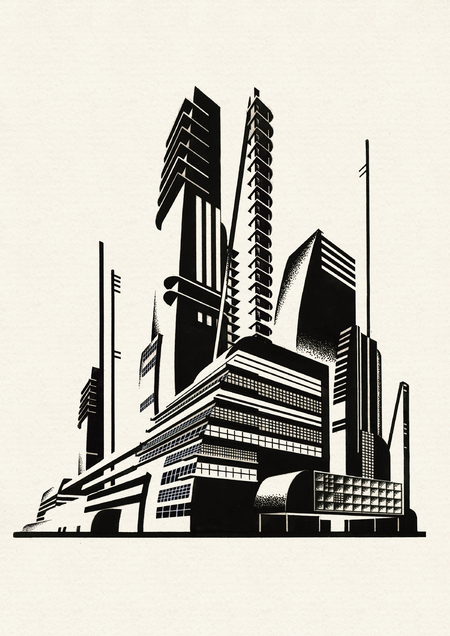
MELODIES OF CONSTRUCTIVISM
After graduating from the Academy of Arts in 1925, Yakov Chernikhov became interested in industrial architecture, which was the most progressive sector of construction. Compared to others, it offered greater multifunctionality and a wider array of possibilities, thus promising a much broader scope of creative development.
The pathos of industrialization—its sublime, heroically romantic hue—defined the artistic explorations across various art forms in those years. In 1927, Alexander Mosolov’s one-movement symphonic piece, «Factory,» premiered, which used musical means to recreate the image of a working plant. It immediately entered the repertoire of leading orchestras, and for several years, evenings of symphonic music in Moscow and Leningrad began with its performance. Sergei Prokofiev composed his famous «Steel Leap» around the same time, and Dmitri Shostakovich wrote the ballet «Bolt.»

Machinery has leveled the inequality of talent and gifts, meaning genius does not strive against diligence and meticulousness. While machines favor increased earning potential, they do not favor artistic flair, which at times exceeded bounds, inspiring the public imagination.
«Black pipes, casings, connecting rods, cylinders. I am ready to speak with you, to raise my hands before you, to sing your praises, my iron friends… I walk to the factory as if to a celebration, as if to a feast, ” Alexander Gastev wrote in „Poetry of the Labor Blow”—a distinctive manifesto of proletarian poetry of that era.
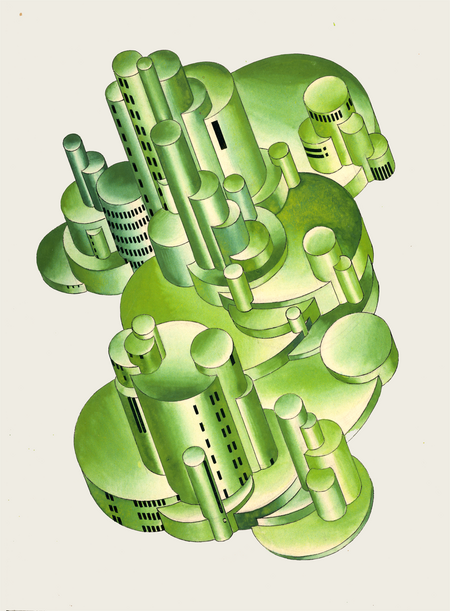
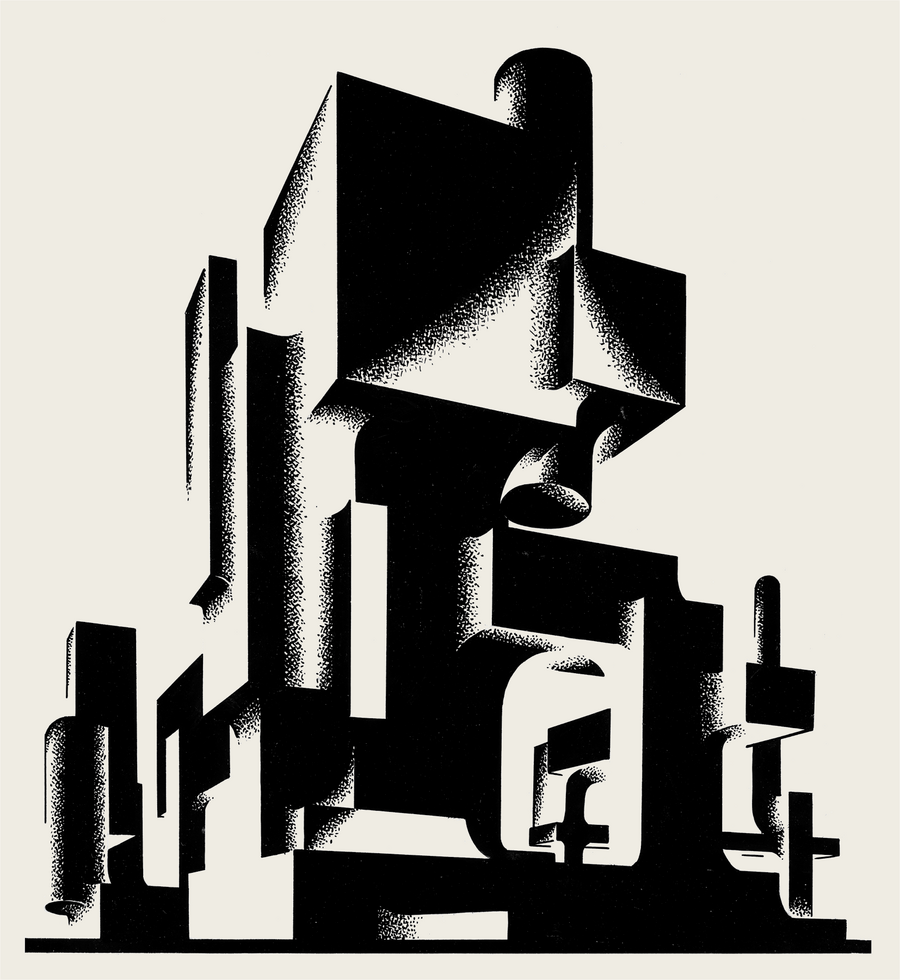
Theatrical Composition No. 237 from the cycle «Construction of Architectural and Machine Forms»
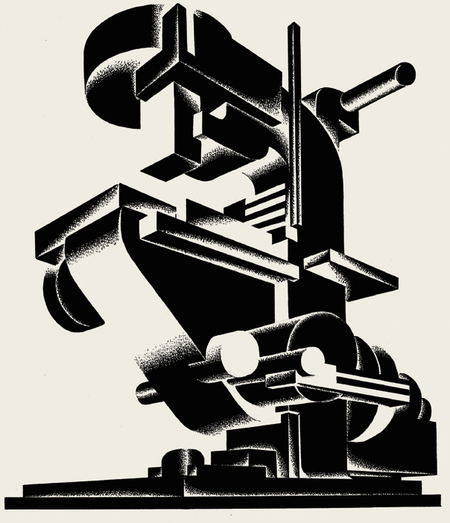
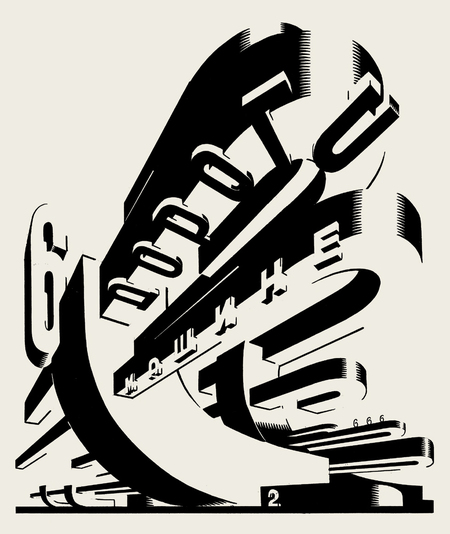
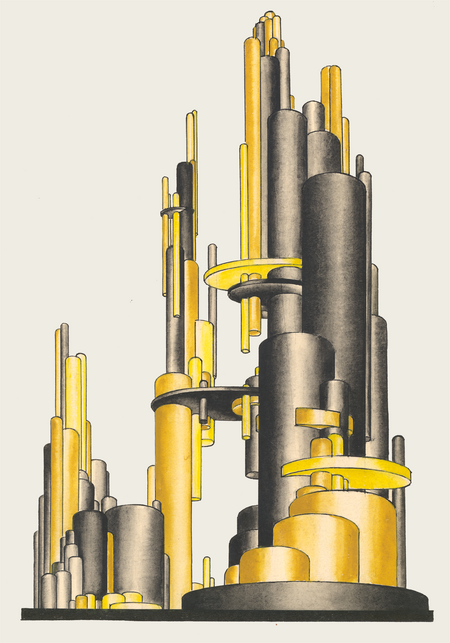
Acknowledging the considerable «self-sufficient role» of the machine in the 20th century, Chernikhov, unlike theorists of «Product Art» and radical Constructivists, was far removed from its fetishization. In his 1931 book, Construction of Architectural and Machine Forms, he defines Constructivism primarily as a phenomenon inherent to nature and organized life in general. By unveiling a unique panorama of Constructivism to the viewer through graphic means, he also demonstrates the Machine’s evolution through its gradual «metamorphosis» into monumental forms.
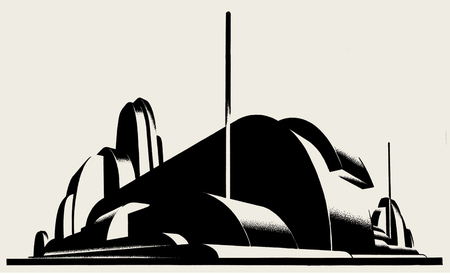
A well-designed machine affects our consciousness not only through its compactness but also through the rational combination of its parts. Machines can be statically supportive, statically load-bearing, perform complex functions of motion, or execute other intricate operations. Regardless of its function, the machine always justifies itself structurally; consequently, its constructivism is rational.
Chernihov contended that structures imitating or adapting to machines—just as they do to natural forms—are «alien to architecture in spirit, because they are founded on a false understanding of the primary stimulus of construction itself, and the ‘asceticism’ of modern architecture is a temporary phenomenon, with purely economic underpinnings.» He asserted that «architecture becomes art the moment its creative forms are perceived as values of an artistic order, and the aesthetic interpretation of concepts like space and mass, which we encounter throughout the history of art, must be supplemented by understanding them as a specific artistic formalization.»
The resonance of forms generates a «melody» in their harmonious combination. Construction, by uniting individual parts, creates a unique shape. The feeling experienced when viewing well-solved constructions is equivalent to that arising from contemplating works of high art. The beauty inherent in perfect constructions is perceived through the direct impact of objects crafted by human hands. This applies equally to architecture and to machinery. The human being is affected by the entire assembly of elements brought together within a specific spectrum.
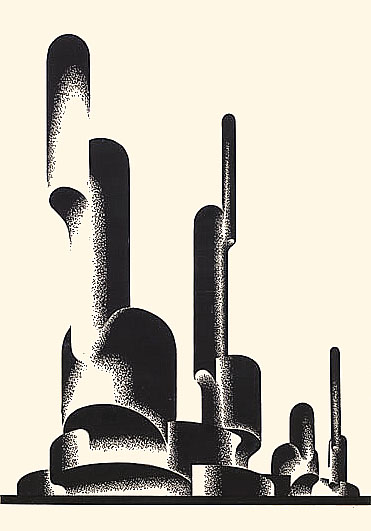
The melody of a majestic (aspirational) constructive joining of parts often affects us because the overall mass of the grouped elements is bound by a compact structural composition. This was noted even earlier in the architecture of Gothic buildings, which possess a refined and complex structure.
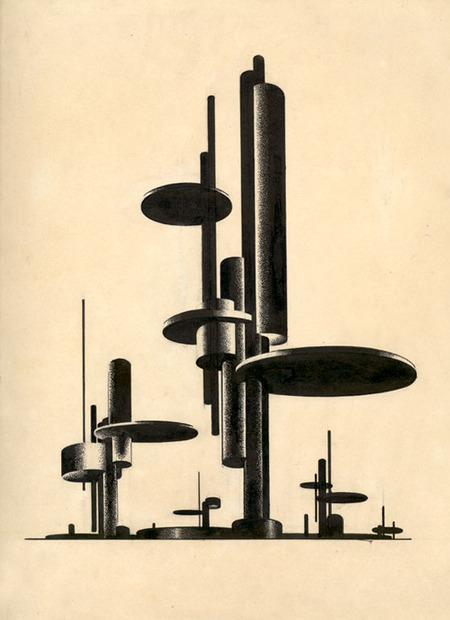
For instance, the aircraft possesses a similar trajectory of aspiration. Some engines and machinery are striking in the sheer power of their drive—a sensation prompted by our conviction in the rationality of their structural assembly. It is no wonder that many hear the «music of time» in the hum and operation of machines. The interplay between structural principles and motion creates a «mechanical animacy» that we unconsciously celebrate. When a creative work combines genuine grandeur and a driving aspiration, along with functional movement within it, a distinct «melody» emerges—one separate from other constructed melodies.
Today’s factory buildings must adhere to the production principles of the era. Influenced by the functional rationale inherent in the machine, the new architectural style takes on a quality of laconicism, utilitarianism, simplification, and clarity in its constituent forms. The machine is not a dead mechanical structure for service; rather, it is something self-sufficient and, in a sense, not foreign to art.