
Competition Task: 1. Visualize at least 3–5 key characters from the play «The Blue Bird» for subsequent installation of character figures in various locations across Moscow. 2. Develop a concept. Justify the connection between the character and a historical site related to the Moscow Art Theatre (MKhT) or another location in Moscow (including mandatory route points).
IN SEARCH OF THE BLUEBIRD
In Metelinka’s play, the miracle begins with simplicity: the children notice that objects possess souls—the Soul of Bread, Milk, Fire, Clocks… «In Search of the Bluebird» is a journey that helps everyone see this miracle as a family: for the child, it is play and fairy tale; for the adult, it is the story of the city and the theater.
The route leads from objects to memory. First, it follows the tracks of craft and elemental forces: where sugar was cooked, fire was turned into light, and milk was traded. This is the «lower circle»: it is about how the world works, and it is convenient here to stop, examine facades, and discuss what sweets are made of and how food was preserved in the past. Then the path moves toward the theater—to places that hold the memory of premieres, the birth of the Moscow Art Theatre (MKhT), and the people who once performed this tale. This is the «upper circle»: it is about meaning and remembrance, and here it is good to slow down, sit on a bench, and conclude the story in one’s own way.
The route closes the circle of the play itself: it begins in the MKhT «home» with Tiltil and Mitil and ends by the Bluebird. Between them lies a path from the mundane to the eternal. And this is the core meaning: the miracle is not somewhere far away—it is right here, as soon as you look closely at each other and at the city.
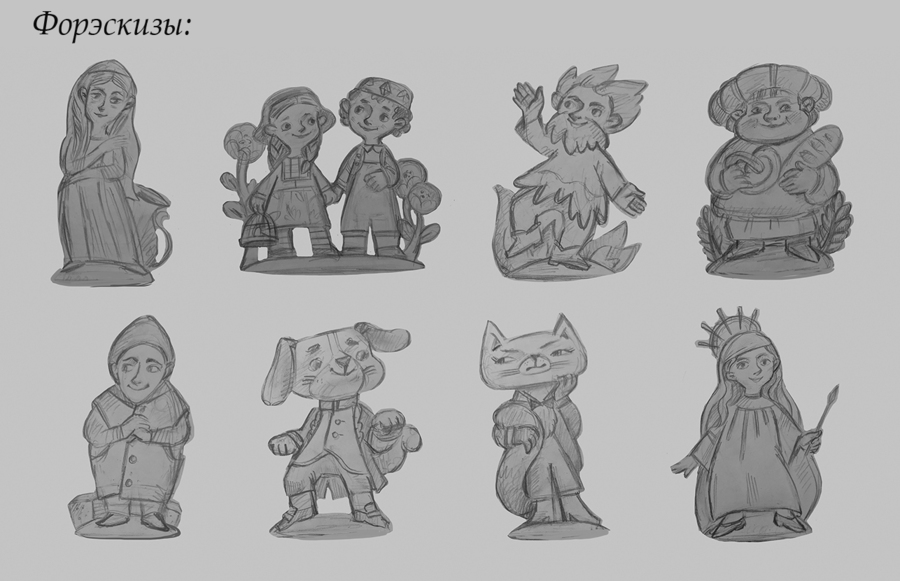
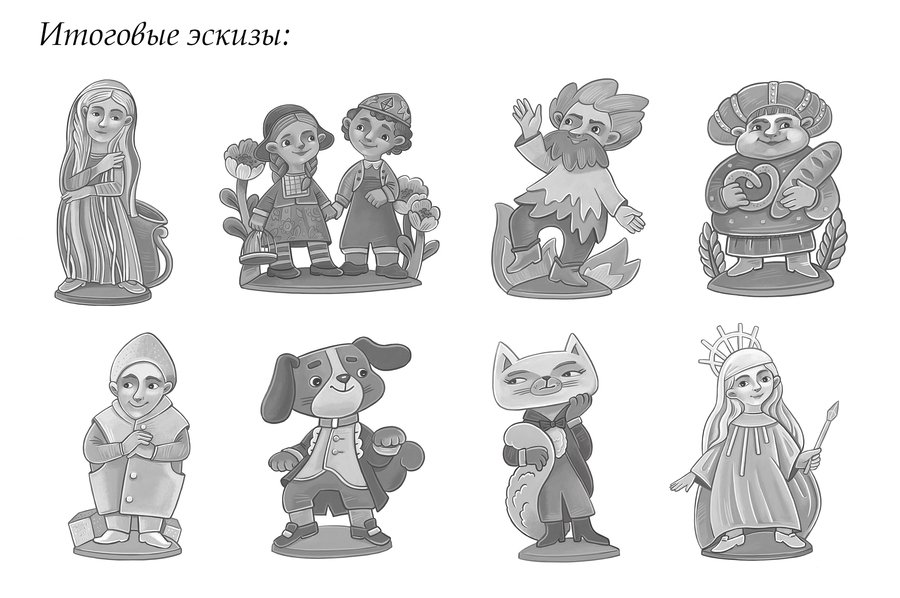
Character legends and their associations with locations in Moscow:
1. Tiltil and Mitil — Kamgermersky Pereulok, 3
MKhT named after A. P. Chekhov
The play opens and closes in the same house: in the woodcutter’s hut, where clocks tick with weights, a wardrobe stands, bread is fermenting, and the hearth is dying down. Everything else is travel. Therefore, the trail must begin where it ends: in the alley that Moscow ceded to the Theater of Arts.
2. Khleb — Tverskaya Street, 10
Former «Filippov’s Main Store»
In the play, the bread is proud and generous: it cuts pieces from itself to feed the children, insisting that its greatest virtue is its heart—the soft crumb—not the crust everyone stares at. For a century and a half, people came here for bread like this; they loved Filippov’s bakery for how carefully they selected the flour and even the water. Now the bakery is closed, and the building is enclosed by a construction hoarding, so the Soul of the Bread stands outside, by the fence—where it is finally being looked at again.
3. Moloko — GUM, the arcade on Nikolskaya Street
The State Universal Store (GUM)
Moloko is presented in white—and in this attire, it seems to hold all the tenderness and warmth that people have associated with this product for centuries. For hundreds of years, trade thrived at the GUM site between Ilyinka and Nikolskaya Street; the city always came here for its most essential needs, and milk was always highly regarded here. Furthermore, since 1954, a workshop has operated in the GUM basement, making the famous ice cream—using a timeless recipe, genuine milk, and cream—exclusively for this store. Thus, the Soul of Moloko is located precisely where it is still cherished and valued.
4. Souls of Time — Garden-Samotyochnaya, 3
S. V. Obraztsov Puppet Theatre
In the play, the Souls of Time don’t just chime—they pop out of the wall clocks, whirl in a joyful dance, and then disappear back into their casing just as quickly. These clocks are unique in Moscow: on the façade of the Obraztsov Puppet Theatre, twelve little houses open every hour, and animals emerge from them one by one. Sergei Obraztsov conceived these clocks after a trip to Prague, where he saw medieval clock towers with lifelike figurines, and he wanted the theater to begin not with a coat rack, but right in the street. At noon, all twelve houses open simultaneously—and this is perhaps the most accurate portrait of the Souls of Time in all of Moscow: a miniature performance where time dances.
5. Water — Zaryadye Park The lower tier embankment of Zaryadye Park
The water is entirely blue and is perpetually weeping: it is drunk, washed in, and splashed over. Of all the Spirits, it is the only one that does not ask for an address but for an environment; therefore, the figure of Water can be placed at the water’s edge, a meter from the Moskva River.
6. Ogony — Bolotnaya Embankment, 15
GES 2 House of Culture
Ogony in the play is loud, volatile, and yet cowardly: he threatens to break out and burn everything down, but honestly admits that he fears Water more than anything in the world, and also that people treat him worse than anyone else. Here, at GES-2, the first steam turbines in Moscow were installed in 1907 to convert fuel into light—to light lamps in streetcars and apartments, to run machinery, and to drive trains. It is logical for Ogony to be here, where he served his purpose and from where he looks at the river he is still afraid of.
7. Sakhar — Bersenevskaya Embankment, 6
The complex of the former «Eynem» confectionery factory («Krasny Oktyabr»)
In the play, Sugar grieves that his fingers are being chopped off for candies—and is immediately comforted: go ahead and chop them off, because when sugar is swallowed, it becomes your strength and your thoughts. This island, where candies were made for a century and a half, is his natural home. Since 1851, Sugar here was not a product on a shelf, but a profession learned over decades—they melted it, poured it into molds, cut it into squares, and twisted it into caramel, and every candy was a small miracle of sugar transforming into joy. The Sugar figurine can be placed near the brick wall of the former building.
8. Soul of Light — Petrovsky Lane, 3
The Natyonal Theatre
Light is the only Soul named in the play, and the only one forbidden entry to the Palace of Night: it remains outside, waiting. The Korsh House, where The Natyonal Theatre is currently located, was the first place in Moscow to install electric lighting in all rooms in 1885—a radical act at the time. Light belongs where its appearance is an event.
9. Nochi — Bolshaya Dmitrovka, 17
Moscow Academic Music Theatre of K.S. Stanislavsky and V.I. Nemirovich-Danchenko
Nochi unleashes terrors and locks people within their dreams. The Queen of the Night is a major character in Mozart’s opera, «The Magic Flute.» The Theatre of K.S. Stanislavsky and V.I. Nemirovich-Danchenko has been performing «The Magic Flute» since the early 20th century, which is why the figure of Nochi can logically be placed here, near this theatre.
10. Tree Spirits: Oak, Pine, Poplar, Birch, Willow, Linden — Carriage Row, 3
The Hermitage Garden
The spirit of the Oak leaves its palace, leaning on a knobbly staff and a young oak sapling, with the Blue Bird perched on its shoulder. This painting can only be displayed where the forest has already grown. The Hermitage Garden is the cradle of the Moscow Art Theatre: it was here that the theater premiered «Tsar Fyodor,» and it was also here that «The Seagull» became a triumph. The theater was born in a grove and carried its bird from there.
11. The cat is here, near the gate from Karetny Ryad. Entrance to the «Hermitage» Garden from Karetny Ryad.
In the play, the cat is cunning and human-like: she knows all the secrets and negotiates with the trees. It makes logical sense to place her right here, near the Spirits of the Trees.
12. Smert — Leontyevsky Pereulok, 6
K. S. Stanislavsky Museum House
Smert appears once a day; her name cannot be spoken aloud, and she is the sister of Snu. On August 7, 1938, she came for the founder of the Theatre of Arts to this house—and the house has not changed since then: the stove, the nursery, the study from the inventory. This is not a place where the Country of Memories, where the dead wake up while they are remembered, was conceived.
13. The Dog — Square in Glinishchevsky Lane
The square in Glinishchevsky Lane (near the MHAT Artists' House)
The Dog is the only character with a living prototype: Jako, Metterling’s dog. According to a common version, the lane was named after kennels and a hunting market, so it is the only one of all the characters who can be outside rather than on stage. And in the text, the dog refuses to go home: whoever is destined to stay outside, remains outside.
14. Blue Bird — Tverskoy Boulevard, 22 MHCAT named after M. Gorky
The Blue Bird perishes in the light and only lives in a fairy tale—it is the only Soul that has no room in the cottage. But it has an address: the world premiere took place on September 30, 1908, and it is the only Stanislavsky production that never closed and has been performed in a different theater since 1987, but with the same voice. The Bird belongs where it is set free from its cage every evening.
Modern technologies give us the ability to envision what approximately sketched character concepts might look like in their final material form. I decided to take advantage of this capability.