
The book club has long gone beyond simply being a gathering in a living room where everyone has read the same novel and shares their impressions in turn. Today, a club can be an intimate discussion, a lecture by a literary scholar, a reading marathon, a quiet group reading session in a coffee shop, or a large online community whose members are not even required to read the same book.
Classic Club: One Book—One Meeting
This is the first format that comes to mind. Participants select a book in advance, read it by a specific date, and then meet—at home, in a library, a bookstore, a cafe, or online—to discuss the text. The conversation usually revolves around simple but important questions: what struck you in the book, whom you empathized with, how the plot is structured, why the author chose that specific language, and how close the historical or cultural context feels to you. The moderator can be a librarian, a book blogger, a professor, an editor, a critic, or one of the club members. This format is ideal when you don’t just want to read a book, but want to experience it through conversation. It is especially suitable for novels that evoke polarized reactions, classics that require context, and books that can easily be connected to personal experience. Online, a classic club either meets for discussion via video call or discusses the book in a chat.
Expert Club: Reading with a Guide
In this case, the focus is not just on the book, but also on the person who helps reveal it. This could be a literary critic, translator, author, editor, art historian, historian, psychologist, or language instructor. Expert clubs gather for context. For example, a novel can be read alongside a historian of the era; an artist’s memoirs can be discussed with an art historian; a book on fashion with a costume researcher; an English text with a teacher who can explain idioms, intonations, and stylistic nuances. This format offers participants added educational value.
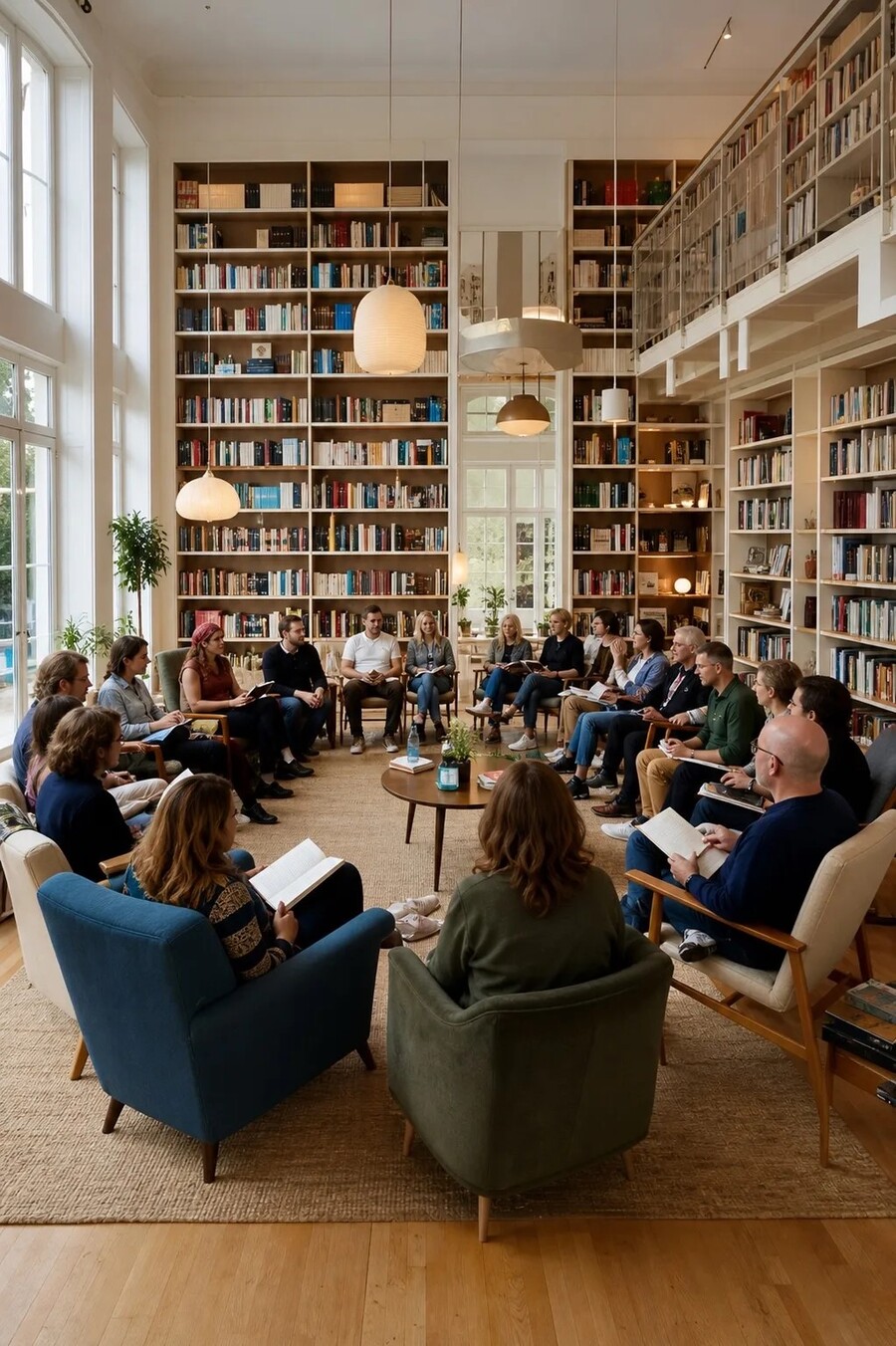
Club Course: Reading Systematically
Sometimes the club is structured as an educational program. It has a theme, a curriculum, and a duration—for example, «American Prose of the 20th Century,» «Women in English Literature,» «The Bildungsroman,» «Books on Fashion,» «Contemporary Science Fiction,» or «Classics in New Translations.» Members read several books in a row, receive a schedule, supplementary materials, discussion prompts, and sometimes even prerecorded lectures. Assignments, short essays, glossaries, and curated lists of films and visual sources may also be included. The main goal of such a club is to build a comprehensive picture of a specific theme, era, genre, or literary tradition. This format is ideal for those who need structure and intellectual grounding. It works especially well online: materials can be consumed at one’s own pace, and meetings can be saved as recordings.
Author or Genre Club
This type of club has a clear focus. It can be dedicated to a specific author, literary period, country, genre, or reading type. For example: • A Jane Austen or Virginia Woolf club; • A club dedicated to 19th-century Russian prose; • A community of gothic novel enthusiasts; • A non-fiction reading group focused on culture and history; • A discussion group for contemporary Korean literature; • A club for detectives, fantasy, romance novels, or comics. A narrow theme helps quickly find like-minded people: you don’t have to spend ages explaining why you are rereading Jane Eyre, debating a new Proust translation, or ready to spend hours discussing the costumes of heroines in a Victorian novel. However, a thematic club carries a risk—it can become too insular. This is why it is especially invigorated by invited experts, new participants, and unexpected connections to cinema, theater, music, or visual culture.
Read-Aloud Club
Here, people gather for the sheer pleasure of reading. One person reads aloud while others participate in role-playing or listen to a professional actor, author, or translator. This format is well-suited for poetry, drama, fairy tales, memoirs, short fiction, letters, and books where voice, rhythm, and intonation are particularly important. It can be intimate, geared toward children, theatrical, library-based, or almost salon-style. Reading aloud is also possible online—for instance, in a voice chat or a private meeting. However, it is especially powerful in person—after all, personal connection is what matters most here. Sometimes, this is the gentlest way to return to reading for those who find it difficult to start a large book alone.
Silent Book Club: Being Together and Reading in Silence
On the opposite end is the Silent Book Club—a «quiet book club.» The format originated in San Francisco and has grown into an international community with thousands of local chapters across dozens of countries. The idea is very simple: everyone brings their own book, participants sit together, turn off their phones, and immerse themselves in reading. Sometimes members get to know each other and briefly share what they are reading, and at the end, they discuss what they’ve read and exchange recommendations. Other times, however, no one says anything at the beginning or the end of the meeting—socializing is not required. The point of the Silent Book Club is that it helps carve out time for reading without pressure or obligation.
Readalong: Sync up and discuss along the way
Readalong, or shared reading, most often takes place online. Participants read the same book at a set pace—for instance, several chapters per week—and discuss it not just at the very end, but along the way. This can be a chat, a commentary channel, a private social media group, a forum, or a dedicated reading community application. The moderator publishes discussion prompts, reminds participants of the schedule, suggests quotes, and provides supplementary materials. Sometimes, «checkpoints» are introduced: a discussion following each section, chapter, or specific date. This format is especially convenient for lengthy novels, classics, book series, and texts that people want to discuss without spoilers. It creates a sense of reading «together"—a person doesn’t confront the book in isolation; they know that other readers are currently around the same page.
The Club as a Community: The books.mediiia Format
books.mediiia is closely aligned with this type of community. It is not a classic book club where everyone is required to read a single book by a set deadline and attend a discussion. Rather, it is a community for people for whom the book is a part of their intellectual and aesthetic life. Here, what matters is not a single, required reading list, but a shared perspective on the book as a cultural object. We discuss rare and collectible editions, book design, the history of personal libraries, literary narratives, visual culture, books from the past, and new publishing projects. We meet authors, editors, artists, collectors, researchers, and individuals for whom the book has become a professional or personal pursuit. Our community does not need to gather weekly to validate its existence. It thrives through consistent, substantive conversation—through publications, interviews, recommendations, archival discoveries, short notes, personal stories, and the chance to meet in person occasionally.
books.mediiia can be a space for those who don’t want to report on what they’ve read, but still want to be surrounded by books—to open them, examine them, discuss them, collect them, and remember them. It is not a club with obligations, but a cultural circle where everyone has their own reading journey and a shared interest in how books become a part of our lives.