Categorization
1. Concept 2. Hypothesis 3. Anatomy of the Ritual: How «One Hundred Stories» Was Played 4. Epochal Context: Why This Game Emerged 5. Visual Code of Fear: An Analysis of Ukiyo-e Engravings 6. From Ritual to Pop Culture: Transformation 7. Conclusion
Concept
The game «Hyakumonogatari» is more than just a way to tell scary stories. It is a spatial and visual ritual where objects (a candle, a mirror, a lantern) function as the «interface» between the human and the supernatural.
My work will analyze how the rules of the game (extinguishing 100 candles) and its visual attributes (ukiyo-e engravings, spirit imagery) construct the experience of fear. This research examines how traditional visual codes (the symbolism of darkness, fire, and mirrors) transition from ritual to contemporary design and popular culture.
Hypothesis
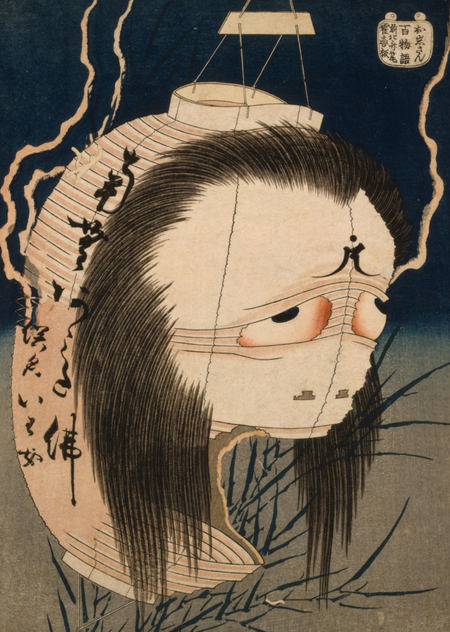
Hyakumonogatari is not merely a folkloric genre; it is a structured visual system where the counting mechanism (100 candles) and spatial constraints (the dark room, the mirror) create an immersive effect. The visual imagery of this game—ukiyo-e engravings—formed established visual codes of fear (long hair, white garments, flickering light) that are still actively used in contemporary design and cinema, though they have lost their original ritualistic meaning.
1. Anatomy of Ritual: How They Played «One Hundred Stories»
During the Edo period in Japan, there were two main variations of the «one hundred stories» game, and both were strictly organized rituals, not chaotic ghost-story telling.
First Option
A simpler variation involved all participants gathering in one dark room, where a hundred candles or paper lanterns were lit. Guests sat in a circle and took turns telling scary Kaihan stories; after each story, one participant would extinguish one candle.
Aodong Lamps
The core mechanic here is built on the gradual diminishing of light: the room sinks into darkness step by step. If the narrators' faces were clearly visible at the start, by the middle of the game they are barely discernible, and by the end, the last vestiges of light only barely outline their silhouettes. This visual fading is what creates the effect of building tension. When the last candle burns out or when all one hundred stories have been told, legend holds that a spirit will appear in the darkness or something supernatural will happen.
Second Option
However, there was also a more complex, classical variation that transformed the game into a true spatial ritual, which best suits the concept of «the candle as an interface.» In this version, three adjacent rooms were used: in the first, the storytellers gathered, and a single candle burned, symbolizing zero; the second room was empty and dark, serving as a corridor the storyteller had to physically pass through before entering the third; and in the third room, which served as the altar, ninety-nine candles were burning, and a mirror stood on a small table.
Spatial Organization Scheme of the «Hyakumonogatari» Ritual
The mechanism of action was as follows: a guest from the first room would tell a story, then take their candle and walk alone through the dark second room into the third, where they would extinguish one of ninety-nine candles. They would then look into a mirror—as tradition held, this was the moment one could see if a spirit was behind them—and return, bringing darkness and cold with them. In this game, the mirror was not merely an object, but a portal, a boundary between the world of mortals and the world of spirits, and looking into it after extinguishing a candle was perceived as a test to see whether the storyteller had crossed an acceptable limit.
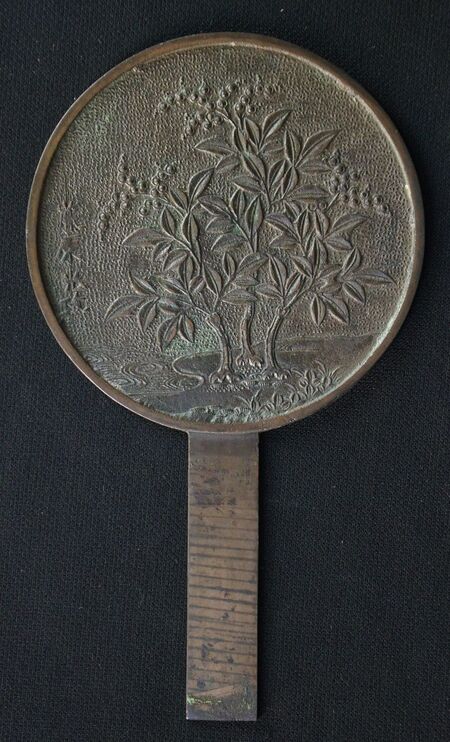
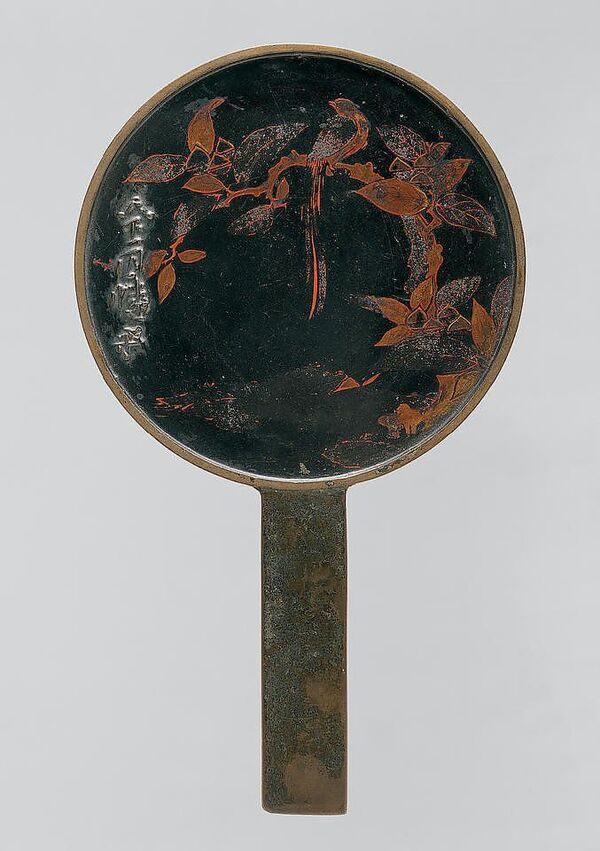
The mirror on the table in the third room is a reconstruction modeled after bronze mirrors with handles from the Edo period.
The key rule that transformed the game from a party into a ritual was the prohibition on completion. In most descriptions, participants stopped at the ninety-ninth story, leaving the final candle untouched.
It was believed that if the hundredth story was told and the final candle extinguished, the spirits would gain complete freedom, and irreparable disaster would ensue.
Reconstruction: a line of blue «Ao-Andon» lanterns in a dark room. This is how the game space looked—a space where the light diminished with every story told.
This fear of the «point of no return» was so intense that even when stories were available, people preferred to stop the game rather than seeing it through. Furthermore, the game descriptions include other details that are often overlooked: for instance, participants had to wear blue clothing, which echoed the color of the blue Ondon lanterns and created a unified color palette for the ritual, and the game itself would begin at dusk and often last until two or three in the morning, when, according to belief, supernatural beings were most active.
The texture of ritual garments. Participants in «Hyakumonogatari» wore blue kimonos inside out (sakasa-awase), exposing the rough seams. This detail blurred the boundary between the living and the dead.
2. Historical Context: Why This Game Arose
«Ukiyo-mono» did not emerge by chance: its rise and popularity during the Edo period (1603–1868) were intertwined with profound social and cultural shifts. The growth of urban centers (Edo, Kyoto, Osaka) fostered a new class—townsmen, artisans, and merchants—who became the primary consumers of Ukiyo culture, or the «floating world.» Unlike its medieval Buddhist connotation (impermanence and suffering), during the Edo period, the term signified a world of play, humor, and enjoyment, where anyone could assume any role. This culture was bold and ironic, satirizing the seriousness of the samurai elite.
It was in this environment that kaidan—the genre of supernatural tales—flourished. Gatherings for telling one hundred stories (hyaku-monogatari kaidankai) were common across all social strata, and as these stories began to be collected and published in anthologies, a distinct literary genre took shape. The popularity of kaidan was attributed not only to a love of the macabre but also to an attraction to the grotesque, a desire to explain the inexplicable in everyday life, interest in exoticism, and a subtle social critique. The genre was not merely entertainment; it was a form of world-making where fear and laughter intertwined.
Seasonality also ran deep: the game was held on summer nights, during the Obon festival, when, according to belief, the spirits of ancestors return to the living world. Lighting lanterns to guide the spirits home paired perfectly with the «Hundred Candles» game—it continued and amplified the ritual practice, transforming it into a controlled experience of encountering the otherworldly.
Finally, the spatial dimension was important. The inhabitants of Edo believed that a special power existed where different spaces intersected—at crossroads, on bridges, and along riverbanks. A room with candles, a dark corridor, and a mirror in a distant room were precisely these «liminal» spaces, where the boundary between worlds became tenuous. The game structured this space, transforming it into a stage for a ritual of fear.
Thus, «Hyakumonogatari» emerged at the intersection of growing urban culture, the popularity of kaidan, the seasonal Obon practices, and a particular perception of space. It was a product of its time—an era where fear became not only a subject of faith but also a form of entertainment accessible to everyone.