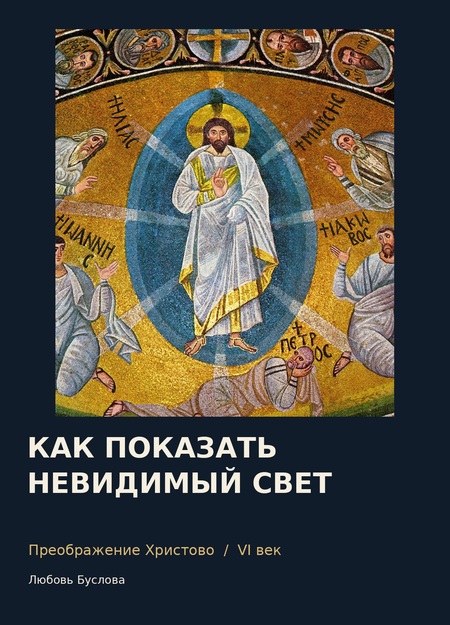
Concept
The theme emerged from my interest in spirituality and human inner transformation. For me, faith is linked to self-knowledge, re-evaluating one’s actions, conscience, and the pursuit of integrity. I resonate with the idea that there is enough light for everyone, but the perception of that light is tied to the individual’s internal yearning for it. This is a personal starting point for my research, not a statement reflecting the views of all people or 6th-century masters.
In art, I am fascinated by the transition from lived experience to visible form. The artist arranges color, line, and material, and the religious content of the image may refer to something that lacks a conventional physical appearance. Therefore, I chose the Transfiguration of Christ: light constitutes part of the event itself, and the characters surrounding Christ allow us to trace how his influence is depicted.
The study is limited to three monuments from the same century. This constraint allows for a detailed comparison of solutions to a single problem. Sinai and Shifta portray Christ in human form within a mandorla, whereas in Ravenna, the cross becomes the central sign. The difference in technique is also important: two works are executed in mosaic, and the third is in fresco painting. Moreover, the differences between them cannot be explained by the material alone—both the iconography and the compositional structure change.
The material was selected based on thematic similarity, chronological proximity, and the availability of published imagery and scholarly research. Shivta holds a special position. Its fragmented preservation renders standard photography insufficient for comparing all details, but the publication of a technical study allows the inclusion of elements lost to the naked eye in the analysis. The presumed dating of the monument remains consistent across all conclusions; it is not used to prove a sequential evolution from one solution to another.
The organization follows the differences in artistic techniques. The section on Sinai examines the blue mandorla and the rays that cross its border. The section on Ravenna focuses on the cross, the starry field, and the arrangement of witnesses. The section on Shivta connects the analysis of the preserved fresco with a discussion of how technical photography alters the visual material available to us. In the conclusion, the monuments are compared using the same parameters.
Textual sources were selected based on their direct connection to the monuments and their methods of study. Gospel episodes provide the narrative framework. Ezh Miziolek’s article helps distinguish the description of the Sinaitic composition from the symbolic interpretations of light. S. H. Nam’s work offers material for comparing Sinai and Ravenna. The research by Emma Maayan-Fanar and the Ravit Linn collective provides diverse information about the Divine: iconographic analysis, discussion of dating, and pigment data. These publications do not replace the examination of the images but allow for testing observations and pinpointing contentious areas.
My question is how the connection between the visual representation of the divine manifestation and its witnesses is constructed. I hypothesize that the framing simultaneously highlights the central image while the rays, the turns of the figures, and their positioning connect it to the surrounding space. This hypothesis should be tested through specific details: where the boundary of the central field lies, what crosses it, and where the figures are directed. This approach allows for maintaining a personal interest in spirituality without substituting the analysis of the works with general discourses on faith.
On Sinai, the center is marked by a blue oval; in Ravenna—by a cross within a star circle. In Shivta, the center itself must be sought among traces of pigment. What happens to the witnesses in this process?
Unknown Masters. The Transfiguration of Christ. Monastery of St. Catherine, Sinai, 548–565 AD. Forsyth, Weitzmann, 1973, Plate CIII; reproduction by Linn et al., 2017, Figure 1. Unknown Masters. Mosaic of the Apse of Sant’Apollinare in Classe, Ravenna, 546–549 AD. Photo S. H. Nam, 2024, Figure 1. R. Linn. Southern Apse of Shivta: combination of photography and VIL imaging with digital reconstruction of contours, 2016. Linn et al., 2017, Figure 8. Fragments are shown. Comparative layout.
Both mosaic centers have a defined boundary. We will trace which elements cross this boundary and which remain inside.
Unknown masters. Transfiguration of Christ. Monastery of St. Catherine, Sinai, 548–565 AD. Forsyth, Weitzmann, 1973, plate CIII; reproduction Linn et al., 2017, Fig. 1. Unknown masters. Mosaic of the apse of Sant’Apollinare-in-Classe, Ravenna, 546–549 AD. Photo S. H. Nam, 2024, Fig. 1. Fragments are shown. Comparative composition.
Two mosaics are available for comparison based on reproductions. The condition of the painting requires a different approach: in addition to the photograph, an image obtained from a technical study will be necessary [5].
Unknown masters. The Transfiguration of Christ. Saint Catherine’s Monastery, Sinai, 548–565 AD. Forsyth, Weitzmann, 1973, Plate CIII; reproduction Linn et al., 2017, Fig. 1. Unknown masters. Mosaic of the apse of Sant’Apollinare in Classe, Ravenna, 546–549 AD. Photo S. H. Nam, 2024, Fig. 1. Unknown master. The Transfiguration of Christ. Church of Shiva, likely 6th century. Photo R. Linn, 2016. Linn et al., 2017, Fig. 3. Comparative composition.
Against a gold background, Christ stands frontally. Two prophets flank him, and three students at his feet form an open group around him.
Unknown master. The Transfiguration of Christ. Monastery of Saint Catherine, Sinai, 548–565. Forsyth, Weitzmann, 1973, plate CIII; reproduction Linn et al., 2017, figure 1.
The outer border mirrors the curve of the conch. Inside it, a second blue boundary encloses only the central figure: the architectural field and the space of manifestation do not coincide.
Unknown masters. The Transfiguration of Christ. Monastery of Saint Catherine, Sinai, 548–565. Forsyth, Weitzmann, 1973, Plate CIII; reproduction from Linn et al., 2017, Fig. 1. Fragments are shown.
The long folds of the light-colored garment support the verticality of the figure. This stable silhouette remains a focal point as the viewer’s eye moves to the leaning bodies around it.
Unknown masters. The Transfiguration of Christ. Monastery of Saint Catherine, Sinai, 548–565. Forsyth, Weitzmann, 1973, plate CIII; reproduction Linn et al., 2017, figure 1. Fragments are shown.
Christ’s garments appear particularly bright next to the deepest blue. To denote the light source, the master did not need to render the entire surrounding field white.
Unknown Masters. The Transfiguration of Christ. Monastery of St. Catherine, Sinai, 548–565. Forsyth, Weitzmann, 1973, plate CIII; reproduction from Linn et al., 2017, Fig. 1. Fragments shown.
Miziolet distinguishes three blue zones that lighten toward the edge; in a footnote, he provides a different count. The transition from dark to light is most reliably discernible from the image [2, p. 43, 59, note 108].
Unknown Masters. The Transfiguration of Christ. Saint Catherine’s Monastery, Sinai, 548–565. Forsyth, Weitzmann, 1973, plate CIII; reproduction from Linn et al., 2017, fig. 1. Fragments are shown.
The circular nimbus isolates the head, while the elongated mandorla encompasses the entire body. Both contours relate to Christ, yet they define different scales of focus.
Unknown master. Transfiguration of Christ. Monastery of St. Catherine, Sinai, 548–565. Forsyth, Weitzmann, 1973, plate CIII; reproduction from Linn et al., 2017, fig. 1. Fragments are shown.
Along the side border, a narrow light stripe is clearly visible. The gaze can travel across it, from blue directly into gold: the contour does not sever Christ from the others.
Unknown masters. The Transfiguration of Christ. Monastery of Saint Catherine, Sinai, 548–565. Forsyth, Weitzmann, 1973, Plate CIII; reproduction by Linn et al., 2017, Fig. 1. Fragments are shown.
Rays emanate upward and outward from the figures of the prophets. In contrast, the tilt of their bodies directs the viewer’s gaze toward Christ.
Unknown masters. The Transfiguration of Christ. Monastery of Saint Catherine, Sinai, 548–565. Forsyth, Weitzmann, 1973, plate CIII; reproduction by Linn et al., 2017, figure 1. Fragments are shown.
The prophets are depicted on opposite sides of the oval. Their raised arms create a central line of sight, though the figures themselves do not touch [2, p. 43].
Unknown masters. The Transfiguration of Christ. Saint Catherine’s Monastery, Sinai, 548–565. Forsyth, Weitzmann, 1973, plate CIII; reproduction Linn et al., 2017, Fig. 1. Fragments shown. Comparative composition.
The knee is lowered, the arms are raised out to the sides of the face. This is how the figure engages with the event twice: a beam approaches him, and his own posture responds to what is happening.
Unknown masters. The Transfiguration of Christ. Monastery of Saint Catherine, Sinai, 548–565. Forsyth, Weitzmann, 1973, plate CIII; reproduction by Linn et al., 2017, fig. 1. Fragments are shown.







