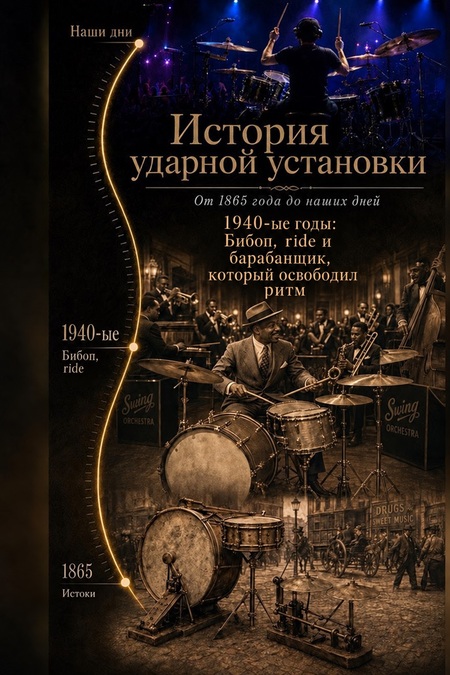
Bibop, ride cymbal, and the drummer who freed the rhythm
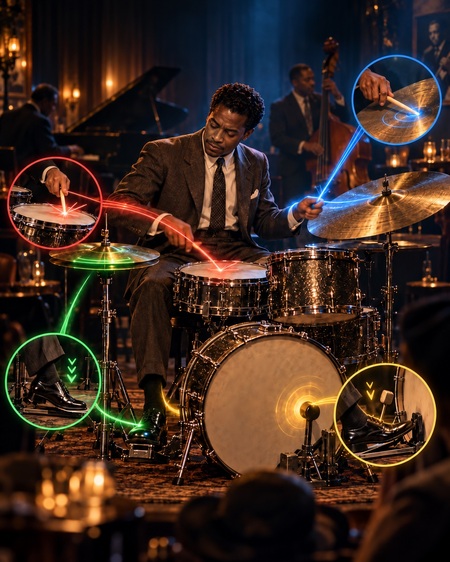
The 1940s: From Swing Band to the Revolution of Modern Drumming
By the late 1930s, the drum kit had already become a complete musical instrument. It had a recognizable structure, its own lexicon, star performers, and even its own industry. Gene Krupa proved that a drummer could be the main protagonist on stage. Chick Webb demonstrated that a drummer could lead a large orchestra. Jo Jones taught the kit to sound lighter and freer.
What more could one ask for?
But the 1940s arrived, revealing that the drummers of the previous decade had merely set the stage for a true revolution.
This revolution didn’t require the invention of another pedal or a new drum. It lay in changing the philosophy of playing itself.
The drummer stopped being merely a keeper of time. Now, they could command time, play around it, converse with soloists, create unexpected accents, and transform a familiar rhythm into a complex musical construction.
This only required changing the distribution of responsibilities among the four limbs.
It sounds simple. But try explaining to your own left foot that it must now think independently.
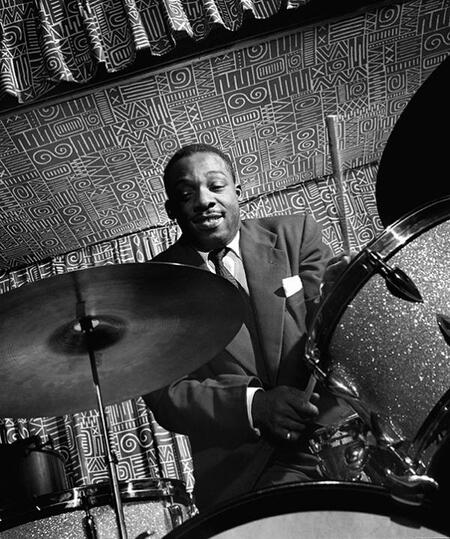
Kenny Clarke: The Man Who Transformed Time on the Drum
Kenny Clarke, nicknamed Klook, is considered one of the principal architects of the modern jazz drumming language. His innovation lay in how he reimagined the function of the time-keeping instruments. In the swing era, the rhythm was often established by the bass drum and hi-hat. The bass drum could softly mark the four beats of the measure, while the hi-hat maintained the swing pulsation. Clarke proposed a different principle. The constant establishment of time is primarily shifted to the ride cymbal. The right hand plays a steady swing pattern on the ride cymbal. The bass drum and snare no longer have to constantly mark the strong beats; instead, they gain the opportunity to create independent accents. This was a genuine revolution. The musical texture was now divided into several independent layers. The ride ensures continuous motion. The double bass provides the harmonic and metric foundation. The snare drum responds to the soloists' phrases, adding syncopation and unexpected accents. The bass drum can support the pulse very subtly, or sometimes intervene suddenly with a powerful strike. Clarke was not the only musician to experiment with similar techniques; masters of swing like Jo Jones and Sid Catlett paved the way for this new approach. But it was Clarke who helped transform these ideas into the foundation of a new style. This is where the crucial concept in modern drumming art appears—coordinated independence. The drummer no longer executes one unified rhythm with all hands and feet. Each limb is assigned its own musical task.
Ride Cymbal: The cymbal becomes the primary instrument of time. To grasp the significance of this shift, we must discuss the ride cymbal specifically. In previous chapters, we traced how cymbals gradually moved from purely theatrical effects to becoming fully realized components of the drum kit. The crash handled the climaxes. The china added sharp timbral color. The hi-hat allowed the player to control the metallic sound with their foot. But now, it is the ride that becomes the central instrument of the new jazz rhythm. Why? Primarily due to its sustained duration. Unlike the snare or kick drum, the ride doesn’t merely create discrete impacts; it shapes a continuous sonic space. Each subsequent beat emerges from the decay of the preceding one. This results in a feeling of perpetual motion. The characteristic swing pattern also plays a crucial role—a pattern drummers often emulate aurally: chick-chick-chirik or as American sparrows chirp: Ding, ding-da-ding, ding-da-ding… This is not a mechanical alternation of identical hits. True swing demands work with accents, durations, dynamics, and an internal sense of time. A drummer can subtly alter the articulation, emphasize specific notes, play closer to the edge of the cymbal or toward its bell, thereby generating varied sonic nuances. Yet, the ride continues to fulfill its primary function: unifying the ensemble. For me, as a drummer, this is one of the most astonishing discoveries in the history of our instrument. To gain greater freedom, musicians didn’t add another drum. They redefined the purpose of an existing cymbal.
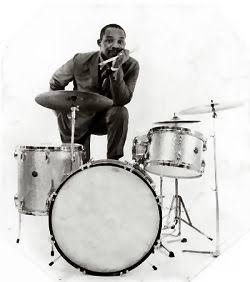
Dropping Bombs: The Bass Drum Begins to Explode Music
One of the most characteristic techniques of early bebop was the so-called «dropping bombs.» The name sounds almost military, which appears especially symbolic for the 1940s. But we are, of course, talking about music. The drummer is no longer obligated to play the bass drum strictly on every beat. Instead, they can suddenly strike it between beats or emphasize the soloist’s syncopated phrase. Imagine this: the ride cymbal maintains a steady pulse, the upright bass confidently carries its line, and the saxophonist begins a rapid passage—and suddenly, the bass drum adds a powerful, unexpected accent. This is one variation of the «bomb.» Similar accents could also be played on the snare drum. What mattered was not the specific instrument, but the disruption of the expected rhythmic pattern. In swing, the bass drum more often provided a stable foundation. In bebop, it becomes a tool for musical commentary. And here is the fundamental difference: the unexpected strike should not shatter the time. It should create tension within a stable pulse. It is like a conversation between two intelligent people, one of whom suddenly delivers an unexpected yet perfectly accurate line. Of course, the opposite can also happen: the drummer delivers so many lines that the other band members begin to dream of silence. But the best bebop masters knew how to maintain balance. It is important to distinguish between two techniques: Feathering the Bass Drum and Dropping bombs. The first involved barely audible quarter-note playing on the bass drum, creating a soft rhythmic foundation. The second involved sudden, louder accents, often between the main beats of the measure. Kenny Clarke and other bebop drummers could combine both approaches: maintaining a quiet pulse with their foot while simultaneously using the bass drum for unexpected rhythmic commentary. Thus, the bebop revolution was not a complete abandonment of the constant bass pulse, but the liberation of the bass drum from the duty of being the primary timekeeper.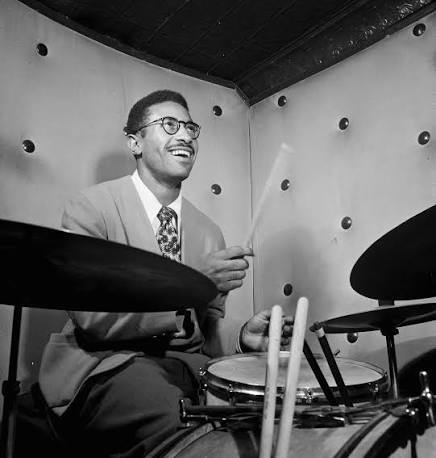
Max Roach: The Drum Kit Begins to Think in Musical Phrases
If Kenny Clarke formulated a new rhythmic concept, Max Roach elevated it to the highest level of art.
Roach became one of the most crucial drummers of the 1940s. He played with Charlie Parker, Dizzy Gillespie, and other pioneers of bebop.
His approach was distinguished by extraordinary precision, musicality, and a keen sense of form.
Roach didn’t just place unexpected accents; he built musical sentences from them.
His solos could possess a beginning, development, climax, and resolution. He utilized the different timbres of the kit as voices of a single instrument.
The snare, bass drum, toms, and cymbals ceased to be separate objects and became a kind of percussion keyboard.
Furthermore, Roach knew how to generate expression not just through a large number of notes.
A pause, a short accent, a shift in dynamics, or an unexpected displacement could be far more potent than a long, technical passage.
A landmark moment was the 1945 November 26 recording of Charlie Parker’s «Ko-Ko, ” which featured Max Roach. This composition became one of the classic documents of bebop’s emergence.
In this recording, the drum kit already demonstrates a new principle of interaction with soloists. It doesn’t merely accompany them; it actively participates in creating the overall musical tension.
Roach demonstrated that a drummer can think like a composer, even while improvising.
This laid the foundation for the future evolution of drumming—from bebop to modern jazz, fusion, and progressive rock.To be continued