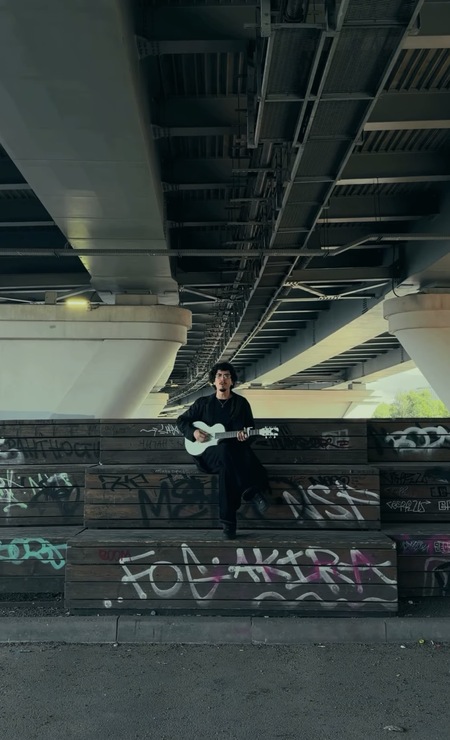
At the Dne Piter Platform, I saw my acquaintance Aziz on stage. He is an incredibly talented and very promising musician, so I decided to interview him. Unfortunately, a text transcript cannot convey the interesting accent and unique presence that Aziz possesses.
-Please tell us about your background—where were you born and how did you grow up?
I was born in Tunisia, in North Africa. I lived there for 20 years and studied, and at age 16, I decided to get into music. Not seriously, just as a hobby. At one point, I got the chance to perform with friends and decided to play the drums. When I was 21, I moved to Russia to study.
How different is life in Russia from life in your hometown?
It’s completely different—there’s a whole other culture, a different mindset, and different people here. I have an anniversary coming up soon; in nine days, it will be ten years since I moved to St. Petersburg, and I still haven’t fully adapted. I would be lying if I said I had.
Do you perhaps encounter concepts that still seem unusual or difficult to grasp?
How people behave. Sometimes I miss connecting with people here. Everyone feels too cold to me. Mostly, when I encounter warmer people, I’m very surprised. Seeing that kind of thing is rather unexpected for me.
So, is that why people say Russians are the least smiling nation?
When it comes to St. Petersburg, that’s true. People behave differently further south. When I meet cheerful people in St. Petersburg, I think, «Wow, that’s something else; I don’t see that here.»
What would you say about the stereotype that Russian people are not naturally smiley, but are very heartfelt and hospitable?
Yes, there are moments when I’m just hanging out with someone, we start discussing deep topics, and the person opens up. With Russians, it feels like you’re watching television on a grainy screen. Their faces are like screens through which it’s hard to fully understand who they truly are. You need to spend a little more time with someone Russian for it to become clear what kind of person they are, because initially, everyone here has a poker face.
Why did you decide to move to Russia and choose St. Petersburg specifically?
In my final year at a Tunisian school, while I was preparing for exams—which, by the way, are quite similar to the EGE system—I randomly called a friend who was one year older and learned that he was studying in St. Petersburg. Initially, I didn’t even know he was in Russia; I thought he had moved to Serbia. My friend mentioned that he really didn’t like St. Petersburg and somehow felt that the city would be a better fit for me. He said that at the end of the school year, he was moving to Europe and could help me obtain all the necessary documents to enroll in St. Petersburg. It’s been 10 years since I’ve been here.
Do you agree with your friend? Is St. Petersburg truly your city?
He was probably right. I feel like the city chose me. Usually, people go to France or Canada, but at that time, things were difficult, and getting visas was challenging due to budget constraints. Russia turned out to be the fastest and most reliable option. Declining an offer was impossible at the time—you send your documents, and if you receive an invitation from the university, you just pay the tuition and come. So, I didn’t have specific plans to move to Russia. I had plans to leave Tunisia. Where—it didn’t matter.
When you finally decided to move to Russia, were you planning to find something new for yourself, or were you intending to make a living through music?
I was very young, so everything around me was new. No background, no expectations. And that helped me a lot, for example, when dealing with problems that arose because I had no experience in anything. I had nothing to lose. I left and that was it. I wasn’t involved in music at all; I came to study. I wanted to become a doctor.
How did you transition from medicine to music?
I wanted to be a dentist but chose the wrong university. It turned out I had fallen victim to scammers—the university lacked accreditation and was not state-run. So, I paid money but couldn’t get the education I had hoped for. Consequently, I needed to find an alternative, a different university. Because of that inconvenient situation and new acquaintances, I chose music as a profession. I realize now that this is likely my calling. I wouldn’t believe it if I pictured myself as a doctor instead of a musician today.
Tell us about your overall relationship with music
I have loved it since I was a child. My parents certainly noticed this and decided to enroll me in the Conservatory—a college for classical and Arabic music. That is, something a thousand times more difficult than a regular music school. As a 7-year-old child, I understood nothing. I had significant concentration issues, so drawing swirls and dots was torture. On the Solfeggio exam, I performed so poorly that the instructors wanted to keep me in for another year. They told me then, «You don’t understand anything. In reality, you should repeat the first year, but you have a too-promising voice, so we will let you pass as a second-year student.» I refused. I don’t know why. I simply didn’t like it there. It was terribly far to travel to, boring, and after school, I was always hungry and never understood anything.
Some time after that, my dad decided to get me a drum kit. I hadn’t touched the drums for two years when I met a guy from school who started teaching me. Then I found friends with whom I played in bars and restaurants. At one point, I felt like I was the best drummer in the world. Of course, that wasn’t true. When I came to Russia, I realized it was all in my head and that my actual playing level was low—very amateur. So, I decided that singing and playing guitar in my own cover band, which I called «Playonazm, ” would suit me better.
How did you find people for your group?
I really wanted to form a big band, but it didn’t happen because some people were sick, others were working, and some didn’t want to go outside because it was cold. I couldn’t get the group together for about three months; it was very frustrating. That’s another quirk of the Russian mentality—or perhaps more specifically, the St. Petersburg mentality—some kind of laziness. The only person who was seriously committed back then was my friend Sasha. We used to rehearse at his house. For a while, we did street performances. Then we decided we needed to switch to something more serious, so we went to bars, then restaurants, private events, and so on. I haven’t worked with Sasha since this year; we performed together for five years. Now, I work at «Nemodnyye» and perform solo.
As far as I know, you don’t just cover songs—you write your own music as well.
I write my own music, but for now, it’s still in the early stages. I have the material; all that’s left is to book a studio session and release it. I’m currently stabilizing my personal life, so I’m not recording yet. I’m considering the best way to approach it. This is a completely different project; it requires significant resources and time without distractions. I don’t want to rush it.
Maybe you thought about moving away from cover art and working only on your own pieces?
This is my dream. I don’t want to be playing blues in pubs for the next 30 years. Blues is cool—I love blues—but I can’t keep doing it forever. I’ve been doing covers with Sasha for five years, and I’m really sick of it. I’m the kind of person who can’t truly relax. Maybe in a couple of years, I’ll quit music altogether and just live for myself. We’ll see. I believe that if you enjoy what you’re doing, everything will work out. It’s also important to have the right people around you.
Since we’re talking about dreams: before registering, you told me that you wanted to go to the «Voice» show.
I still want to, but it’s not a dream. It’s a tool for promotion for me. I submitted an application, but I haven’t received a response yet. It needs to be updated every year. Overall, I want to get in there because television is still a method of PR. Nobody really watches it these days, but TV still holds significant authority in the creative industry. If someone is on television, people start thinking: «Wow, that’s a star.»