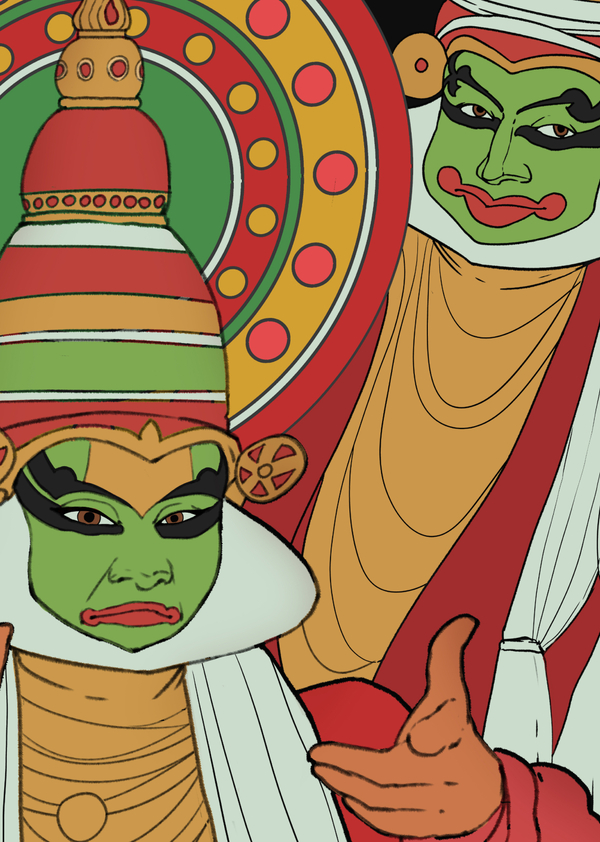
A series of six portraits featuring artists from regional dance schools in India. The portraits aim to capture the unique character of each school and its renowned dancer, drawing inspiration from the foundational ideas of all traditional Indian dance forms. Whereas European dance is a symbiosis of choreography, costume, and set design—whether it be «Don Quixote» with Mikhail Baryshnikov or the large productions of Nikolai Tsiskaridze—Indian dance is characterized by a profound minimalism on stage, designed to emphasize the artist’s figure. It is precisely this focus on silhouette, costume, choreography, and the dancer themselves that provided rich ground for this illustration.
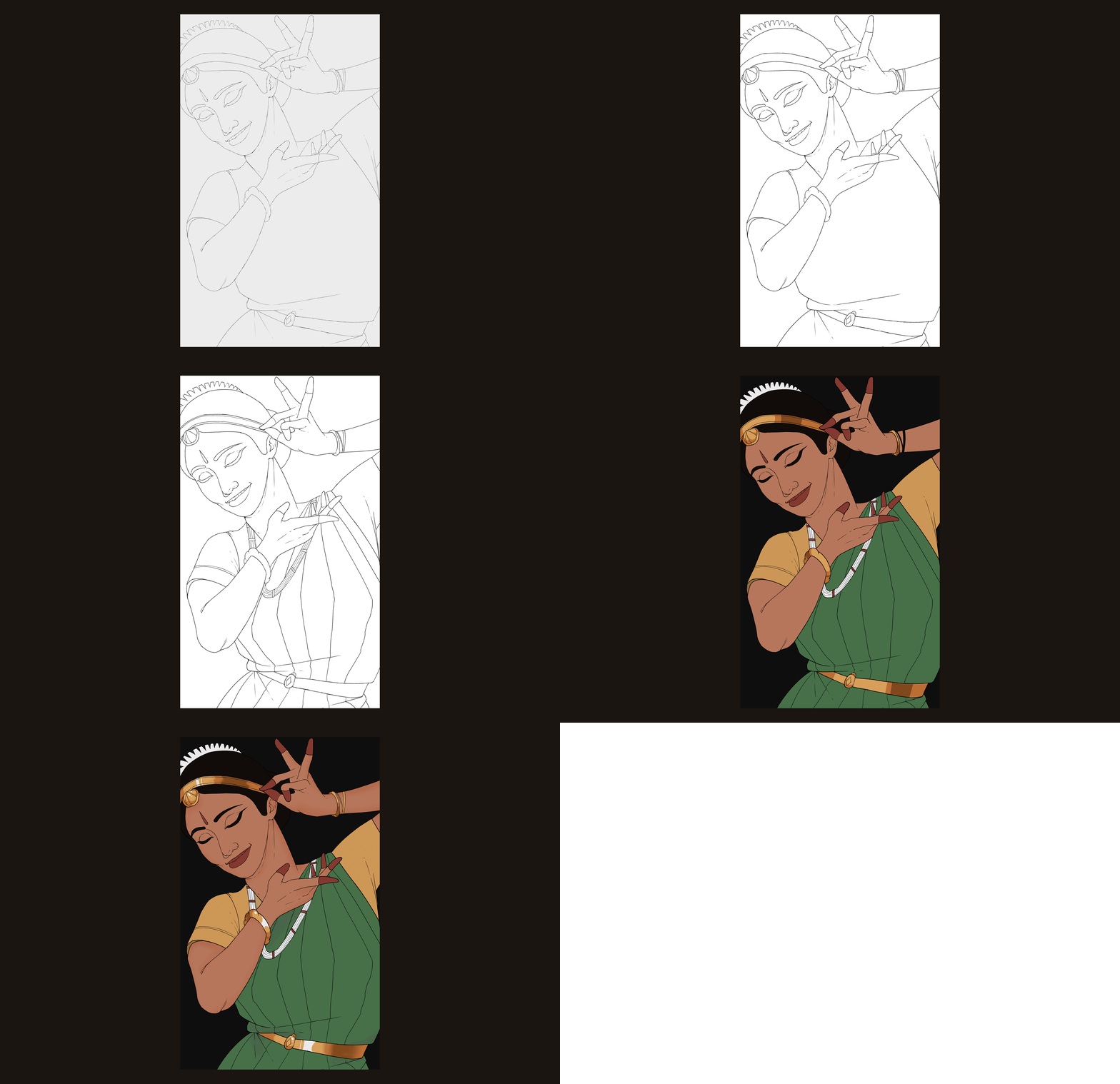
Original size 3120x2014
- Alaramel Valli — Bharatanatyam dance tradition. A distinctive feature of this dance is the work of the hands, which complement the character’s emotions and experiences through movement—most often, coquetry, playfulness, languid thoughtfulness, and ecstasy.
- Sudha Mukhopadhayayā — Mohiniyattam dance tradition. The recognizable two-toned sari is enhanced by gold jewelry, intended to create a visual contrast between the costume and the restrained color palette of the artist’s emotions on stage.
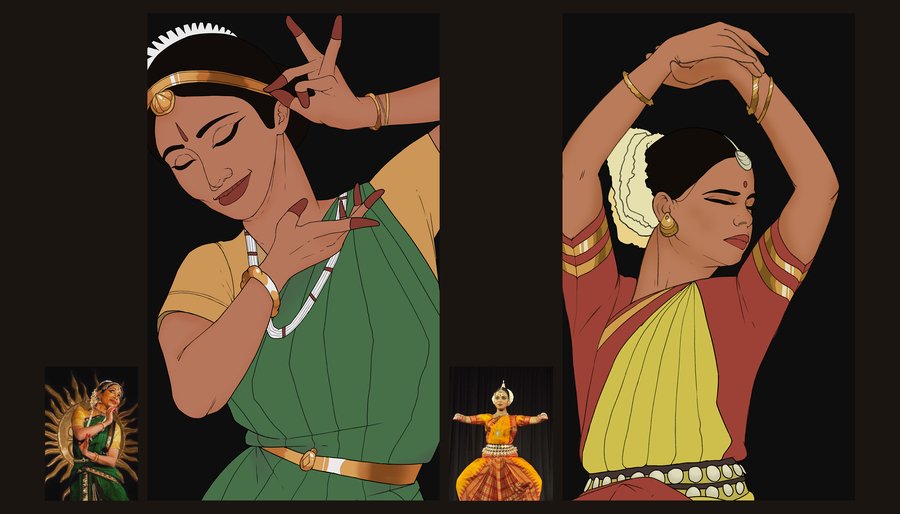
Original size 3120x1783
- Kalamandalam Gopika—a Kathakali school. One of the most recognizable figures in Indian dance culture, yet highly unconventional for the art form. While most schools focus solely on the dance, intentionally keeping the backdrop minimalistic and black, Kathakali transforms complex choreography into a full-scale production complete with spectacular costumes. It is no surprise that the most recognizable artist from the Kalamandalam Gopika school is a genuine star not only in her region but across all of India.
Original size 3120x2769
- Deepika Reddy — Kuchipudi style.
The dance is distinguished by its focus on religious themes derived from traditional Indian epics. This is reflected in the minimalist costumes, which are complemented by abundant vertical movements of the hands, shoulders, and head, all oriented toward sublime themes and heroic figures.
5. Madhavi Mudgal — Odissi style.
A defining characteristic of Odissi is its emphasis on emotionality, which integrates seamlessly with costumes rich in color yet minimal in ornamentation, alongside the performer’s movements and facial expressions.
Original size 3120x1889
- Birju Maharaj—the Kathak school. A recognizable feature of this school is the complex and precise rhythm struck by ankle bells. In addition to this, the conciseness in the movements of the hands, head, facial expressions, and costume is considered an essential part of the dance. Birju Maharaj became a benchmark for many generations of dancers due to his technique and charisma, which required no elaborate costumes or dramatic emotional scenes. Despite the passage of time, Maharaj remains a star of traditional dance both in India and internationally.
Original size 3120x2984
Original size 3120x3025
Exhibition
Original size 3120x1539