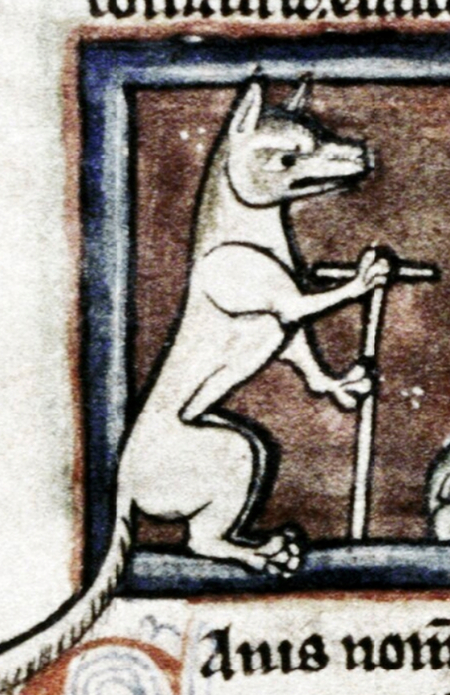
The Image of the Dog as a Carrier of Moral Codes in Visual Culture in Christianity and Confucianism During the 12th–15th Centuries
Navigation Menu
- Concept
- Introduction
- Europe: — Bestiaries and religious scenes — Domini Canes: the dog as a symbol of faith protection — «The Arnolfini Portrait.» The dog as a symbol of fidelity
- China: — Animalistic painting — Domestic scenes — Scroll puzzles
- Conclusion
1. Concept
The focus of this research is the transformation of the dog from a utilitarian companion into a vessel of symbolic meaning. In Christian culture, the dog evolves into an allegory for fidelity, compassion, and the defense of faith. In the Confucian tradition, the animal is perceived as a natural part of the social order. Love for one’s neighbor extends to all people, and subsequently to the entire world—a sentiment reflected, for example, in the respectful regard for pets.
2. Introduction
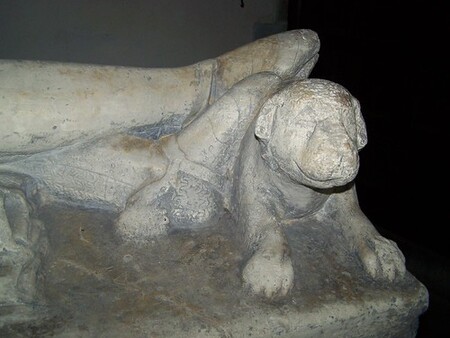
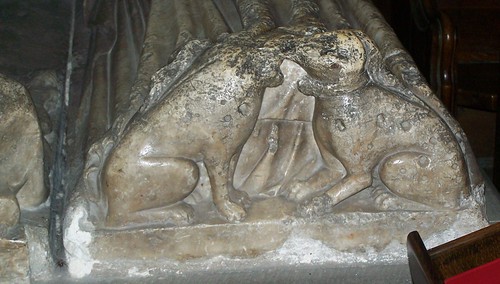
Effigies on Tombstones of the Yorkshire Knightly Class: Sir Robert de Stiverton (1307, Kildwick) and Marjorie Rockliffe (c. 1407, Pickering). The dog at the feet symbolizes fidelity and eternal peace.
In Christian culture of the 12th–15th centuries, the image of the dog evolves from allegory to an active agent of the Lord’s will. On portraits and tombstones, the dog at the feet depicts loyalty and constancy to its human «pack.» In hagiography, dogs become messengers who save saints, as in the story of Saint Roch [1], or instruments of divine justice, exposing criminals. The dog in Christian art is a metaphor for tireless service to God and the defense of sacred truths.
In the Confucian context, the dog is integrated into the system of ethical virtues from the beginning and is not subjected to negative debate. For instance, in Chinese sources, Confucius himself commanded that the guardian dog Kun-tzu be buried «with honors» [2] as an expression of compassion, and the key Confucian principle of «virtue of procreation of life» [3] underscores the natural inclusion of animals in the moral hierarchy.
3. Europe
Bestiaries and religious scenes
The image of the dog was one of the most frequently featured subjects in medieval bestiaries from the 12th to the 15th centuries. Unlike exotic animals, the dog was familiar to everyone, which made it a powerful tool for conveying Christian morality through relatable visual imagery.
The chapter on dogs is typically one of the most extensive in bestiaries. This is because medieval authors distinguished dozens of breeds or functional types of dogs, assigning each its own moral significance.
Hugo Follonsky, «Birds, ” folio 192v, second half of the 13th century, MS 101, Municipal Library of Valenciennes, France.
The image of the dog is divided into three functional types: guardians, hunters, and herders. As Michele Pastore notes, [4] this distinction suggests that in medieval tradition, the dog was perceived primarily through the lens of its utility and loyalty to duty.
The Northumberland Bestiary, section on dogs (De canibus), folio 20r, c. 1250–1260, MS. 100, Getty Museum, Los Angeles, USA.
In late medieval miniatures, the dog begins to play an active role in the narrative: it aids, heals, and accompanies the human. On a deeper level, the animal’s image suggests the unseen presence of God in everyday life, transforming every action into a sacred lesson in faithfulness, purity, and service.
Bestiary of Ann Walsh, section on dogs, folio 18r, 15th century, GKS 1633 4°, Royal Library, Copenhagen, Denmark.
Bestiary (Second Family), «On Dogs» section, folio 12v, late 13th century, MS lat. 6838B, Bibliothèque nationale de France, Paris.
This type of miniature depicts a dog mourning its owner or licking wounds. «The dog’s ability to heal wounds by licking them symbolizes how the wounds of sin can be healed through confession.» [5]
Bestiarium «On the Nature of Animals» (De natura animalium), section on dogs, folio 15v, circa 1270, MS 711, Municipal Library of Douai, France.
Bestiary (Second Family), beginning of the «On Dogs» section, folio 12r, late 13th century, MS lat. 6838B, Bibliothèque nationale de France, Paris.
Bestiarium (Second Family), fragment «On Dogs» (De canibus), fol. 81v, late 13th century, MS lat. 3630, National Library of France, Paris.
The central narrative, which moves from book to book, is the story of a dog who identified its owner’s murderer in a crowd and forced the killer to confess. [6] This was used to illustrate the idea that no crime can escape God, and the dog here acts as an earthly instrument of divine justice.
Book of the Nature of Animals, fragment featuring dogs, folio 7v, 14th century, MS ital. 450, Bibliothèque nationale de France, Paris.
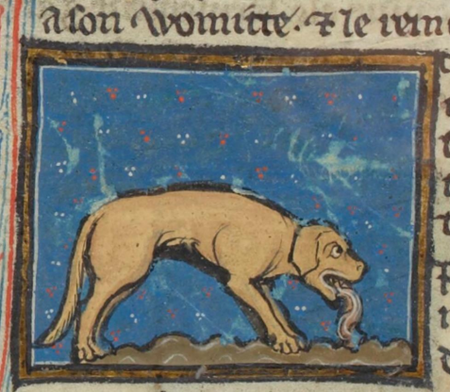
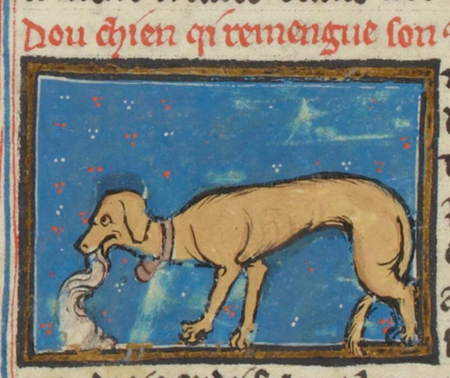
Richard de Furnival, «Bestiaire d’amour, ” section on the dog, folio 229r, c. 1285, MS fr. 412, Bibliothèque nationale de France, Paris.
«As a dog returns to its vomit, so a fool repeats his folly.» This is a direct biblical quote (Proverbs 26:11) that, in bestiaries, symbolizes the sinner returning to his vices. The «torn away» sin is reabsorbed, representing spiritual weakness and cyclical decline.
Ashmole Bestiary, section «Of Dogs» (De canibus), folio 28r, c. 1210, MS. Ashmole 1511, fragment depicting a dog, Bodleian Library, Oxford.
Pierre de Bouteille, «Bestiarium» (part of L’Image du Monde), fragment on dogs, folio 247v, 14th century, MS H. 437, Historical Library of Medicine, Montpellier, France.
A dog holding a piece of meat in its mouth sees its reflection in the water and, mistaking it for another dog with meat, drops its piece to try and snatch it from the other dog. This plot comes from Aesop’s fable and has been adapted into bestiaries. The animal here symbolizes greed and foolishness because it abandons real sustenance by being deceived by its own reflection.
Because of its closeness to humanity, the dog becomes a universal moral mirror. Through narratives about recognizing murderers and healing wounds, the idea is transmitted that loyalty to one’s master on Earth is a direct metaphor for the believer’s fidelity to God. Thus, the bestiaries transform the dog from a utilitarian assistant into a visual aid for Christian ethics, where the animal’s physiological trait receives theological justification.
Domini Canes: The dog as a symbol of faith’s protection