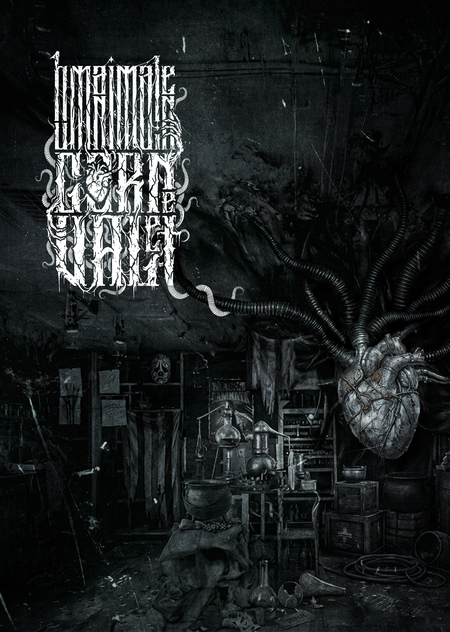
The expression cor ne valet is pseudo-Latin, a question — «is the heart ready?» — that echoes French carnaval ← Italian carnevale ← Latin carrus navalis («ship-cart»); popular etymology instead derives the word from Late Latin carne («meat, flesh») + vale («farewell»). Its closest equivalent in Church Slavonic is «мѧсопоу́стъ», the last day of the winter meat-eating period, the third of the four Sundays of preparation for Great Lent, also known as the Sunday of the Last Judgment. In my conception, the cry «cor ne valet!» sets in motion the chain of pre-mortem, mortal and post-mortem trials out of which this album is assembled, at each of which the heart is again and again tested for its suitability for anything at all.
humanimalien — lyrics, programming, arrangements, mixing, mastering, cover art
1 as 0
massa damnata
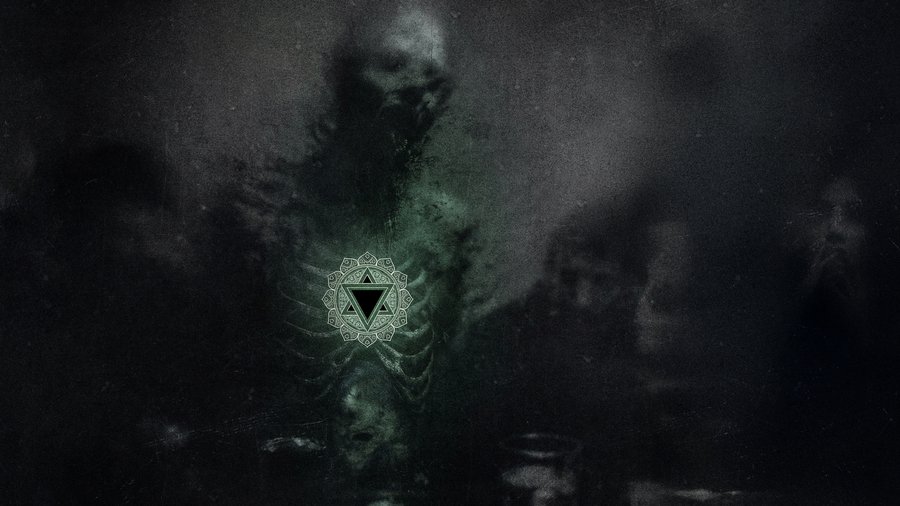
Massa damnata is a Latin theological term meaning «the damned mass»: humanity as a whole seen as a fallen, already sentenced crowd of sinners, prior to any salvation or redemption. Anahata is the heart chakra, the center of feelings, attachments, and vulnerabilities.
beatza
The song is dedicated to the memory of Dmitry «Wolforest» Guskov (1970–2025) — my friend from childhood, adolescence, youth and university days, who would have turned 55 today if he had not died earlier this year. The lyrics were written by me in 1989 during our summer night vigils in a prefab apartment block on Butlerova Street, on the edge of the Bitza forest park, and slightly revised in 2007.
morgenrøde
A reimagining of the Easter homily by the Norwegian project Burzum from the album Belus (2010). Featuring a choir of myrrh-bearing women and Karelian–Finnish jaw harp («munniharppu»). Translated by humanimalien.
מְנֵא תְּקֵל וּפַרְסִין
Mene, Tekel, Upharsin is a biblical Aramaic judgment formula from the Book of Daniel. It is the writing on the wall at King Belshazzar’s feast: «mene» — «numbered,» «tekel» — «weighed,» «upharsin» — «divided.» In Daniel’s interpretation, it means that the days of the kingdom are counted, it has been weighed and found wanting, and will be divided and given to others.
ambulance
This song is based on an instrumental piece by Sphæra Octava, which was included in the official soundtrack to my poetry book The Art of Caring for the Dead (Gayatri, 2009), from which I also took the lyrics for this track.
wat (ch)er
This song reads like the literary source for a film noir, and what we ended up with feels like its screen version: old, cold, eyes wet from gaslight and cigarette smoke. We don’t move through the city by the map — the city makes the moves, playing us as trumps.
Two players get dealt messages like verdicts: one is told, you are wat (ch)er; the other, they’re looking for you. They’re born in different years — and they’ll play their last hand in different years, too. Months pass; life goes on; the game stays in the background like death or eternity. Then Wat (ch)er finds a note: If you don’t walk the city, you’ll be it for four rounds. So he walks.