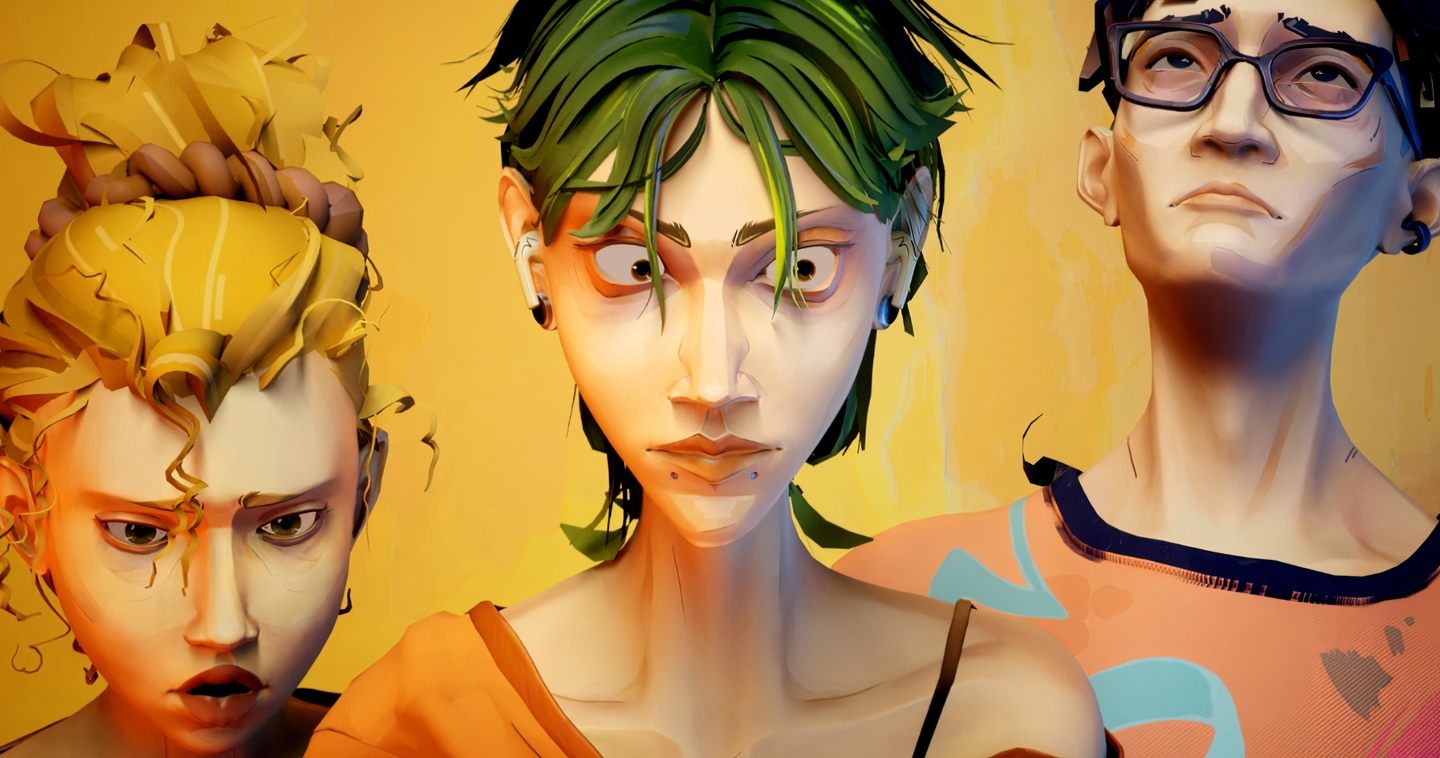
Your first independent production!
The thesis project is an opportunity to consolidate everything you have learned during your studies into one major body of work. Here, an idea transforms into a film, music video, trailer, or educational video, and individual skills become integrated into the overarching concept.
This is not merely a final assignment; it is your first experience in independent production. You choose the theme, establish a visual language, structure the entire process, take ownership of the decisions, and bring the project to a finished product ready to be shown to an audience and added to your portfolio.
The thesis year serves a purpose beyond just creating a strong portfolio piece. It is the time to test yourself in a chosen role, collaborate within a team, navigate the full production pipeline, and determine the direction in which you wish to develop further.
Diplomas are also vital for the department. They bring together the ideas, skills, and interests of the entire class. Every film, music video, trailer, or documentary video showcases how students can work with narrative, graphics, motion, sound, and visual language.
What the Capstone Year Involves
The graduation year combines the Thesis Project (VKR) and the Visual Investigation (VI). They run concurrently, yet they address different objectives and can support one another.The Thesis Project is your main culminating project. In it, you create a film, music video, trailer, or educational video, navigating the entire process from initial concept and pre-production through to the final edit and screening.The Visual Investigation is a deep dive into a topic. It helps you explore an area of interest thoroughly, gather and analyze materials, and formulate observations and conclusions. The VI can be linked to your Thesis Project, forming the basis for its visual, directorial, or production decisions.
What can a thesis project be like
A CGI Diploma Project is a completed audiovisual work. You can create short films, science popular videos with graphics, music videos featuring CGI, VFX, and expressive graphics, or action trailers. Hybrid formats are also possible, provided they support the project’s core idea and remain feasible within the scope of a single academic year.
The project format depends on the chosen idea, the selected role, and the team composition. Within a diploma project, you can focus on directing and editing, characters, environment, animation, VFX, simulations, lighting, materials, or composition. The most crucial element is ensuring that the concept aligns with a realistic scope of work, and that your role and area of responsibility are clear from the outset.
A diploma project can be completed individually or in a team. An individual project requires a precise definition of scale. It is better to produce a small, yet complete and high-quality piece than to attempt to assemble a massive production alone. In a team project, each member has a primary role and defined area of responsibility. However, the team functions as a collective of generalists: participants contribute to overarching project goals rather than waiting for their specific phase to begin over six months. Each person’s individual contribution must be distinguishable, yet the final result emerges from collaborative effort across all production stages.
A New Approach to the Thesis Year
Project quality emerges where creative vision intersects with an organized process.
We want thesis projects to become stronger not just through isolated striking images, but through the overall quality of the work. You already possess the necessary skills, technical capabilities, experience in teamwork, and access to faculty. The next step is learning how to bring all of that together into a cohesive and professionally organized production.
A thesis project requires more than just a strong concept and expressive graphics. It demands a clear division of roles, realistic planning, regular communication, a defined pipeline, and accountability for the outcome. This approach should not intimidate you or feel like a restriction on creative freedom. It is necessary so that a good idea is not lost in the process, and the team can drive the project to a final, high-quality standard. Therefore, in the thesis year, we will operate closer to a studio approach, where the overall goal emerges from the strong contributions of each team member.
How the Thesis Year is Structured
Start → Concept → Pre-Production → Production → Pre-Defense → Finalization → Defense
The diploma project develops incrementally. At the start of the year, it is important to define the core idea, the format of the work, the team composition, or the scope of an individual project, and to map out the initial plan.
During the concept phase, you formulate the premise, gather references, and select the visual language. In pre-production, you develop the script, storyboards, or animatics, create a list of scenes and assets, assign roles, establish the pipeline, and plan the production.
Next, the project is built through iterations: testing, initial shots, feedback, and refinements. The preview stage helps verify whether the project functions as a whole, identify weaknesses, and adjust the plan.
Revisions are a normal part of production. They do not mean the initial idea was flawed; rather, they help make it more precise and stronger.
The final part of the year is dedicated to assembly, refinement, presentation, and defense. It is crucial to showcase not only the final piece but also the journey that led to it—the key decisions, the process, and the individual contribution of each team member.
What to prepare at each stage
Module 1
At the first session, the foundation of the final project is established. It is important to demonstrate that the idea has already evolved into a defined project, complete with a clear direction, scope of work, and an initial production plan. We do not expect a finished video, but the concept, visual form, and logic for the subsequent stages of work must be evident.
Preview
For the preview meeting, bring a working version of your project to discuss the direction before the session:
— working title and brief idea description;
— initial references and visual direction;
— rough synopsis;
— early concepts for the script, storyboard, or animatic;
— team composition and roles;
— specific questions requiring feedback.For the Visual Identity (VI), bring the theme, concept, preliminary goals and objectives, and a draft outlining its connection to the Thesis Project (VKR), if one exists.
Review
For the Final Project (VKR): — Cover page. — Title page with the final project title and author’s name. — Project objective and synopsis. — Animatic, storyboard, or pre-visualization. — Final concepts for main characters and locations. — Work distribution within the team. — Work plan and software used. — Other project developments. — For team projects—individual contribution per module.
For the Visual Inventory (VI): — Topic and concept. — Goals and objectives. — Connection to the Final Project, if applicable. — Structure or rubricator.
Module 2
The second session marks the end of the preliminary research phase (VI) and the beginning of the full production phase of the Final Qualification Work (VKR). The research must be ready for submission for review, and the diploma project must already feature materials that confirm its real scope and chosen visual language.
VI Preview
Draft version with placeholdersThe full research text is being prepared. Missing illustrations and sections are filled with placeholders indicating the intended content. Video materials must be recorded but may not be fully edited or polished. The approximate completion level of the work is 80%.At this stage, the curator provides feedback on necessary revisions across all aspects of the work.
ReviewFor the Research Project (VI):
— Final version of the research;
— Formatted long-form article;
— Completed illustrations, video, and other materials;
— Stated conclusions.For the Diploma Project (VKR):
— Finished pre-viz;
— Main characters in the sculpture;
— Development work on locations, props, graphics, animation, VFX, and other project tasks;
— Current task distribution and individual contribution of each participant;
— Plan for future production.
Module 3
End of January — Checkpoint
Character Retopology and Rigging KickoffBy the end of January, the main characters must be converted from sculpts into production-ready models suitable for further animation. This stage concludes retopology and begins the rigging process for key characters.The team will also present whiteboxes or blocking for at least three future final shots at this checkpoint. These shots could feature characters, environments, or key project scenes.The meeting will discuss the scope and composition of the shot, its expressiveness, and its viability for further execution. After approval, the team prepares the selected shots for final visual review.
Pre-Review
The pre-review assesses the progress of the Final Course Project (FCP) after the completion of retopology and the initiation of rigging. The team demonstrates that core production tasks have started, and that the technical solutions for characters and primary scenes pose no risks to subsequent animation.At this stage, you must present:
— characters with completed retopology;
— working rigs for key characters;
— deformation, posing, and basic movement tests;
— initial animation or blocking tests for the characters' most critical actions;
— progress on key assets: environments, props, set dressing, or other elements required to begin scene work;
— an updated production plan detailing upcoming tasks.
Review/Preliminary Defense
To be ready for review, the project must transition into the practical production phase. The team will present functional technical solutions, initial animation segments, and the development of the project’s visual language.You must prepare at least three final static frames. These frames should demonstrate the project’s intended final quality—including characters, environment, materials, lighting, color, composition, and atmosphere.The frames do not need to be animated. Their purpose is to capture the project’s final visual style and serve as a guideline for subsequent work.The frames will be selected and approved during the January checkpoint. They must be prepared in final visual quality for the review, showcasing the project’s approved artistic direction.
Please present: — completed rigs for key characters; — rig and deformation tests in motion; — initial animation scenes or excerpts from key episodes; — progress on main locations, environments, props, and set dressing; — materials, textures, shading, and lighting tests; — at least three finished static shots demonstrating the final visual style of the project; — updated previz or storyboard; — a current plan for further production; — task distribution and individual contribution of each team member.
Module 4
In the fourth module, the project reaches its final stretch. The team compiles all scenes into a unified video, completing the animation, image work, and sound design.