Navigation Menu
1. Concept
2. Henry Darger’s World
3. Childlike and Cruel
4. Another View of the World
5. Conclusion
Concept
Henry Darger’s creativity occupies a special place in outsider art. His works can easily be mistaken for illustrations in children’s fairy tales. They feature many vibrant landscapes, fantastical creatures, unusual characters, and numerous small figures enacting scenes in an imaginary world. At first glance, they possess a naive, carefree, and even slightly toy-like quality. However, upon examining the depicted events more closely, the impression begins to shift. Beneath the colorful scenery lie wars, abductions, persecutions, torture, and the deaths of children.
This contradiction becomes the starting point for the research. In Darjer’s works, childlike aesthetics coexist with brutality, and neither element seems random or secondary. Bright colors, conventionalized characters, decorative landscapes, and fairy-tale imagery do not soften the violence depicted—rather, they make it even more unexpected. A strange sensation arises, as if two entirely different narratives are unfolding before the viewer simultaneously: one resembles a children’s story, the other a brutal war chronicle. Yet, they are not separated from one another; they exist within the same image, complementing and amplifying each other.
It is particularly fascinating to observe how the perception of a work changes upon closer examination. Something that initially appears innocuous gradually acquires unsettling qualities. Even the most colorful and detailed compositions can contain scenes that are difficult to reconcile with the conventional understanding of children’s illustration. The viewer is presented with a peculiar visual conflict: the image simultaneously draws them in with its innocence and repels them with what unfolds within it.
A question arises: why does an artist combine images of such differing natures? And how does this combination affect the perception of their work?
The aim of this study is to examine how the contrast between childlike aesthetics and harsh content manifests in the works of Henry Darger and how this affects their reception.
In this research, I propose to examine how this contradiction manifests in specific works, which visual techniques amplify it, and why even the most colorful scenes can leave a heavy impression at first glance. After all, if you look closely at the research title, it becomes clear that this story is far from simple.
Henry Darger’s World
Untitled. Henry Darger. 1960s.
I propose beginning with the fact that the world of Darger is enchanting from the start because of its scale and unusual structure. There are plants, strange creatures, and children everywhere. None of these elements exist in isolation; they interact closely, forming a kind of «everyday life» within this world. Moreover, the artist’s works are often panoramic, which intensifies the viewer’s immersion into this world.
Untitled. Henry Darger. 1940s–1960s.
Sometimes paintings feature entirely fantastical creatures. Therefore, Darger writes brief explanations on the sheets.
Untitled. Henry Darger. 1940s–1960s.
Among the many images, girls are most often prominent. They appear in various compositions, move across landscapes, encounter unusual creatures, and become the central figures in many depictions.
Untitled. Henry Darger. 1950s–1960s.
Brightness, childlike wonder, and plants everywhere—one might call this a constant of this world. But if you look closer, you begin to notice the strangeness: a pair of adult figures are suffocating children while others stand nearby, their faces displaying absolute serenity.
Kids' and intense
Untitled. Henry Darger. 1940s–1960s.
As you continue to observe the panoramas, you can notice that unsettling events are unfolding across the fantastical landscapes. A storm gathers on the horizon, smoke billows, and people in uniform are either kidnapping or killing the local inhabitants.
Untitled. Henry Darger. 1940s–1960s. (Fragment, left half of the panorama)
Or, for example, a scene of a flattering fire on the left side of the panorama, where kids are escaping in flight.
Untitled. Henry Darger. 1940s–1960s. (Fragment, right half of the panorama)
And the right half of them is already captured and broadcast on loops. The images remain vibrant and colorful, yet they evoke a profound sense of discomfort. Darger works out minute details, even the weight on the feet of the hanged children.
Untitled. Henry Darger. 1950s.
Additionally, scenes of children being captured are common. Everything is present: clouds, blue sky, flags, horses, forest, and furthermore, a convoy of bearded men leading bound girls connected by a rope around the neck.
Untitled. Henry Darger. 1940s–1960s.
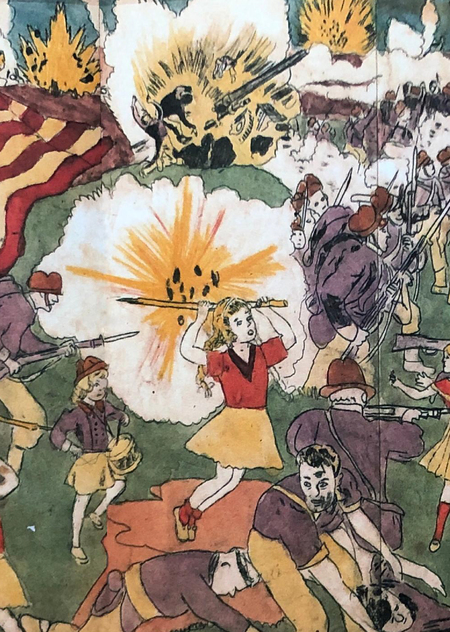
This image is also a powerful example of the contrast between naivety and brutality. The children are fleeing, searching for a way to survive, while in the background, the landscape is picturesque—a river, a sunset sky, and a whole host of explosions threatening the children’s lives.
Untitled. Henry Darger. 1940s–1960s.