Гайдлайн LOOL
источники и схема данных для ведения LOOL
concept
LOOL — media about things that haven’t made it to the main feed yet. We search for and showcase: authors and phenomena on the periphery of attention trends before they became trends the origins of memes and visual codes the creative process (how it was made) niche finds in fashion, art, video, and internet culture
Key Concept:«Off the beaten path» isn’t merely «obscure.» It is something that possesses its own voice—something not yet diluted by algorithms and capable of shifting perception if given attention at the right moment.
data sources for media
Authors' social media (Instagram*, TikTok, YouTube, X) — posts, Reels, descriptions, comments, and visuals.Direct audience submissions (via «Send Back to Feed» form, DMs, comments) — recommendations, links, and context.Open media and databases (Are.na, Pinterest, Behance, Dribbble, Substack, niche blogs) — visual references, articles, and interviews.Meme and trend platforms (Know Your Meme, Reddit, archives, Telegram chats, Discord) — meme origins and early appearances.Fashion and cultural media (Dazed, i-D, Highsnobiety, local Telegram channels) — context, names, and drops.Internal monitoring (manual and semi-automated scrolling) — new accounts, unusual features, and strange formats.Internal channel data (statistics, reactions, saves, shares) — understanding what resonates with the audience.
*Instagram — recognized as an extremist platform within the Russian Federation
Data schema separated for human and machine processing
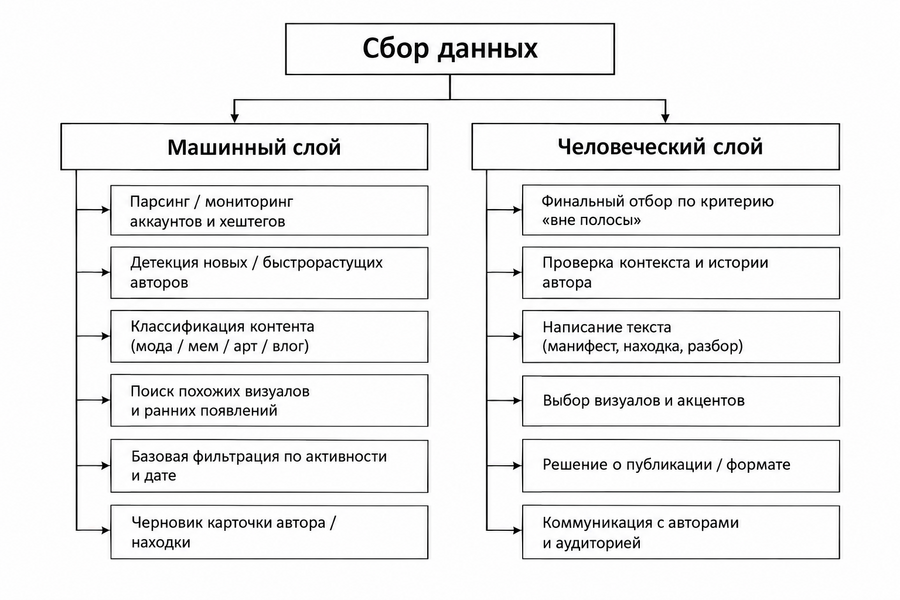
Data compiled with Grok, image generated with ChatGPT
feed:
1 — The machine collects and performs preliminary sorting on a large volume of signals. 2 — A human determines what is truly «out of bounds» and transforms the raw data into editorial content. 3 — After publication, the machine assists in analyzing the reaction (what users save, what they share). 4 — Based on this analysis, the human refines the selection criteria.
Guidelines for automated services in the scheme
General Principles: Automation aids in finding and structuring information, but it does not make final editorial decisions. Any automatically generated text or card must undergo human review before publication. The priority is accuracy and context, not speed at all costs. Specific Rules: Collection Only collect publicly available data. Do not scrape private accounts or direct messages. Record the date of initial signal detection.Classification and Filtering The system may suggest categories (fashion / meme / art / video / other). Do not discard material solely based on low metrics—something «off-track» often starts with low reach. Flag material as «requires human review» if there are signs of controversial or sensitive content.Draft Generation Automated descriptions of creators and findings are only drafts. It is prohibited to publish machine-generated text without editing. The draft style must be neutral, without exaggeration or clickbait.Tracing Origin (Memes, Trends) The system searches for the earliest appearances. The final «Meme Origin» version is always verified by a human (source, context, potential attribution errors).Audience Interaction Automated replies to common questions are permissible. Requests to «Return to Track» are handled by a human (or a human + machine with a final human decision).Transparency If significant automated assistance was used in the material (e.g., searching for early versions of a meme), this can be briefly noted in internal metadata. Do not present machine-generated content as entirely manual editorial work.