Navigation
(1) Concept (2) Costume as Flag (3) Costume as Archetype (4) Costume as Narrative (5) Costume as Heritage (6) Conclusion
(1) Concept
The research topic is the function of national costume in modern game design and the methods of its transformation in the digital environment. This research examines how artists and designers in game studios utilize elements of traditional costume across different types of game worlds and what roles these elements serve within the game’s visual language.
Video games have become one of the most significant visual media of our time, and in-game costumes are a vital tool for communication between the developer and the player. Through costume, the game conveys a character’s cultural identity, the world’s characteristics, historical context, and visual archetypes. At the same time, modern game design increasingly targets a global audience, making national motifs a way to represent diverse cultures within mass digital products. This work specifically focuses on the function of costume as a distinct tool of game design.
Main Research Question:
«How does national costume function in contemporary video games, and how does its role change depending on the game world structure, character type, and the project’s artistic approach?»
The object of study is the in-game costumes found in modern video games. The subject of study is the methods for incorporating national and ethnocultural elements into costume design and the functions these elements perform within the game’s structure.
The research material includes costumes from four games: The Finals, Overwatch, Red Dead Redemption 2, and ARC Raiders. The games were selected for several reasons. First, each demonstrates a distinct function of the costume. Second, the projects belong to different genres and setting types: competitive shooter, hero shooter, historical action, and post-apocalyptic science fiction. This allows us to track how the handling of national costume evolves depending on the architecture of the game world. Third, all selected games utilize the costume as a vital part of visual identity.
The research methodology is based on visual and comparative analysis. The study examines silhouettes, ornaments, materials, accessories, historical prototypes, and cultural sources within the game costumes. Iconographic analysis is also employed, which allows for the identification of specific national and historical allusions within character design. The comparative approach helps determine the differences in the function of the costume across various games and uncover patterns in their application.
The research structure is built upon a functional principle. The first chapter examines the costume as a form of cultural representation and a visual «flag» of national identity. The second chapter is dedicated to the costume as a character archetype and a means of revealing the character’s nature and background. The third chapter analyzes the narrative function of the costume and its role in constructing a historically authentic world. The fourth chapter explores hybrid forms of costume, where elements from different cultures converge within a single post-national space. This categorization allows us to trace the gradual shift from direct and most obvious national identification toward mixed and synthetic forms.
(2) Costume as a Flag
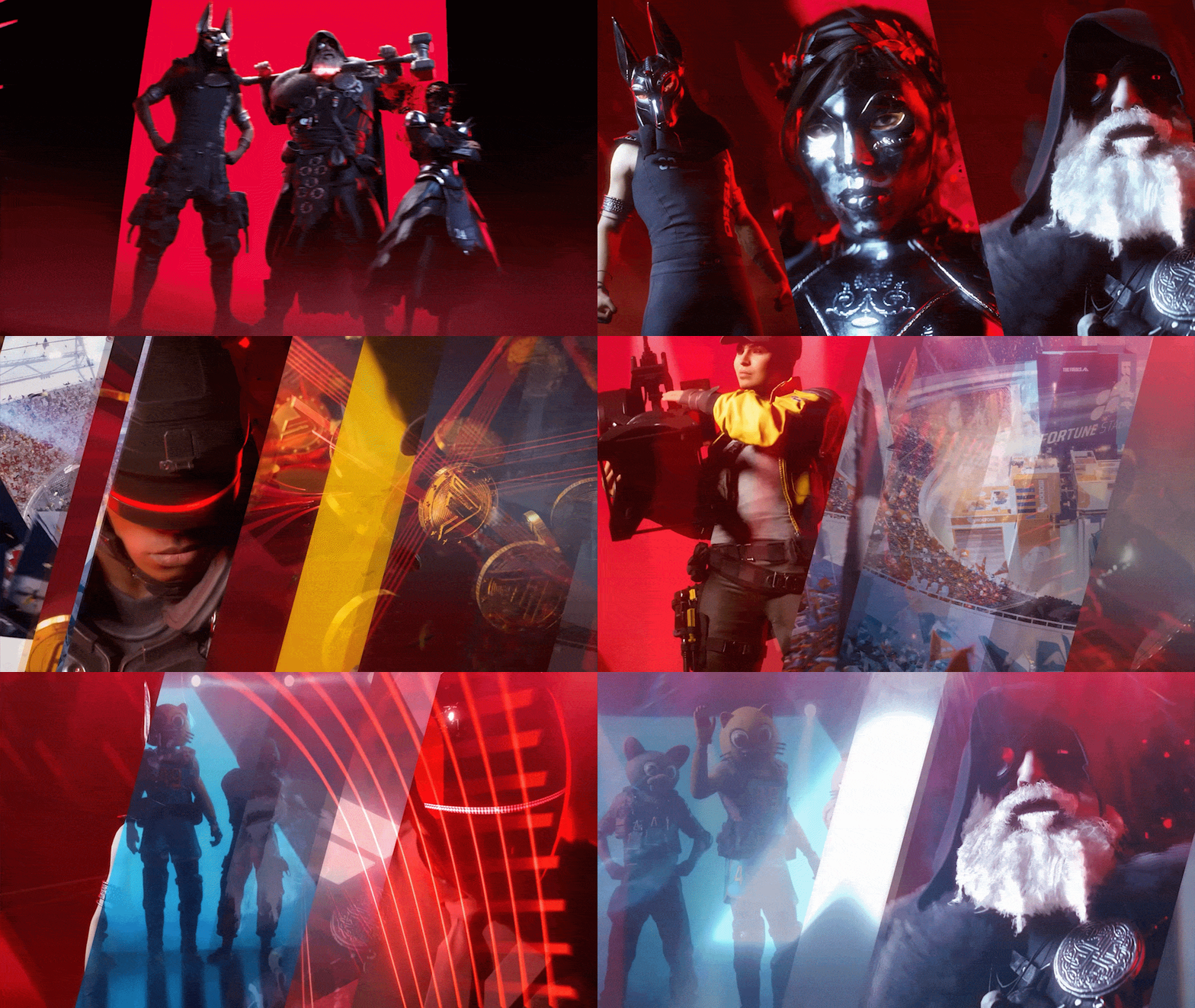
The Finals—a competitive online shooter where players participate in a virtual competitive show of the future. The game has no fixed characters; players build their appearance entirely through a customization system. National costumes function here as a form of cultural representation. They are based on recognizable historical imagery but are adapted to modern gaming aesthetics.
The Finals, Embark Studios (2023)
Japan
The first costume references the Edo period (1603–1868) aesthetic of the Japanese geisha. The Shimada hairstyle with kanzashi and the white Oi-shiroi makeup with red lips reproduce the canonical look of a maiko—a geisha apprentice—though the makeup interpretation is somewhat more contemporary. The upper part of the costume reinterprets the haori through a tactical military aesthetic: the construction maintains the silhouette of a traditional cloak, while the high standing collar introduces modern features. The lower part presents a stylized hakama, complemented by a red fabric side panel that echoes the mae-kake in placement. The floral pattern on the fabric is executed in a botanic pattern—the peony, a symbol of wealth and aristocracy in Japanese decorative tradition.
The «Lotus Reaper» Costume, The Finals, Embark Studios
Woman in a kimono. Princess Nobuko of the Kuni clan, circa 1921. Shimada-magi hairstyle of the Meiji period, 1918. Niijima Yae (1845–1932) with a katana, dressed in hakama and haori.
Japan
This image is built around the figure of a wandering monk—a Komuso from the Fuke school—established during the Edo period. The woven headdress, an amigasa or ronin-gasa, immediately catches the eye with its characteristic shape and viewing slits. The wide hakama trousers and the upper kimono-do, featuring a gold-embossed botanical pattern, are rendered in the traditional dark blue color, kon-iro, characteristic of the garments worn by travelers and artisans of the Edo era. The footwear is a shortened version of geta combined with white tabi socks. The black cloak, wrapped around the neck and covering the back, with its monochrome print, references the tradition of depicting ocean waves in Japanese ukiyo-e prints.
The Wanderer Costume, The Finals, Embark Studios
Postcard, men in monk-like clothing, circa 1905. Hakama trousers with a gilded sea motif, circa 1735. Roninkasu (Kasa) straw hat. Groom in hakama with haori and bride, 1952.
Japan
The Gusoku armor replicates the complete battle attire of a Samurai from the Sengoku–Edo period (16th–17th centuries). The helmet, a Suji-kabuto of the Akoda-nari style, features characteristic vertical ribs. The Menpo half-mask, with its integrated gorget, protects the lower face and neck. The cuirass and pauldrons (sode) reproduce the laminar structure of historical armor, featuring Odoshi lacing. The lower body garment includes Hakama, and leg protection consists of Kogake and Zikata-bi, distinctive footwear with a split big toe.
«Finals Samurai» Costume, The Finals, Embark Studios
Cuirass and leg armor, late 18th — early 19th century. Menpo half-mask, circa 1615–1868. Suzika-kabuto helmet, late 15th — 16th century. Gusoku armor, cuirass, and sode pauldrons, 18th century.
China
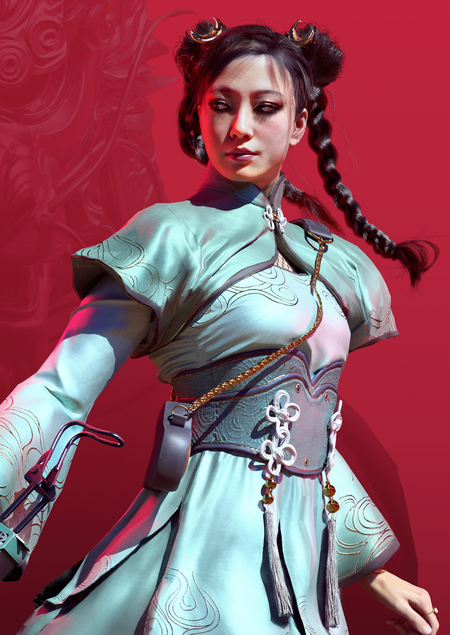
This ensemble is a stylized interpretation of traditional Chinese women’s attire, drawing inspiration from the Qing Dynasty and the early 20th century. The top features a qipao (or cheonsam)—a fitted dress characterized by a mandarin collar and a central V-neck. The shoulder cape reinterprets the yunjian—a removable collar-cape in court attire that symbolized the vault of heaven—transforming it into a fashionable cape. Gold patterns of xianyun—stylized clouds and waves, which symbolize luck and harmony in Chinese decorative arts—are reproduced on the sleeves and skirt hem. The delicate jade-green color references Chinese nephrite culture—a material associated with purity and noble spirit. The waist and collar are adorned with traditional zhungozhe knots with tassels, serving as decorative talismans. The hairstyle replicates the shuangya zhi—a traditional hairstyle for young, unmarried women in China—though slightly reinterpreted in shape, complemented by braids and modernized with crescent-shaped gold hairpins. The bottom half of the outfit is a short, multilayered skirt, entirely replacing the traditional long hem of the qipao.
«Luminosity» Costume, The Finals, Embark Studios
Chinese knots on flute and costume, «Lady Playing the Flute,» Tan Yin, 1520. Hairstyle with buns, Zhang Xuan (copy). Yunjiang cloak, «Sewing a Wedding Dress.» Woman in a cheongsam, 1920–1945.
Europe
The costume is based on 15th–16th century Western European knightly armor. The closed armet helm, featuring two narrow viewing slits, ventilation perforations, and a decorative crest, adheres to the tradition of ceremonial armor from the era of Maximilian I. The polished breastplate and spaulders, with their multilayered plates, reference the Milanese school of armor making. The chainmail skirt, or hauberk, is also a defensive element characteristic of this period. The yellow surcoat, marked with a number, reinterprets the function of a heraldic mantle as a means of identifying a tournament participant. Patches of light-blue fabric on the forearms recreate the tradition of a heraldic livery. The pointed shield, depicted with a sun bearing straight and wavy rays, alludes to Western European heraldic tradition. Numerous leather belts with pockets represent a modern tactical element, intentionally anachronistic to the historical period.
The Sovereignbound costume («The Sovereign»), The Finals, Embark Studios
Breastplate, Germany, c. 1480. Armet, Germany, c. 1510. Chainmail, c. 1400. Maximilian I’s Gauntlets, 1485. Roundel, c. 1560. Cuirass, c. 1415. Engraving «Knight and Lady,» mid-15th century.
Mexico
The costume references the warrior and ritual culture of the Aztec (Mexica) during the Late Postclassic period (1300–1521). The blue stone mask, featuring geometric facial elements, combines characteristics of the Teotihuacan stone masks (1st–7th centuries CE), covered in turquoise mosaics, with the head of Tlaloc, the god of rain and thunder. The turquoise color—chalchihuitl—held sacred significance in Aztec culture. The mask alludes to the feather headdress of the penache, which in turn reproduces a headwear type attributed to Montezuma II. The disc ornaments flanking the mask and the ear spools are characteristic elements of Aztec and Teotihuacan iconography. The blue-turquoise and red geometric patterns on the arms reproduce the meander pattern of the chicalcoliuhqui, which is linked to the iconography of Quetzalcoatl. The participant number is also included in the coloring, reminding the viewer that this is part of a game. The circular emblem on the chest refers to the olin sign from the Tonalpohualli ritual calendar, which also reproduces the structure of the Aztec Sun Stone. The tactical gear on the belt and shoulders is a deliberate anachronism.
«Wild Herald» Costume, The Finals, Embark Studios
Aztec Sun Stone, 1250–1521. Headdress with quetzal feathers of Moctezuma II, 16th century. Head of Quetzalcoatl. Mosaic mask of Quetzalcoatl, 1400–1521. Tlaloc, ceramics, 1440–1469.
Egypt
The mask references the iconography of the ancient Egyptian god Anubis—the patron of embalming and guide of souls into the afterlife, traditionally depicted with the head of a jackal. The mask exists in two versions—a dark metal with red accents and chrome details (a more aggressive and free-flowing stylization) and a black and gold palette (significantly closer to the canonical image): the gold here corresponds to the Egyptian concept of the sky—metal as the flesh of the gods. The broad collar necklace of the mask is one of the key and recognizable attributes of Egyptian nobility and deities: historically, it was crafted from gold, faience, carnelian, and lapis lazuli and served as a function of magical protection. The thin bracelets on the wrists and the broad armbands refer to the tradition of wearing the Medjuj and Nenhet—metal adornments that signified the owner’s power and status.
The Tomb Reaper and Dune of Doom accessories, The Finals, Embark Studios
Collar, New Kingdom, c. 1479–1425 BCE. Bracelets, 1st Century CE. Bracelet, 1479–1425 BCE. Collar, 332–246 BCE. Statue of Anubis, Ptolemaic Period, 332–30 BCE.