Concept
Doris Salcedo is a Colombian artist whose work addresses the aftermath of political violence in Colombia: forced disappearances, killings, enforced silence, and oblivion. Her pieces do not illustrate specific events; rather, they create material and spatial forms through which the memory of what occurred can be preserved and shared with others. Salcedo was chosen for this study because almost all of her practice centers on the question of how the memory of the absent can exist, and how this memory takes on different forms across various periods—from an object to a collective action. The visual research complements the curatorial project for her solo exhibition, «Forms of Memory,» where the artist’s work is organized into three thematic zones: memory as object, memory as space, and memory as collective action.
The study aims to analyze how the forms of memory’s existence and presentation evolve in Salcedo’s work. In her early pieces, memory is contained within objects that bear the trace of loss: shirts, shoes, doors, and furniture. Later, it expands into space, where the building’s facade, the museum floor, and rooms filled with earth and grass become carriers of trauma. In her works from the 2010s, memory becomes the result of a shared action involving many people. This raises questions about how the viewer’s position and the very nature of the memorial statement change alongside the form of memory—can memory be an object to be contemplated, and at what point does it transform into an action performed together?
Within this study, twelve works are analyzed in detail, distributed across three exhibition zones. The first section addresses memory as an object: Untitled (1988–1990), Atrabiliarios, La casa viuda IV, Thou-less, and Disremembered 1. The second section focuses on memory as a space: Noviembre 6 y 7, Shibboleth, Plegaria Muda, and A Flor de Piel. The third section explores memory as a collective action: Palimpsest, Sumando Ausencias, and Fragmentos. A consistent framework is applied to every work: the event or absence behind it; the material, technique, and labor; the mode of preserving or displaying memory; the role of the viewer; and its placement within the zone and the overall trajectory. The zones are not isolated—some works are situated at the boundaries, and these transitions are integral to the study’s argument.
Visual material is selected based on its significance for analyzing memory forms. For each project, it is assumed that one to four images will be used: a general view, a detail, and documentation of the exhibition or action. For works that existed as interventions in public space (Noviembre 6 y 7, Sumando Ausencias), documentation is critically important—it becomes a method of preserving memory after the event concludes.The textual base will comprise scholarly and analytical publications, museum materials, and the artist’s own writings. Andreas Huyssen’s article on Fragmentos, Julián Marín-Lancheros’s study on counter-monuments and symbolic reparation, the analysis of Carlos Gutiérrez Cajaraville and Ana Calonge Conde’s Palimpsest, Vera Mackie’s article on Atrabiliarios, materials from the MCA Chicago, Tate, Museo Reina Sofía, and the Beyeler Foundation, along with Salcedo’s own text on Noviembre 6 y 7, will allow us to examine the artist’s practice from both an insider’s and an analytical perspective. Comparing self-descriptions with critical interpretations will reveal how her relationship with memory is perceived through different lenses.
The research structure aligns with the exhibition’s logic. The first part will focus on memory as a subject, analyzing works where loss is embedded in objects—from found materials to newly fabricated pieces. The second part examines memory as space: the façade of a building, the museum floor, the living expanse of earth and grass, and the covering on the gallery floor. The third section is dedicated to memory as a collective action and the transformation of the viewer’s role from a witness to a participant. The research concludes with a conclusion that synthesizes the three forms and formulates an answer to the central question.
The research hypothesis posits that in the work of Salcedo, memory does not remain static but progressively transforms its form: shifting from an object that is preserved, through a space that is experienced, to an action that is jointly performed. Alongside the form of memory, the viewer’s position also changes. Furthermore, this trajectory is not linear—the forms intersect, and each has its own limits. This is not about nostalgic memory, but about the memory of the absent and the unacknowledged, understood as a labor of mourning that requires time, effort, and the participation of others.
The objective of this research is to identify how the forms of existence and presentation of memory are transformed in the work of Doris Salcedo, and to determine how this transformation underpins the structure of the exhibition, «Forms of Memory.»
The relevance of this study stems from the growing attention paid to issues of memory regarding violence, loss, and absence in contemporary society and art. Using Salcedo’s work as an example, this research examines what artistic means can be employed to sustain memory where official forms of remembrance are silent or inadequate, and what roles are assigned to material, space, and the viewer in this process.
Key research question: Can memory of violence exist as a complete object, or does it inherently demand action and the involvement of others? What happens to memory when its preservation shifts from the artist to the community, and what is the value of this transition—preserving the event, or creating conditions for shared experience?
Part 1. Memory as a Subject
The first zone of the «Forms of Memory» exhibition is built on the idea that the memory of someone who is no longer with us can live on in an object. For Doris Salcedo, this is not a metaphor, but the result of years of fieldwork: she collects testimonies from survivors of violence and creates sculptures from everyday materials based on these accounts—furniture, shoes, clothing [1]. The artist refers to herself as a «secondary witness»: her work often begins with interviews with victims and their loved ones [2]. Objects that retain traces of previous use are already imbued with meaning; therefore, Salcedo’s sculptures make absence concrete without detailing specific events [2].
This zone features five works: Untitled (1988–1990), Atrabiliarios, La casa viuda IV, Thou-less, and Disremembered 1. MCA Chicago chose the same trajectory, from the earliest Untitled to the Disremembered series, for Salcedo’s first retrospective [1]. Within the zone, there is a noticeable shift from an found object with a history of use to an object that the artist recreates. In Untitled, Atrabiliarios, and La casa viuda IV, the materials are shirts, shoes, a door, parts of a bed, and clothing; in Thou-less and Disremembered 1, the object is handcrafted by the artist. An author for Harvard Magazine notes that in her later works, the effect arises not from the object’s previous life, but from the labor, skill, and will required to bring the material into conception: steel is crumpled, surfaces are carved by hand, and silk is pierced by thousands of needles [2].
Untitled with Shirts—one of Salcedo’s earliest works—is a response to the two massacres in 1988 on the banana plantations of La Negra and La Honduras in northern Colombia [1, 6]. According to Salcedo, as quoted by Uniandes, peasants were taken from their beds and killed at their home thresholds in the sight of their families [4]. This investigation into these events, according to the MCA, strongly influenced both the visual and material qualities of the work [1].
«Untitled, ” 1989–2014, Doris Salcedo
At the heart of the form are eleven sculptures made from white cotton shirts, encased in plaster and pierced with steel rebar [1]. The Pinault Collection describes the shirts as stacked in piles through which steel rods pass [3]. The stacks are of varying heights, and according to the MCA, they seem to measure lost human lives; the shirts evoke both standard plantation workwear and funerary garments [1].
«Untitled, ” 1989–2014, Doris Salcedo
Sculptures with shirts were displayed alongside hospital furniture. The MCA recreated the 1990 exhibition at the Garcés Velásquez Gallery in Bogotá: beds and frames from hospital beds wrapped in animal fiber stand against the wall, inside of which lie white shirts wrapped like cocoons [1]. Uniandes adds that the wrappings create the impression that there are other objects inside and that the item has already been repaired after damage; researchers refer to this installation as one of the first «mourning acts» in Salcedo’s practice [4]. According to the MCA, the combination of organic and inorganic materials and the embedding of one object within another would become a technique repeated throughout her entire body of work [1].Memory is preserved here within an object that references the body without showing it. Uniandes notes that the work touches the viewer with a suggestion of human presence without direct depiction [4]. A student review of the retrospective writes that the stacks of shirts speak to absence and to families who live among the belongings of the deceased, while the steel rod pierces the clothing with impersonal violence; the reviewer believes these works open up the practice of interviewing within the artist’s work [5]. The Pinault Collection calls the plaster-covered shirts a monument to anonymous victims whom we only know through the news [3]. For the object zone, this is the starting point: the shirt is simultaneously a functional form and a shroud, a unit of counting loss, and a trace of the body. Salcedo will return to the shirt in Disremembered, where the clothing will become almost invisible.
«Untitled, ” 1989–2014, Doris Salcedo
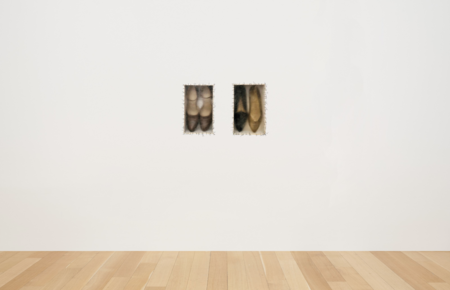
Atrabiliarios is dedicated to women who disappeared in Colombia [7]. The decision to feature footwear stemmed from fieldwork. According to Salcedo, in Vera Maki’s presentation [7], the only common trait across all cases that allowed for the identification of remains from mass graves was the footwear of the victims—and this footwear retains a trace of the path that led the person to a tragic end. Through conversations with families, the artist also learned another point: unlived grief is almost always tied to the relatives preserving the personal belongings of the missing [8]. The title also works as a memorial: the word «atrabiliarios» originates from «black bile, ” meaning melancholy, and the plural form suggests a collective rather than an individual melancholy. The English title of the work, Defiant, evokes the perseverance of the women and their loved ones who refuse to forget [7].
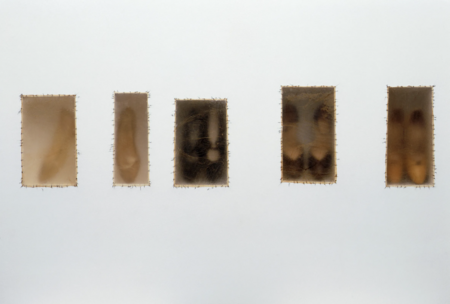
«Atrabiliarios, ” 1992–2003, Doris Salcedo
Physically, the work is arranged as follows: niches are cut into the wall, each holding one or two shoes, and the niche is covered with a translucent membrane made of animal fiber, stitched to the wall with surgical thread [6]. Maki, describing the version at SFMOMA, notes over forty niches and observes that the backlit membrane resembles skin, and the shoes are predominantly women’s: high-heeled, with bows and straps. The solitary shoes are particularly striking, as if the owner lost them while trying to escape. Empty boxes made of the same material lie on the floor [7]. Another version of the work features 20 niches [9], so the number varies depending on the version and location of the exhibition.
«Atrabiliarios,» 1992–2003, Doris Salcedo
The memory here is structured like a veil: an object is simultaneously present and inaccessible. Maki, referencing Salcedo’s explanation of her work at SFMOMA, writes that the membrane resembles a body, subtly obscuring the objects so that we view them as if from a distance of memory. Critic Charles Merewether, whom Maki quotes, defined these shoes as something between a relic and a fetish: as a relic, they substitute for remains; as a fetish, they become a substitute through which the person is simultaneously recognized, yet their absence cannot be accepted [7].
The viewer’s role here is corporeal. Art historian Mike Bal, in The Art Story, suggests that the work operates through «affective contagion»: it doesn’t allow for clear identification; it first disorients, but by immersing oneself in another’s loss, it can lead to empathy for the shoes' owners [8, 10]. Maki adds that the viewer walks through the gallery, squinting as they try to discern the shoes behind the membrane, and the afterimage of the work remains in their own memory. Salcedo herself stated that it was important to construct the piece as a space of encounter—to move the experience of loss from the anonymity of private feeling into a shared space [7]. Even in Atrabiliarios, the object becomes a bridge to the next exhibition area, where memory becomes space.
«Atrabiliarios, ” 1992–2003, Doris Salcedo
La casa viuda IV belongs to the La casa viuda series («The Widow’s House»), which Art Story dates to 1992–1995 [8]. The title is a Colombian expression referring to a home from which loved ones suddenly «disappeared» as a result of political violence [12]. An Artforum critic in 1994 adds that the title refers not only to a widow’s home but also to the home as a widow: a shell that has preserved the traces of everyday life undisturbed [13].
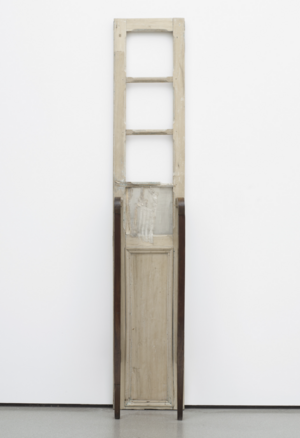
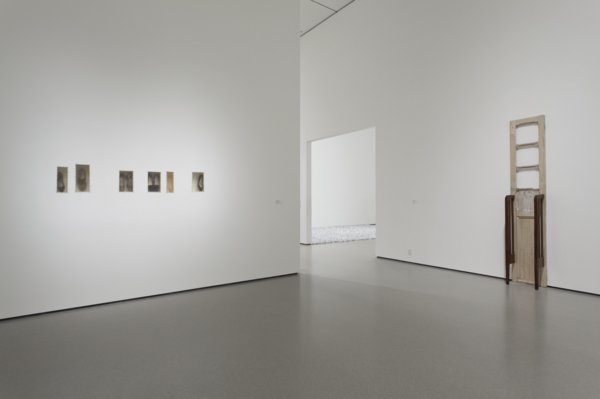
«La casa viuda IV, ” 1992–1995, Doris Salcedo
The work is assembled from found materials: according to MoMA’s description, these include domestic furniture, remnants of clothing, and human bones [11]. In La casa viuda IV, a door—flanked by bedposts—is connected to a sheer women’s blouse and a thin bone; MCA’s materials list names a wooden door, a wooden bed, clothing, and a bone [14]. Reviewer F News describes a bone fragment inserted into a door panel, and above it, in another panel, preserved white fabric; both elements merge with the wood, retaining their own forms [15].
Art Story interprets the work as follows: the worn blouse points to a former owner who now exists only as a ghost; the bone intensifies this feeling, while the door frame itself suggests a human figure [8]. Salcedo herself, as noted in the MoMA caption, believes that the primary potential of art lies not in displaying acts of violence, but in concealing them—she is interested in the intimacy and latent presence of violence [11]. Thus, memory of a person is preserved not in a narrative, but in the remains of their home.
The La casa viuda series grew out of Salcedo’s interviews with rural Colombians who were forced to leave their homes due to violence. Doors divorced from buildings, torn away from their foundations, speak to the loss of home and shelter; remnants of human presence have been added to the furniture—a children’s toy chair, a bone, clothing. The home transforms into a space of mourning [1]. In La casa viuda VI (1995), this logic is distilled down to wooden doors, a steel chair, and a bone [1].
«La casa viuda IV, ” 1992–1995, Doris Salcedo
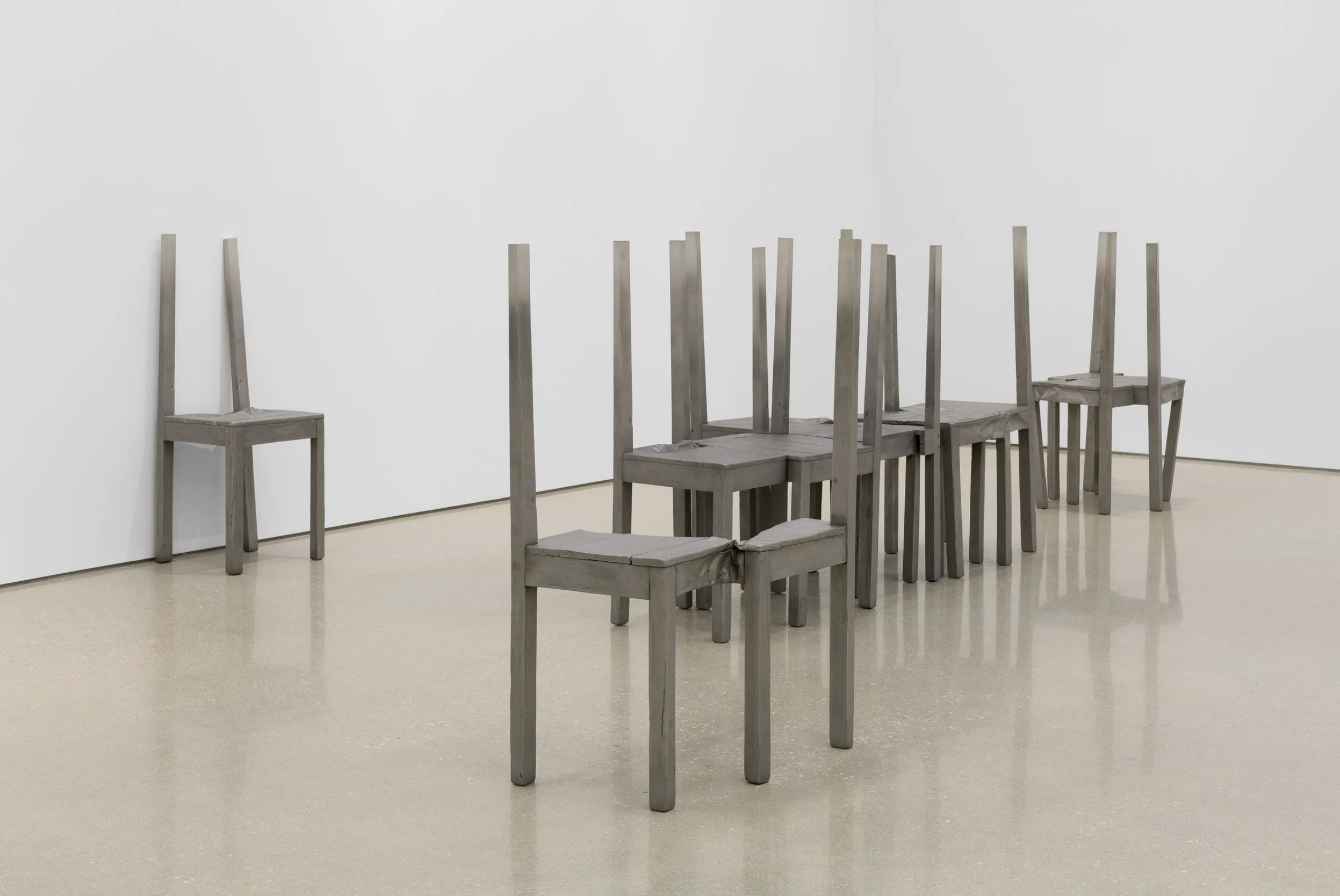
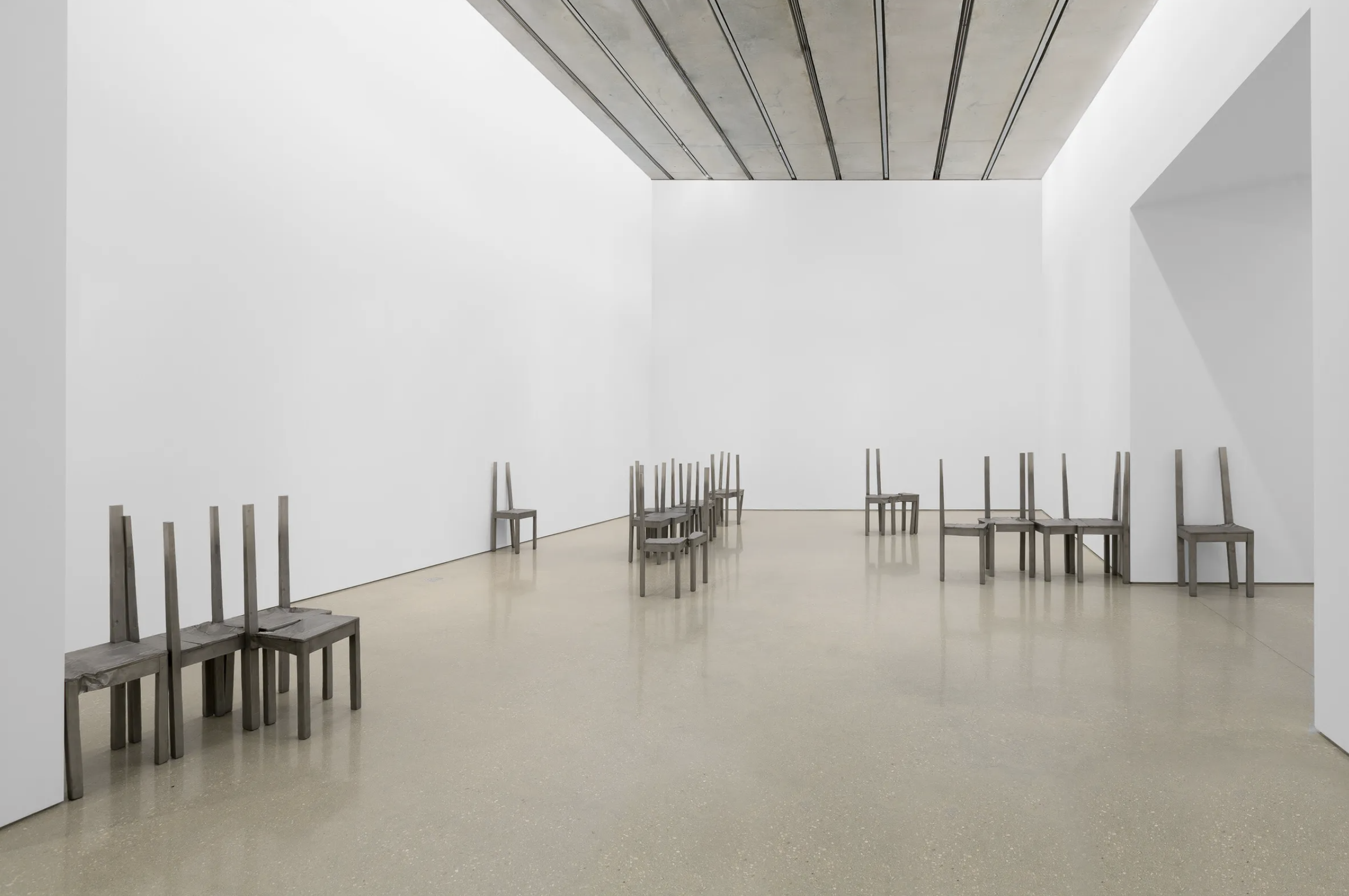
Thou-less marks a significant shift in Salcedo’s practice—it is one of her first works created without found materials. The sculptures are steel castings of wooden chairs, onto which the wood grain texture has been hand-etched; consequently, the solid steel appears vulnerable, crumpled, and wrinkled [1]. Each fragment is cast from a model of a single wooden chair (according to Hyperallergic, via a wax model), and then the wood pattern is reproduced on it using steel engraving [2, 18].
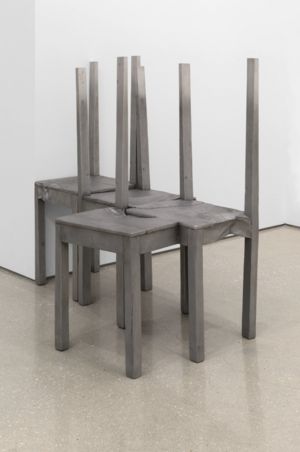
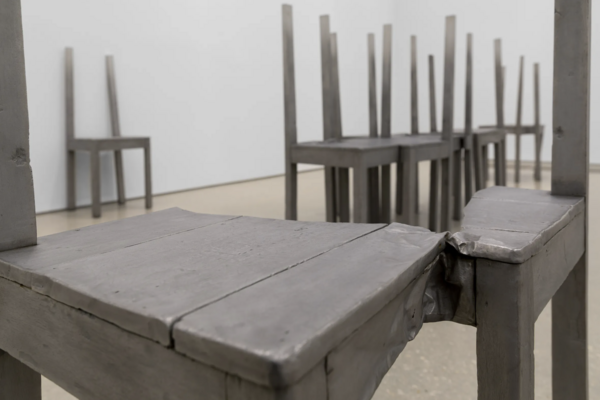
«Thou-less, ” 2001–2002, Doris Salcedo
Chairs occupy a unique place in Salcedo’s language. MCA notes that because a chair has legs, a backrest, and a seat, it is easy to attribute a body to it; in many of her works, the chairs evoke both the presence and absence, the strength and fragility of human bodies [1]. In Thou-less, the chairs are crumpled, flattened, and mended with new seams; they either gather into «trains» and piles or stand alone [18].The chaotic arrangement denies the viewer an obvious path between the chairs, creating a sense of perpetually disrupted domestic order [2]. As Däyal points out, the title implies absence [18]; it literally means «without ‘you’”—that is, without someone to address.
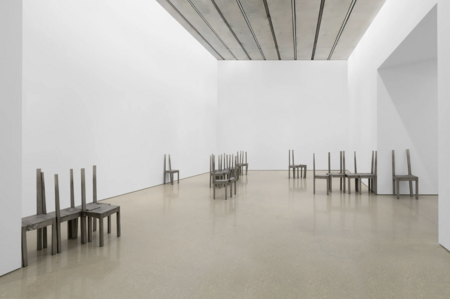
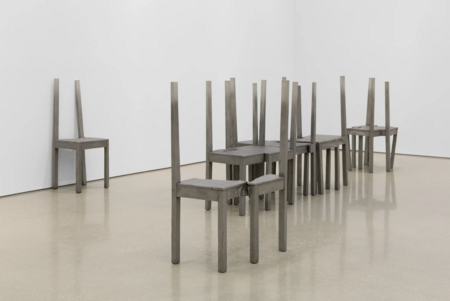
«Thou-less, ” 2001–2002, Doris Salcedo